Clinton Township in Hunterdon County, New Jersey — The American Northeast (Mid-Atlantic)
Hunterdon County Arboretum
“Think of the landscape as a canvas ...” George Bloomer (1898-1978)
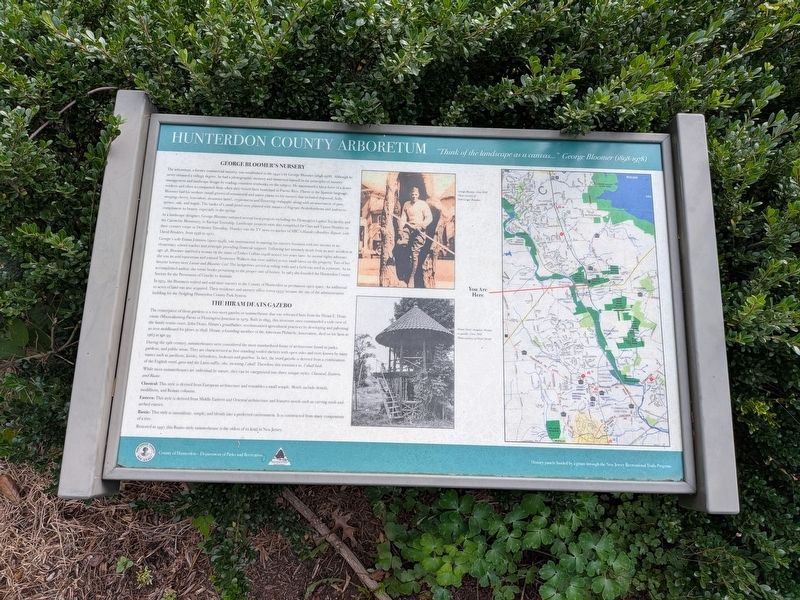
Photographed by Richard Peterson, September 30, 2026
1. Hunterdon County Arboretum Marker
George Bloomer’s Nursery
The arboretum, a former commercial nursery, was established in the 1940’s by George Bloomer (1898-1978). Although he never obtained a college degree, he had a photographic memory and immersed himself in the principles of nursery management and landscape design by reading countless textbooks on the subject. He maintained a labor force of a dozen workers and often accompanied them when they visited their homeland in Puerto Rico. Fluent in the Spanish language, Bloomer had his workers install groves of ornamental and native plants on his nursery that included dogwood, holly, weeping cherry, leucothoe, mountain laurel, cryptomeria and flowering crabapple, along with an assortment of pine, spruce, oak, and maple. The banks of a small pond were planted with masses of fragrant rhododendrons and azaleas to compliment its beauty, especially in the spring.
As a landscape designer, George Bloomer initiated several local projects including the Flemington Lipton Tea facility and the Carmelite Monastery, in Raritan Township. Landscape projects were also completed for Chet and Tipton Huntley on their country
this page online
George's wife Emma Johnson (1900-1948), was instrumental in starting his nursery business with her income as an elementary school teacher and principle providing financial support. Following her untimely death from an auto accident at age 48, Bloomer married a woman by the name of Esther Collins (1908-2000) two years later. An animal rights advocate, she was an avid equestrian and trained Tennessee Walkers that were stabled in two small barns on the property. Two of her favorite horses were Lassie and Bloomer Girl. The hedgerows served as riding trails and a field was used as a pasture. As an accomplished author, she wrote books pertaining to the proper care of horses. In 1965 she founded the Hunterdon County Society for the Prevention of Cruelty to Animals.
In 1974, the Bloomers retired and sold their nursery to the County of Hunterdon as permanent open space. An additional 10 acres of land was also acquired. Their residence and nursery office (circa 1953) became the site of the administration
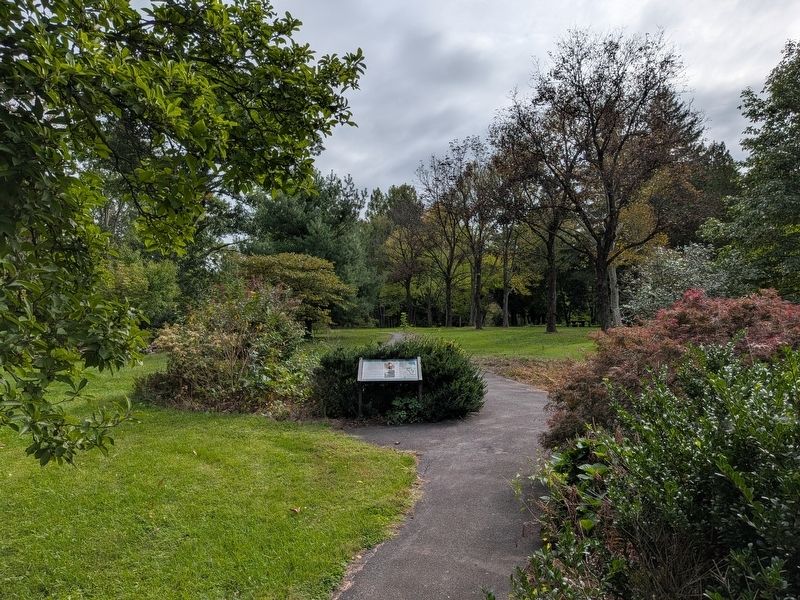
Photographed by Richard Peterson, September 30, 2026
2. Hunterdon County Arboretum Marker
The Hiram Deats Gazebo
The centerpiece of these gardens is a two-story gazebo or summerhouse that was relocated here from the Hiram E. Deats estate (Minneakoning Farm) in Flemington Junction in 1979. Built in 1893, this structure once commanded a wide view of the family tennis court. John Deats, Hiram's grandfather, revolutionized agricultural practices by developing and patenting an iron moldboard for plows in 1828. Hiram, a founding member of the American Philatelic Association, died on his farm in 1963 at age 93.
During the 19th century, summerhouses were considered the most standardized forms of architecture found in parks, gardens, and public areas. They are characterized as free-standing roofed shelters with open sides and were known by many names such as pavilions, kiosks, belvederes, lookouts and gazebos. In fact, the word gazebo is derived from a combination of the English word, gaze and the Latin suffix, ebo, meaning I shall. Therefore this translates to, I shall look.
While most summerhouses are individual by nature, they can be categorized into three unique styles: Classical, Eastern, and Rustic.
Classical: This style is derived from European architecture and resembles a small temple. Motifs include dentils, modillions, and Roman columns.
Eastern: This style is derived from Middle Eastern and Oriental architecture and features motifs such as curving roofs and arched entries.
Rustic: This style is naturalistic, simple, and blends into a preferred environment. It is constructed from many components of a tree.
Restored in 1997, this Rustic-style summerhouse is the oldest of its kind in New Jersey.
Photo captions
– George Bloomer. Circa 1930 · Photo courtesy of Dale Cregar Brandon
– Hiram Deats’ daughter, Miriam, on gazebo. Circa 1902 · Photo courtesy of Hank Snyder
County of Hunterdon – Department of Parks and Recreation
History panels funded by a grant through the New Jersey Recreational Trails Program
Erected by County of Hunterdon Department of Parks and Recreation.
Topics. This historical marker is listed in these topic lists: Architecture • Hispanic Americans • Horticulture & Forestry • Parks & Recreational Areas. A significant historical year for this entry is 1940.
Location. 40° 34.71′ N, 74° 51.612′ W. Marker is in Clinton Township, New Jersey, in Hunterdon County. It can be reached from New Jersey Route 31 0.3 miles north of Stanton Station Road, on the right when traveling north. Marker is on the grounds of Hunterdon County Arboretum. Touch for map. Marker is at or near this postal address: 1020 NJ-31, Lebanon NJ 08833, United States of America. Touch for directions.

Regionally, this marker is in Central Jersey and in the New York City Metropolitan Area. It is also in the American Northeast and in the Mid-Atlantic. Globally, it is in North America, the Western Hemisphere, the Western World, and the Anglosphere. Historically, it finds itself in what was once New Netherland and also one of the original Thirteen Colonies.
Other nearby markers. At least 8 other markers are within 2 miles of this marker, measured as the crow flies: Echo Hill (approx. 0.4 miles away); Newell Cemetery (approx. half a mile away); Rowland's Mill (approx. 0.7 miles away); Pre-Revolutionary War King's Mill (approx. 1.1 miles away); Agricultural First (approx. 1.1 miles away); The Amwell Line - 1704 (approx. 1.2 miles away); Stanton Reformed Church (approx. 1.2 miles away); Clinton Township 9-11 Memorial (approx. 1.3 miles away).
Credits. This page was last revised on October 14, 2026. It was originally submitted on October 1, 2026, by Richard Peterson of East Windsor, New Jersey. This page has been viewed 9 times since then. Photos: 1, 2. submitted on October 1, 2026, by Richard Peterson of East Windsor, New Jersey. • Andrew Ruppenstein was the editor who published this page.
