Near Jasper in Jasper National Park, Alberta — Canada’s Prairie Region (North America)
Athabasca Pass National Historic Site
⎯⎯⎯
Lieu historique national du Col-Athabasca
Photographed by Cosmos Mariner, July 6, 2022
1. Athabasca Pass National Historic Site / Lieu historique national du Col-Athabasca Marker

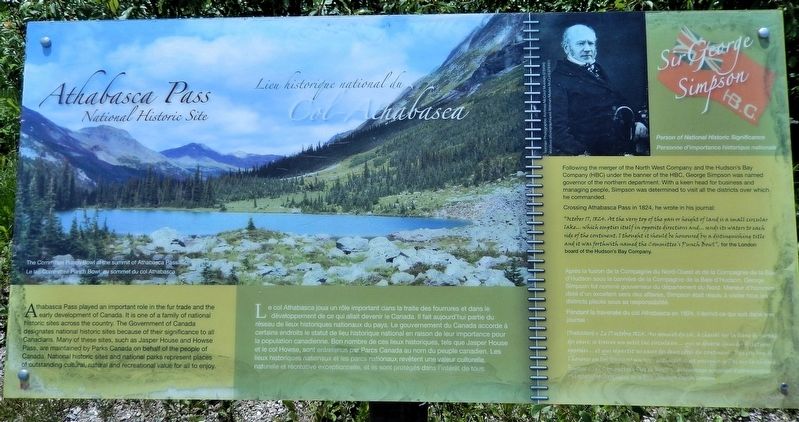
Following the merger of the North West Company and the Hudson's Bay Company (HBC) under the banner of the HBC, George Simpson was named governor of the northern department. With a keen head for business and managing people, Simpson was determined to visit all the districts over which he commanded.
Crossing Athabasca Pass in 1824, he wrote in his journal:
“October 17, 1824. At the very top of the pass or height of land is a small circular lake… which empties itself in opposite directions and… sends its waters to each side of the continent. I thought it should be honoured by a distinguishing title and it was forthwith named the Committee’s Punch Bowl”
this page online
[background image caption] The Committee Punch Bowl at the summit of Athabasca Pass
Après la fusion de la Compagnie du Nord-Ouest et de la Compagnie de la Baie d'Hudson sous la bannière de la Compagnie de la Baie d'Hudson, George Simpson fut nommé gouverneur du département du Nord. Meneur d'hommes doté d'un excellent sens des affaires, Simpson était résolu à visiter tous les districts placés sous sa responsabilité.
Pendant
Norman Photographic Archives/McCord Museum (i78494)
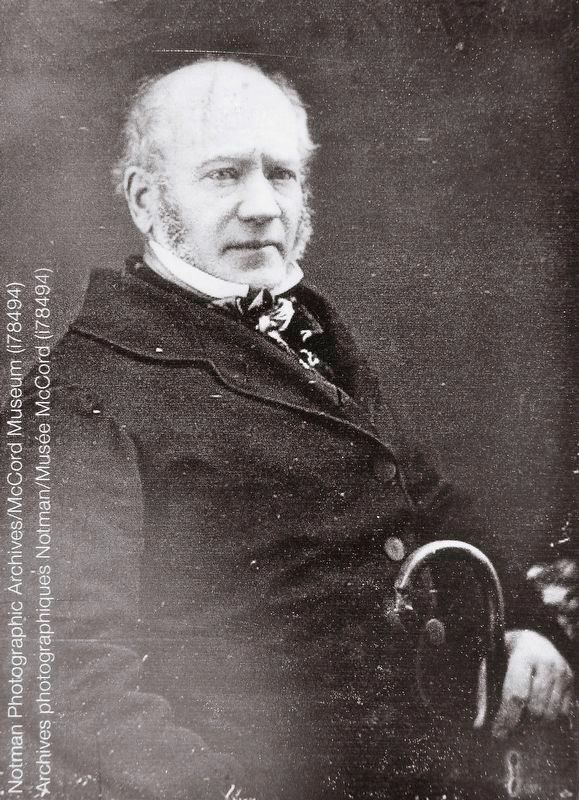
2. Marker detail: Sir George Simpson
Hudson's Bay Company
Hudson's Bay Company
Person of National Historic Significance • • • Personne d’importance historique nationale
[Traduction] « 17 octobre 1824. Au sommet du col, à cheval sur la ligne de partage des eaux, se trouve un petit lac circulaire… qui se déverse dans des directions opposées… et qui répartit ses eaux des deux côtés du continent. J’ai cru bon de l’honorer en lui donnant, un nome distinctif. C’est pourquoi je l’ai sur-le-champ baptisé « lac Committee’s Punch Bowl », en hommage au conseil d’administration qui dirigeait la Compagnie de la Baie d’Hudson depuis Londres.
[légende de l'image de fond] Le Lac Committee Punch Bowl, au sommet du col Athabasca
Erected by Parks Canada / Parcs Canada.
Topics. This historical marker is listed in these topic lists: Industry & Commerce • Natural Features • Parks & Recreational Areas. A significant historical year for this entry is 1824.
Location. 52° 43.031′ N, 117° 52.495′ W. Marker is near Jasper, Alberta, in Jasper National Park. It is on Icefields Parkway (Provincial Highway 93) 24 kilometers south of Yellowhead Highway (Provincial Highway 16), on the right when traveling south. The marker is at the Athabasca
Photographed by Cosmos Mariner, July 6, 2022
3. Athabasca Pass National Historic Site / Lieu historique national du Col-Athabasca Marker
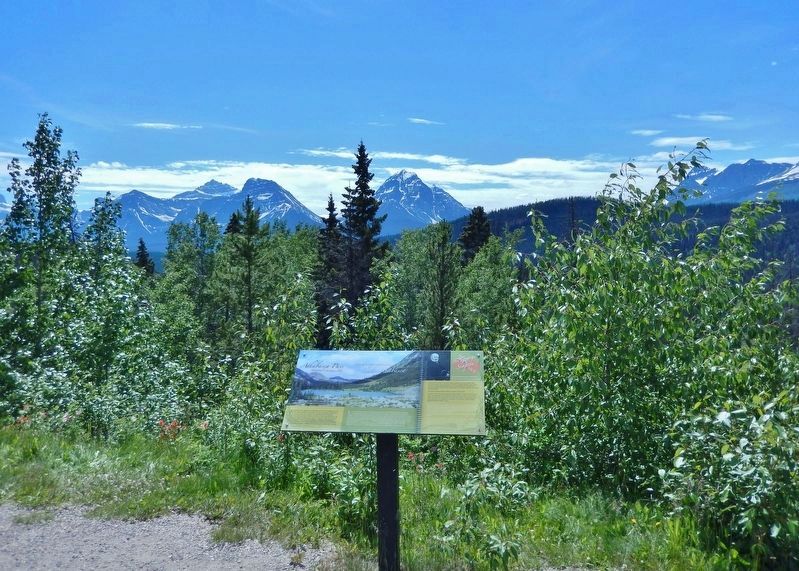
Looking southwest from the Athabasca Pass Lookout wayside.

Regionally, this marker is in the Canadian Rockies. It is also in the Prairies. Globally, it is in North America, the Rocky Mountains, the Western Hemisphere, the Western World, and the Anglosphere. Historically, it finds itself in what was once a British colony and also Rupert’s Land.
Other nearby markers. At least 7 other markers are within 24 kilometers of this marker, measured as the crow flies: New Trade Route Over the Rockies / Une nouvelle route de commerce à travers les Rocheuses (here, next to this marker); David Thompson (here, next to this marker); Passengers on the fur trade / Les passagers de la traite des fourrures (here, next to this marker); a different marker also named David Thompson (a few steps from this marker); Henry House (approx. 22.2 kilometers away); First People / Les premiers habitants (approx. 22.7 kilometers away); ‘Unknown’ Lands / Terra incognita (approx. 22.9 kilometers away).
Also see . . . Sir George Simpson (c.1792-1860) (Wikipedia).
Excerpt: Scottish explorer businessman. He was the colonial governor of the Hudson's Bay Company (HBC) during the period of its greatest power. From 1820 to 1860, he was in practice, if not in law, the British viceroy for the whole of Rupert's Land, an enormous territory of 1.5 million square miles corresponding to nearly forty per cent of modern-day Canada.(Submitted on October 4, 2026, by Cosmos Mariner of Cape Canaveral, Florida.)
His efficient administration of the west was a precondition for the confederation of western and eastern Canada, which later created the Dominion of Canada. He was noted for his grasp of administrative detail and his physical stamina in traveling through the wilderness. Excepting voyageurs and their Siberian equivalents, few men have spent as much time travelling in the wilderness. Simpson was also the first person known to have “circumnavigated” the world by land and became the most powerful man of the North American fur trade during his lifetime.
In August 1824, he left York Factory for the Pacific, taking the unorthodox Nelson–Burntwood River route, and ascended the Churchill River and Athabasca Rivers to Jasper House at the east side of Athabasca Pass. He crossed the pass on horseback to Boat Encampment and then down the Columbia River, reaching its mouth on November 8 at Fort George, previously named Fort Astoria. This 80-day journey was 20 days faster than the previous record. He moved the headquarters of the Columbia District to Fort Vancouver, guessing that the south side of the river might fall to the Americans.
Credits. This page was last revised on October 4, 2026. It was originally submitted on October 1, 2026, by Cosmos Mariner of Cape Canaveral, Florida. This page has been viewed 5 times since then. Photos: 1, 2, 3. submitted on October 4, 2026, by Cosmos Mariner of Cape Canaveral, Florida.
