Grachtengordel in Amsterdam, North Holland, Netherlands — Northwestern Europe
Dirkje Kuik
| — | Walk of Pride Amsterdam | — |
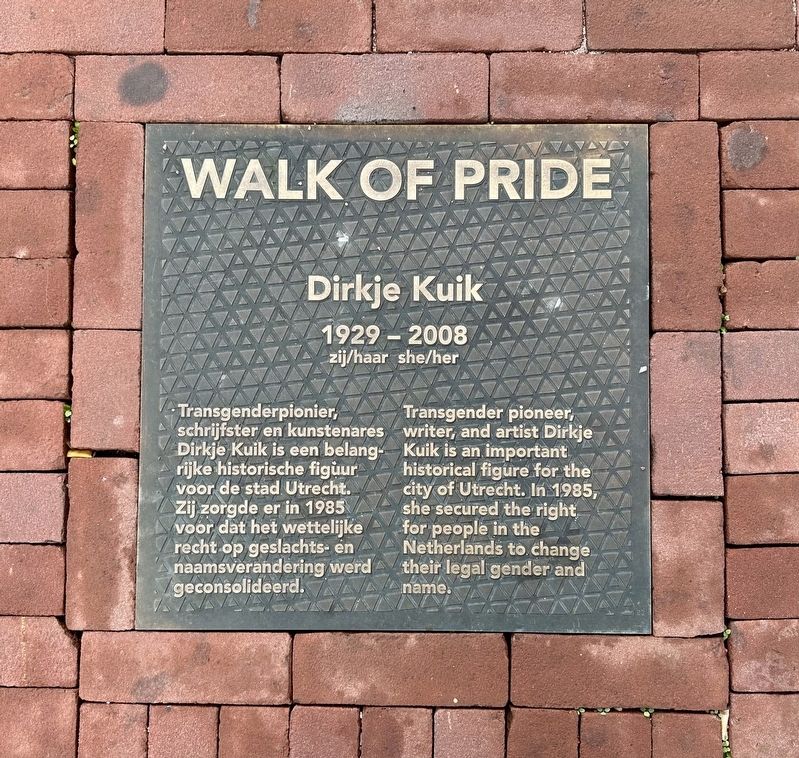
Photographed by Andrew Ruppenstein, August 31, 2026
1. Dirkje Kuik Marker

Dirkje Kuik
1929-2008
zij/haar she/her
Erected 2026 by Walk of Pride Amsterdam. (Marker Number 23.)
Topics and series. This historical marker is listed in these topic lists: Arts, Letters, Music • Civil Rights • Women. In addition, it is included in the Walk of Pride Amsterdam series list. A significant historical year for this entry is 1985.
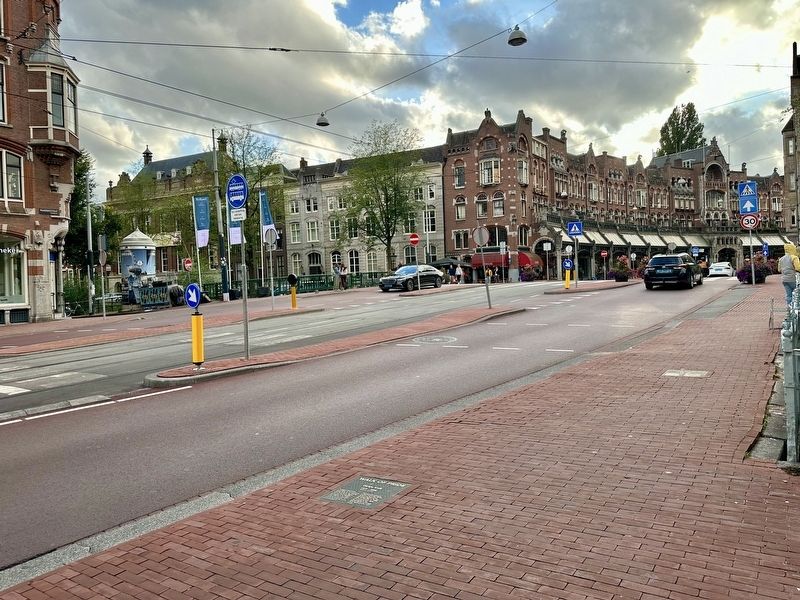
Location. 52° 22.406′ N, 4° 53.26′ E. Marker is in Amsterdam, Noord-Holland (North Holland). It is in Grachtengordel. It is on Raadhuisstraat east of Herengracht, on the right when traveling west. Touch for map. Marker is at or near this postal address: Raadhuisstraat 24, Amsterdam, Noord-Holland 1016 BG, Netherlands.
this page online

Regionally, it is in Europe, the European Union, Atlantic Europe, the Benelux Low Countries, the Schengen Area, Western Europe, and the Western World. Historically, it finds itself in what was once the Holy Roman Empire.
Other nearby markers. At least 8 other markers are within walking distance of this marker: Aaïcha Bergamin (here, next to this marker); Janine Wegman (here, next to this marker); Max Lievendag (a few steps from this marker); Edgar Caïro (a few steps from this marker); Mary Zeldenrust Noordanus (a few steps from this marker); Bessy Ferrera (within shouting distance of this marker); Niek Engelschman (within shouting distance of this marker); Georgina Beyer (within shouting distance of this marker). Touch for a list and map of all markers in Amsterdam.
Also see . . . Dirkje Kuik (Stichting Dirkje Kuik). Excerpt:
Dirkje Kuik (1929–2008), born as William Diederich Kuik, was a renowned Dutch writer, visual artist, and one of the first openly transgender women in the Netherlands. Kuik’s legacy spans both literature and the visual arts, making her a significant cultural figure in(Submitted on October 2, 2026.)Dutch history.Photographed by Andrew Ruppenstein, August 31, 20262. Dirkje Kuik Marker - wide viewThe marker is seen here embedded in the sidewalk.
A Hero of Activism: In the late 1970s, after years of struggling with gender identity, Kuik underwent gender-affirming surgery in London, officially transitioning in 1979. This was during a time when trans issues were rarely discussed in public, making her one of the pioneers of transgender visibility in the Netherlands. Her personal experiences with gender dysphoria heavily influenced her later work. In her writings, Kuik explored these themes in a unique way, describing herself as a “gender diaspora patient,” a term she preferred over the term transsexual, which was commonly used at the time.
Kuik became an activist for transgender rights. She fought a legal battle with the Dutch state to allow individuals to change their legal gender and name, a landmark case that resulted in more progressive policies for trans people in the Netherlands. This activism laid the groundwork for important changes in Dutch law related to gender identity.
Additional keywords. tegel
Credits. This page was last revised on October 8, 2026. It was originally submitted on October 2, 2026, by Andrew Ruppenstein of Lamorinda, California. This page has been viewed 6 times since then. Photos: 1, 2. submitted on October 2, 2026, by Andrew Ruppenstein of Lamorinda, California.
