Greenville in Smithfield in Providence County, Rhode Island — The American Northeast (New England)
A Community Shaped by Revolution
Town of Smithfield Rhode Island
| — | est. 1730-1731 | — |
Photographed by Devry Becker Jones (CC0), September 19, 2026
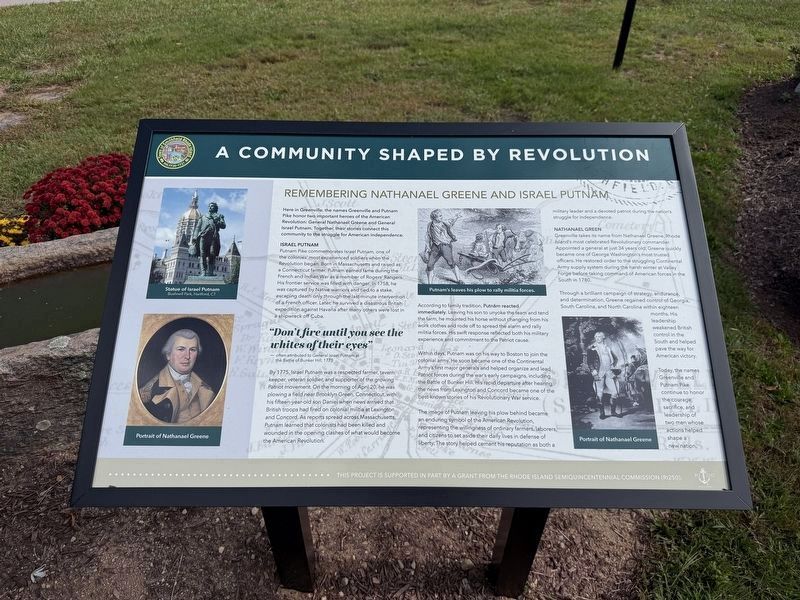
1. A Community Shaped by Revolution Marker
Remembering Nathanael Greene and Israel Putnam
Here in Greenville, the names Greenville and Putnam Pike honor two important hereos of the American Revolution: Greneral Nathanael Greene and General Israel Putnam. Together, their stories connect this community to the struggle for American Independence.
Israel Putnam
Putnam Pike commemorates Israel Putnam, one of the colonies' most experienced soldiers when the Revolution began. Born in Massachusetts and raised as a Connecticut farmer, Putnam earned fame during the French and Indian War as a member of Rogers' Rangers. His frontier service was filled with danger. In 1758, he was captured by Native warriors and tied to a stake, excaping death only through the last-minute intervention of a French officer. Later, he survived a disatrous British expedition against Havana after many others wer elost in a shipwreck off Cuba.
Don't fire until you see the whites of their eyes"
— often attributed to General Israel Putnam at the Battle of Bunker Hill, 1775
By 1775, Israel Putnam was a respected farmer, tavern keeper, veteran soldier, and supporter of the growing Patriot
this page online
According to family tradition, Putnam reacted immediately. Leaving his son to unyoke the team and tend the farm, he mounted his horse without changing from his work clothes and rode off to spread the alarm and rally militia forces. His swift response reflected both this military experience and commitment to the Patriot cause.
Within days, Putnam was on his way to Boston to join the colonial army. He soon became one of the Continental Army's first major generals and helped organize the lead Patriot forces during the war's early campaigns, including the Battle of Bunker Hill. His rapid departure after hearing the news from Lexington and Concord became one of the best-known stories of his Revolutioanry War service.
The image of Putnam leaving
Nathanael Green
Greenville takes its name from Nathanael Greene, Rhode Island's most celebrated Revolutionary commander. Appointed a general at just 34 years old, Greene quickly became one of George Washington's most trusted officers. He restored order to the struggling Continental Army supply system during the harsh winter at Valley Forge before taking command of American forces in the South in 1780.
Through a brilliant campaign of strategy, endurance, and determination, Greene regained control of Georgia, South Caorlina, and North Carolina within eighteen months. His leadership weakened British control in the South and helped pave the way for American victory.
Today, the names of Greenville and Putnam Pike continue to honor the courage, sacrifice, and leadership of two men whose actions helped shape a new revolution.
Erected 2026 by Town of Smithfield, Rhode Island, supported in part by a grant from the Rhode Island Semiquincentennial Commission (RI250).
Topics and series. This historical marker is listed in these topic lists: Colonial Era • Patriots & Patriotism • War, French and Indian • War, US Revolutionary. In addition, it is included in the America 250 series list. A significant historical date for this entry is April 20, 1758.
Location. 41° 52.294′ N, 71° 33.198′ W. Marker is in Smithfield, Rhode Island, in Providence County. It is in Greenville. It is on Putnam Pike (U.S. 44) east of Church Street, on the right when traveling east. Touch for map. Marker is at or near this postal address: 607 Putnam Pike, Greenville RI 02828, United States of America. Touch for directions.

Regionally, this marker is in the Blackstone Valley and in Greater Providence. It is also in the American Northeast, in New England, and on the Eastern Seaboard. Globally, it is in the North Atlantic Region, North America, the Western Hemisphere, the Western World, and the Anglosphere. Historically, it finds itself in what was once one of the original Thirteen Colonies.
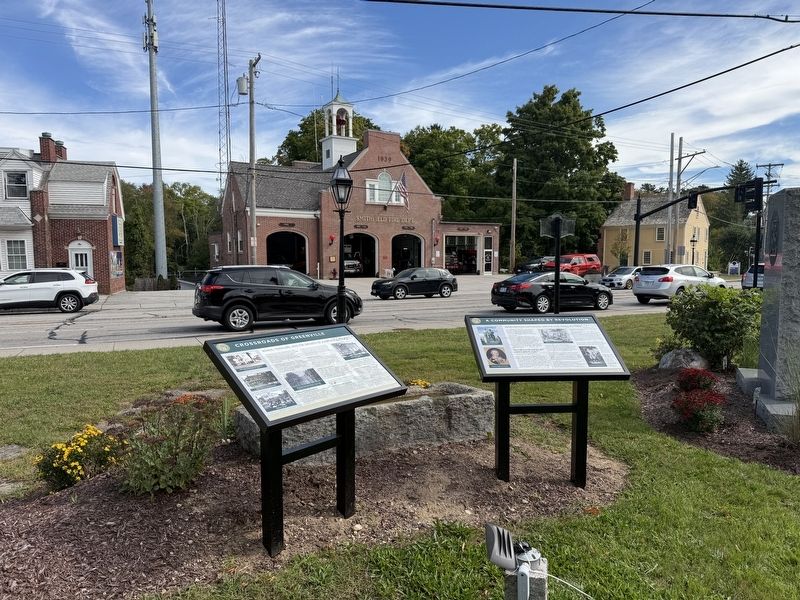
Other nearby markers. At least 8 other markers are within 3 miles of this marker, measured as the crow flies: Crossroads of Greenville (here, next to this marker); World War Memorial (a few steps from this marker); Aircraft Accident Memorial (approx. 1.9 miles away); Scituate Schools (approx. 3.1 miles away); The Bell Garden (approx. 3.1 miles away); The Richmond Mill Bell (approx. 3.1 miles away); Vietnam Veterans Memorial (approx. 3.1 miles away); Scituate Honor Roll (approx. 3.1 miles away). Touch for a list and map of all markers in Smithfield.
Credits. This page was last revised on October 3, 2026. It was originally submitted on October 3, 2026, by Devry Becker Jones of Washington, District of Columbia. This page has been viewed 5 times since then. Photos: 1, 2. submitted on October 3, 2026, by Devry Becker Jones of Washington, District of Columbia.
