Richmond in Washington County, Rhode Island — The American Northeast (New England)
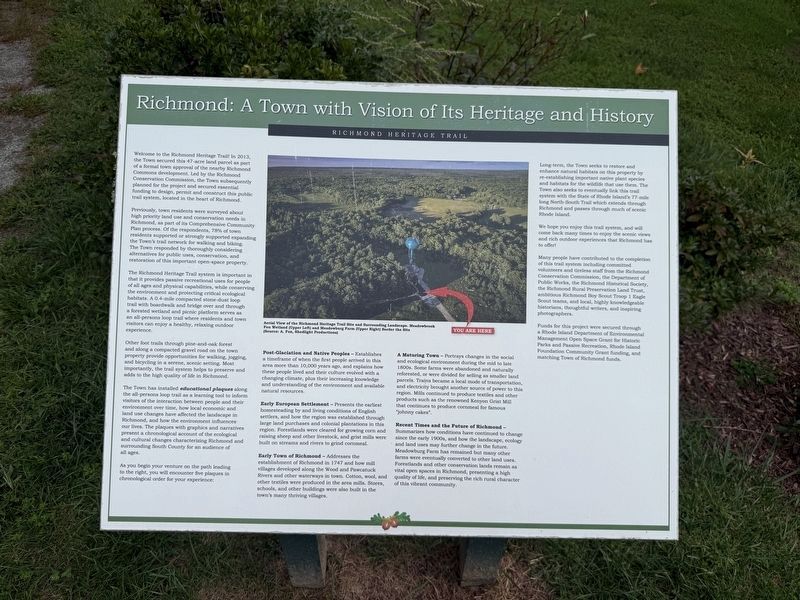
Richmond: A Town with Vision of Its Heritage and History
| — | Richmond Heritage Trail | — |
Photographed by Devry Becker Jones, September 17, 2026
1. Richmond: A Town with Vision of Its Heritage and History Marker
Welcome to the Richmond Heritage Trail! In 2013, the Town secured this 47-acre land parcel as part of a formal town approval of the nearby Richmond Commons development. Led by the Richmond Conservation Commission, the Town subsequently planned for the project and secured essential funding to design, permit and construct this public trail system, located in the heart of Richmond.
Previously, town residents were surveyed about high priority land use and conservation needs in Richmond, as part of its Comprehensive Community Plan process. Of the respondents, 78% of town residents supported or strongly supported expanding the Town's trail network for walking and hiking. The Town responded by thoroughly considering alternatives for public uses, conservation, and recreation of this important open-space property.
The Richmond Heritage Trail system is important in that it provides passive recreational uses for people of all ages and physical capabilities, while conserving the environment and protecting critical ecological habitats. A 0.4-mile compacted stone-dust loop trail with boardwalk and bridge over and through a forested
this page online
Other foot trails through pine and oak forest and along a compacted gravel road on the town property provide opportunities for walking, jogging, and bicycling in a serene, scenic setting. Most importantly, the trail system helps to preserve and add to the high quality of life in Richmond.
The Town has installed educational plaques along the all-persons loop trail as a learning tool to inform visitors of the interaction between people and their environment over time, how local economic and land use changes have affected the landscape in Richmond, and how the environment influences our lives. The plaques with graphics and narratives present a chronological account of the ecological and cultural changes characterizing Richmond and surrounding South County for an audience of all ages.
As you begin your venture on the path leading to the right, you will encounter five plaques in chronological order for your experience:
Post-Glaciation and Native Peoples – Establishes a timeframe of
Photographed by Devry Becker Jones (CC0), September 17, 2026
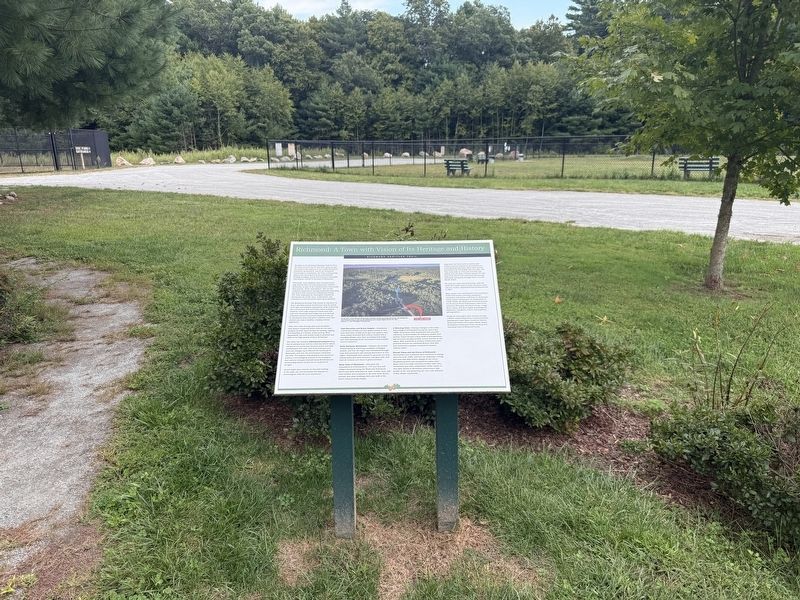
2. Richmond: A Town with Vision of Its Heritage and History Marker
Early European Settlement – Presents the earliest homesteading by and living conditions of English settlers, and how the region was established through large land purchases and colonial plantations in this region. Forestlands were cleared for growing corn and raising sheep and other livestock, and grist mills were built on streams and rivers to grind cornmeal.
Early Town of Richmond – Addresses the establishment of Richmond in 1747 and how mill villages developed along the Wood and Pawcatuck Rivers and other waterways in town. Cotton, wool, and other textiles were produced in the area mills. Stores, schools, and other buildings were also built in the town's many thriving villages.
A Maturing Town – Portrays changes in the social and ecological environment during the mid- to late 1800s. Some farms were abandoned and naturally reforested, or were divided for adding to smaller land parcels. Trains became a local mode of transportation, and electricity brought another source of power to this region. Mills continued to produce textiles and other products such as the renowned Kenyon Grist Mill that continues to produce cornmeal for famous "johnny cakes".
Recent Times and the Future of Richmond – Summarizes how conditions have continued to change since the early 1900s, and how the landscape, ecology and land uses may further change in the future. Meadowburg Farm has remained, but many other farms were eventually converted to other land uses. Forestlands and other conservation lands remain as vital open spaces in Richmond, presenting a high quality of life, and preserving the rich rural character of this vibrant community.
Long-term, the Town seeks to restore and enhance natural habitats on this property by re-establishing important native plant species and habitats for the wildlife that use them. The Town also seeks to eventually link this trail system with the State of Rhode Island's 77-mile long North-South Trail which extends through Richmond and passes through much of scenic Rhode Island.
We hope you enjoy this trail system, and will come back many times to enjoy the scenic views and rich outdoor experiences that Richmond has to offer!
Many people have contributed to the completion of this trail system including committed volunteers and tireless staff from the Richmond Conservation Commission, the Department of Public Works, the Richmond Historical Society, the Richmond Rural Preservation Land Trust, ambitious Richmond Boy Scout Troop 1 Eagle Scout candidates, and local, highly knowledgeable historians, thoughtful writers, and inspiring photographers.
Funds for this project were secured through a Rhode Island Department of Environmental Management Open Space Grant for Historic Parks and Passive Recreation, Rhode Island Foundation Community Grant funding, and matching Town of Richmond funds.
Erected by Town of Richmond, Rhode Island.
Topics. This historical marker is listed in these topic lists: Indigenous Peoples and Communities • Industry & Commerce • Parks & Recreational Areas • Settlements & Settlers. A significant historical year for this entry is 2013.
Location. 41° 30.2′ N, 71° 39.927′ W. Marker is in Richmond, Rhode Island, in Washington County. It is on Richmond Heritage Trail north of Country Acres Road, on the right when traveling north. Touch for map. Marker is at or near this postal address: 3 Country Acrs Rd, Wyoming RI 02898, United States of America. Touch for directions.

Regionally, this marker is on Narragansett Bay and in South County. It is also in the American Northeast, in New England, and on the Eastern Seaboard. Globally, it is in the North Atlantic Region, North America, the Western Hemisphere, the Western World, and the Anglosphere. Historically, it finds itself in what was once one of the original Thirteen Colonies.
Other nearby markers. At least 8 other markers are within 3 miles of this marker, measured as the crow flies: Recent Times and the Future of Richmond (about 400 feet away, measured in a direct line); Post-Glaciation and Native Peoples (about 600 feet away); A Maturing Town (about 600 feet away); Early Town of Richmond (approx. 0.2 miles away); Early European Settlement (approx. 0.2 miles away); World War I, World War II and the Korean Campaign Memorial (approx. 0.4 miles away); Vietnam and Desert Storm Memorial (approx. 0.4 miles away); Old Stone Dam (approx. 2.6 miles away). Touch for a list and map of all markers in Richmond.
Credits. This page was last revised on October 3, 2026. It was originally submitted on October 3, 2026, by Devry Becker Jones of Washington, District of Columbia. This page has been viewed 3 times since then. Photos: 1, 2. submitted on October 3, 2026, by Devry Becker Jones of Washington, District of Columbia.
