Pennsville in Pennsville Township in Salem County, New Jersey — The American Northeast (Mid-Atlantic)
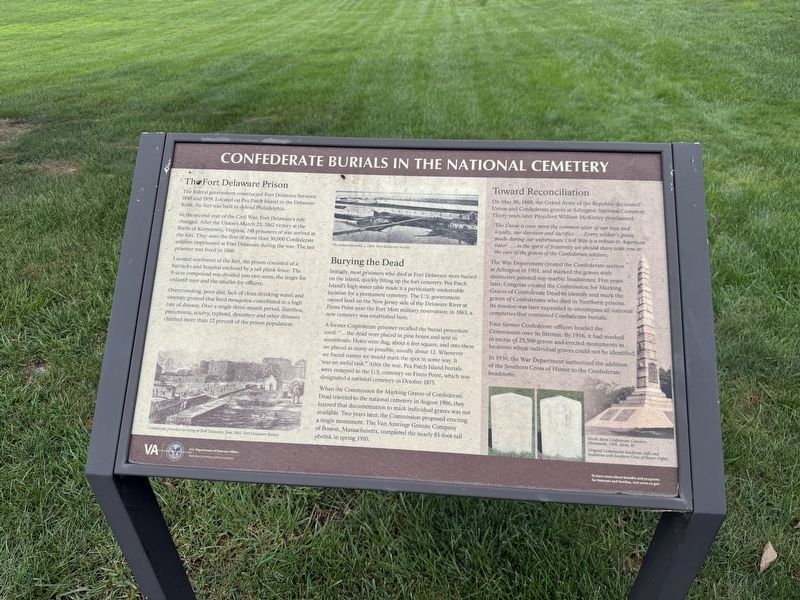
Confederate Burials in the National Cemetery
Photographed by Devry Becker Jones (CC0), September 20, 2026
1. Confederate Burials in the National Cemetery Marker
The Fort Delaware Prison
The federal government constructed Fort Delaware between 1848 and 1859. Located on Pea Patch Island in the Delaware River, the fort was built to defend Philadelphia.
In the second year of the Civil War, Fort Delaware's role changed. After the Union's March 23, 1862 victory at the Battle of Kernstown, Virginia, 248 prisoners of war arrived at the fort. They were the first of more than 30,000 Confederate soldiers imprisoned at Fort Delaware during the war. The last prisoner was freed in 1866.
Located norhtwest of the fort, the prison consisted of barracks and hospital enclosed by a tall plank fence. The 8-acre compound was divided into two areas, the larger for enlisted men and the smaller for officers.
Overcrowding, poor diet, lack of clean drinking water, and swampy ground that bred mosquitos contributed to a high rate of disease. Over a single three-month period, diarrhea, pneumonia, scurvy, typhoid, dysentery and other illnesses claimed more than 12 percent of the prison population.
Burying the Dead
Initially, most prisoners who died a Fort Delaware were buried on the island, quickly
this page online
A former Confederate prisoner recalled the burial procedure used: "… the dead were placed in pine boxes and sent in steamboats. Holes were dug, about 6 feet square, and into these we placed as many as possible, usually about 12. Whenever we found names we would mark the spot in some way. It was an awful task." After the war, Pea Patch Island burials were removed to the U.S. cemetery on Finns Point, which was designated a national cemetery in October 1875.
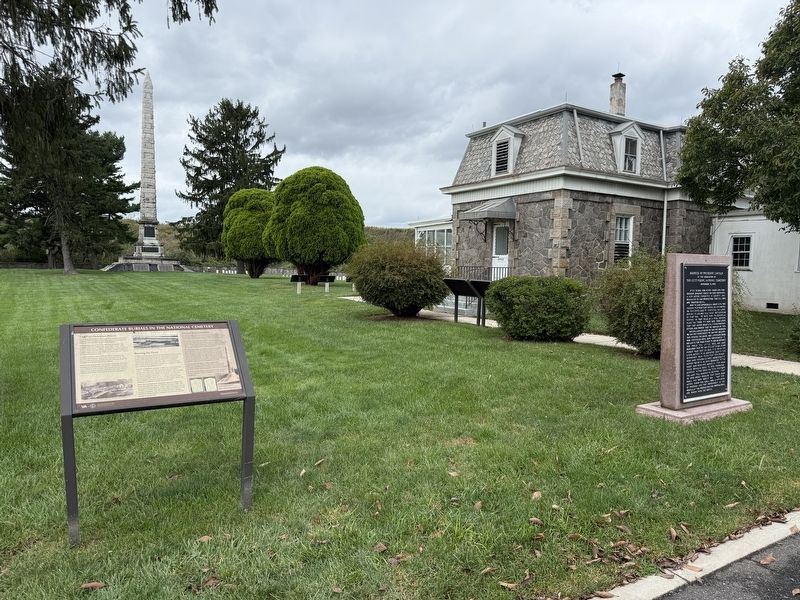
When the Commission for Marking Graves of Confederate Dead traveled to the national cemtery in August 1906, they learned that documentation to mark individual graves was not available. Two years later, the Commission proposed erecting a single monument. The Van Amringe Granite Company of Boston, Massachusetts, completed the nearly 83-foot-tall obelist in spring 1910.
Toward Reconciliation
On
Photographed by Devry Becker Jones (CC0), September 20, 2026
2. Confederate Burials in the National Cemetery Marker
The Union is once more the common altar of our love and loyalty, our devotion and sacrifice … Every soldier's grave made during our unfortunate Civil War is a tribute to American valor … in the spirit of fraternity we should share with you in the care of the graves of the Confederate soldiers.
The War Department created the Confederate section at Arlington in 1901, and marked the graves with distinctive pointed-top marble headstones. Five years later, Congress created the Commission for Marking Graves of Confederate Dead to identify and mark the gravese of Confederates who died in Northern prisons. Its mission was later expanded to encompass all national cemeteries that contained Confederate burials.
Four former Confederate officers headed the Commission over its lifetime. By 1916, it had marked in excess of 25,500 graves and erected monuments in locations where individual graves could not be identified.
In 1930, the War Department authorized the addtion of the Southern Cross of Honor to the Confederate headstone.
Erected by National Cemetery Association, U.S. Department of Veterans Affairs.
Topics and series. This historical marker is listed in these topic lists: Cemeteries & Burial Sites • War, US Civil. In addition, it is included in the National Cemeteries series list. A significant historical date for this entry is March 23, 1862.
Location. 39° 36.682′ N, 75° 33.319′ W. Marker is in Pennsville Township, New Jersey, in Salem County. It is in Pennsville. It is on Cemetery Road 0.7 miles north of Fort Mott Road, on the left when traveling north. Touch for map. Marker is at or near this postal address: 456 Fort Mott Rd, Pennsville NJ 08070, United States of America. Touch for directions.

Regionally, this marker is in Greater Wilmington, in South Jersey, and in Greater Philadelphia. It is also in the American Northeast, in the Mid-Atlantic, and on the Eastern Seaboard. Globally, it is in the North Atlantic Region, North America, the Western Hemisphere, the Western World, and the Anglosphere. Historically, it finds itself in what was once New Netherland and also one of the original Thirteen Colonies.
Other nearby markers. At least 8 other markers are within walking distance of this marker: Finn's Point National Cemetery (a few steps from this marker); A National Cemetery System (a few steps from this marker); Address by President Lincoln (a few steps from this marker); Medal of Honor Tree Memorial (a few steps from this marker); Veterans Memorial (within shouting distance of this marker); Union Monument (within shouting distance of this marker); Confederate Monument (within shouting distance of this marker); New Jersey Coastal Heritage Trail Route (about 300 feet away, measured in a direct line). Touch for a list and map of all markers in Pennsville Township.
Credits. This page was last revised on October 4, 2026. It was originally submitted on October 4, 2026, by Devry Becker Jones of Washington, District of Columbia. This page has been viewed 6 times since then. Photos: 1, 2. submitted on October 4, 2026, by Devry Becker Jones of Washington, District of Columbia.
