Grachtengordel in Amsterdam, North Holland, Netherlands — Northwestern Europe
Riek Stienstra
| — | Walk of Pride Amsterdam | — |
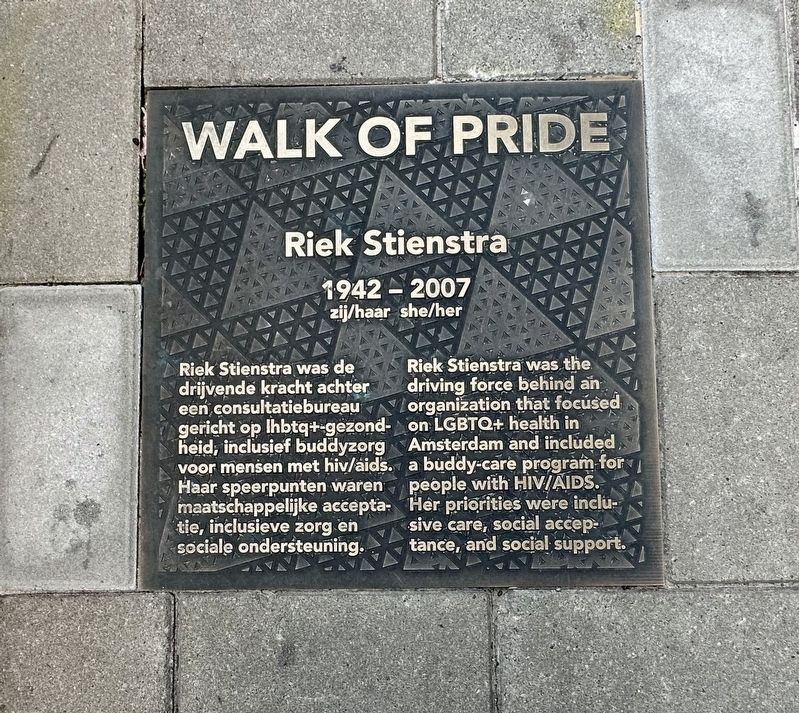
Photographed by Andrew Ruppenstein, August 31, 2026
1. Riek Stienstra Marker

Riek Stienstra
1942-2007
zij/haar she/her;
Riek Stienstra was the driving force behind an organization that focused on LGBTQ+ health in Amsterdam and included a buddy-care program for people with HIV/AIDS. Her priorities were inclusive care, social acceptance, and social support.
Erected 2026 by Walk of Pride Amsterdam. (Marker Number 46.)
Topics and series. This historical marker is listed in these topic lists: Science & Medicine • Women. In addition, it is included in the Walk of Pride Amsterdam series list.
Location. 52° 22.441′ N, 4° 53.139′ E. Marker is in Amsterdam, Noord-Holland (North Holland). It is in Grachtengordel. It is at the intersection of Raadhuisstraat and Keizersgracht, on the right when traveling west on Raadhuisstraat. Touch for map. Marker is at or near this postal address: Raadhuisstraat
this page online

Regionally, it is in Europe, the European Union, Atlantic Europe, the Benelux Low Countries, the Schengen Area, Western Europe, and the Western World. Historically, it finds itself in what was once the Holy Roman Empire.
Other nearby markers. At least 8 other markers are within walking distance of this marker: Thea Wickel (here, next to this marker); Mikel Haman (here, next to this marker); Marsha P. Johnson (a few steps from this marker); Alje Klamer (within shouting distance of this marker); Bo Laurent (within shouting distance of this marker); Herculine Barbin (within shouting distance of this marker); Miriam van der Have (within shouting distance of this marker); Nico (Niek) Engelschman 1913-1988 (within shouting distance of this marker). Touch for a list and map of all markers in Amsterdam.
Also see . . .
1. Riek Stienstra (Wikipedia, in Dutch). Excerpt (in translation):
Stienstra served as director of the Schorer Foundation from 1974 to 2002. The foundation provided support to lesbians and gay men. Stienstra was the foundation's(Submitted on October 4, 2026.)first openly gay director; until then, it had avoided hiring gay employees for fear they would be "too emotionally involved." In her job application, however, Stienstra proudly stated that she was gay herself and therefore had a special affinity for the subject matter. Stienstra’s career was largely defined by the HIV/AIDS epidemic of the 1980s, which claimed the lives of many—particularly gay men. Undeterred by the chaos caused by the epidemic, she organized various initiatives to combat the disease. Stienstra is best known for emphasizing psychological support for the sick. She introduced a "buddy system" modeled on the one in San Francisco—a Dutch model that would later be adopted worldwide.Photographed by Andrew Ruppenstein, August 31, 20262. Riek Stienstra Marker - wide view
Under Stienstra’s leadership, the Schorer Foundation grew to include more than 40 staff members and 200 volunteers (including buddies), becoming the largest healthcare organization for lesbians and gay men in Europe.

2. Riek Stienstra (The Lancet, February 9, 2008). (Submitted on October 4, 2026.)
Credits. This page was last revised on October 4, 2026. It was originally submitted on October 4, 2026, by Andrew Ruppenstein of Lamorinda, California. This page has been viewed 9 times since then. Photos: 1, 2. submitted on October 4, 2026, by Andrew Ruppenstein of Lamorinda, California.
