Fall River in Bristol County, Massachusetts — The American Northeast (New England)
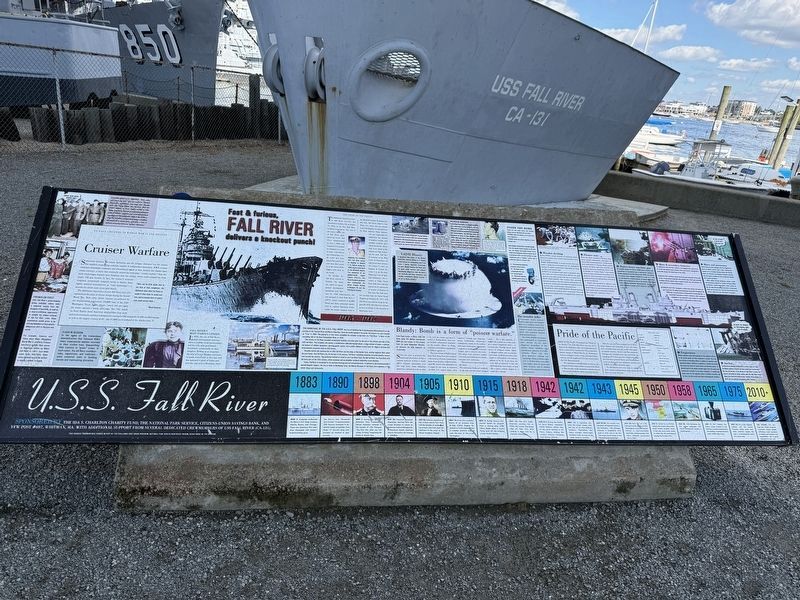
U.S.S. Fall River
Fast & furious, Fall River delivers a knockout punch!
Friends or Foes?
USS Fall River's peace-keeping duties provided sailors with a welcome respite from the drudgery of sea drills, as well as once-in-a-lifetime opportunity to sample the unique cultures of the Far East. Later, these experiences would prove to be stirring reminders of how quickly allegiances shift in the post-war world.
For example, America and China were Allies throughout World War II, and here Chinese merchants peddle their wares to American sialors on board Fall River in 1947. Just three years later, men from these same nations would be locked in deadly combat in Korea.
Flexing Muscles Abroad: "Walk softly, but carry a big stick" was the mantra of Theodore Roosevelt's presidency, and some four decades later, that theme gained new currency. With the painful memory of Pearl Harbor etched in their minds, Americans resolved to maintain a permanent state of military readiness, and to remind potential aggressions of the indomitable might of the US Navy, ships like Fall River paraded along foreign coastlines and anchored in exotic ports, practicing a form of political posturing known as "gunboat diplomacy."
U.S. Navy Cruisers in World War II and Beyond
this page online
The Baltimore-class heavy cruiser Fall River (CA-131) represented the acme of cruiser design during the Second World War. With early Allied cruisers encumbered by the displacement restrictions (10,000 tons) of the 1921 Washington Naval Treaty, Japan—which did not ratify the treaty—gained a handy advantage. The 1941 attack on Pearl Harbor freed American shipbuilders from such political constraints, and they subsequently constructed the 16,400-ton Baltimores, as well as the largest cruisers of all—the 27,000-ton leviathans of the Alaska-class.
Therecan be little doubt that at the time of their completion, the Baltimore class were the finest example of their class for ocean warfare, and no vessels short of capital rank could contain them.
Naval Historian
Class in Session
In the wake of the tremendous demobilization that followed WWII, many experienced seamen returned to thier civilian lives, bequeathing their stations to "green" crews. In such cases, the old Navy standbys–rules, regulations, and traditions–were essential tools in building morale and maintaining discipline.
Fall River's Most Famous Citizen
In 1892, the city of Fall River gained international notoriety when a wealthy local businessman and his wife were gruesomely murdered–purportedly by their daughter. Ending in an acquittal, the trial of Lizzie Borden continues to spark controversy to this day, and has spawned a spate of books and articles, and even a Broadway show!
1945 - 1947
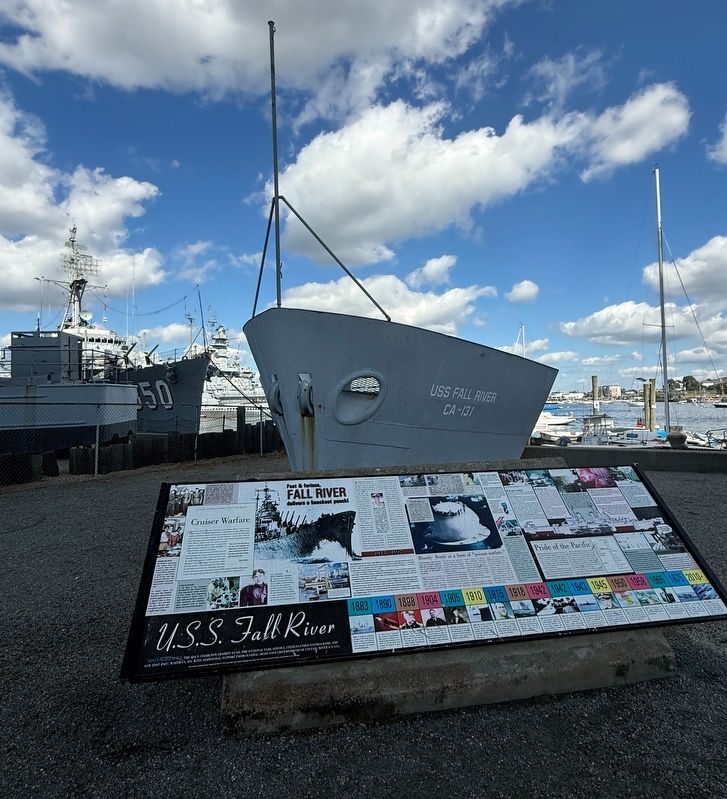
On October 31, Fall River arrived at Norfolk, VA, where she sailed in experimental developmental operations until January 31, 1946. Subsequently, she was assigned to Joint Task Force I (JTF1), which consisted of 42,000 Naval and Army personnel assembled to conduct Operation Crossroads, the atomic weapons tests in the Marshall Islands. To prepare for this duty, Fall River sailed to San Pedro, CA, where she was altered to provide flagship accommodations for Rear Admiral Frank Fahrion, who was responsible for organizing the armada of surplus, foreign, and obsolete warships upon which the bombs' effects were to be tested in the summer of 1946. Following the tests, Fall River returned to the West Coast on September 14 and served from January 12 to June 17, 1947, as flagship of Cruiser Division 1 in the Far East. Following a tour of "gunboat diplomacy," she returned to Puget Sound Navy Yard, where she was placed out of commission in reserve in October of that year. Her hull number stricken from the Naval Vessel Register on February 21, 1971, USS Fall River was sold for scrap on August 28, 1972. Her bow survived and is now on exhibit at the entrance to Battleship Cove.
Admiral F.G. Fahrion
USS Fall River served as flagship to Admiral F. G. Fahrion during the 1946 atomic bomb tests in the Marshall Islands. The namesake of the guided-missile frigate Fahrion (FFG-22), this Naval Academy graduate also commanded the Naval Torpedo Station in Newport, RI, and the USS North Carolina.
The namesake of the U.S.S. Fall River, the City of Fall River lies in Southeastern Massachusetts at the junction of the Taunton River and Mount Hope Bay. ONce the textile capital of the world, this historic city was founded as "Troy" in 1804. The popularity of that name compelled the citizenry to dub their city "Fall River," in honor of the cascading falls of the local Quequechan River, in 1834.
The citizens of Fall River provided recreational facilities and other gifts for the use of the officers and men of the USS Fall River. This included: two pianos, a combination radio-phonograph player, a large number of books, a substantial ammount of athletic equipment, sporting goods, games, and a public address system used for religious services and entertainment programs such as USO shows.
Decades before the construction of USS Fall River and the ships at Battleship Cove, another majestic fleet called this port home–the Fall River Line. At the turn of the century, Fall River's bustling industries attracted wealthy visitors from around the country. The preferred method of travel to and from New York, the old Fall River Line flourished until the early part of the 20th century, when airplanes and automobiles rendered steamship travel obsolete.
Today, Fall River is renowned for its maritime heritage and rich cultural diversity. In addition to the Commonwealth's second-deepest seaport, the city is home to Battleship Cove, the Marine Museum of Fall River, and a plethora of fine ethnic shops and restaurants.
"A Public Relations Problem" Protest letters decrying the use of some 5,000 test animals flooded Washington. One impassioned group of goat breeders suggested using Congressmen instead, remarking "Good goats are scarcer than good Congressmen."
Fall River at Fermilab
Nuclear scientists at Fermilab's particle accellerator in Illinois require high-denisty material like armor plat for their experiments. In 1974, USS Fall River contributed 376 long tons of steel to this research facility.
The Price of "Progress"
Led by King Juda (right), the islanders of Bikini were relocated to nearby Rongerik, and then other states, to make way for the bomb tests. Although harried by perpetual food shortages and homesickness, the Bikinians were not permitted to return to their homeland until 1969. Nine years later, they were displaced again, when US doctors discovered toxic levels of radiation. In 1988, the US committed to a radiological "clean-up" and today scant visible evidence of the tests exist at all.
In 2001, the Nuclear Claims Tribunal awarded the Bikinians $563,315,500 in reparations from the US. However, the tribunal was underfunded and did not have the money to pay for this claim. It is now up to the people of Bikini to petition the U.S. Congress for the money to fulfill this award.
Since the race to produce the bomb had precluded all but a cursory analysis of how it would affect military operations over the long term, many important questions remained such as what to do with the bomb and how to control it. Furthermore, there was no reliable information available on the bomb's effects on ships, airplanes, and military equipment, or defense against it.
The Joint Chiefs of Staff created Joint Task Force One and assigned it the mission of atomic bombing an array of naval ships. A fleet of more than 90 vessels was assembled as a target for the tests. It consisted of older U.S. capital ships, three captured German and Japanese ships, battleships, destroyers, submarines, (some on the surface and some submerged), transports, cargoships, landing ships, concrete barges, and a concrete dry-dock. The ships were partially loaded iwth fuel and ammunition to better simulate real conditions.
The pool news report described the blast:
The mushroom broke out suddenly at the top, and the cloud changed colors … For a few minutes, it looked like a giant ice cream cone as it turned completely white … it seemed like floating layers upon layers of whipped cream. Again it changed colors, now to peaches and cream. In 30 minutes the cloud began to disintegrate into a crazy pattern of fat Zs. In an hour, the wind had so battered it that the disintegrating cloud began to look like a giant, willowy dragon in a small boy's dream.
Fission: Split the nucleus of an atom into two fragments.
Fusion: Crash two atoms together to form a larger one.
Implosion Triggered Fission Bomb
Like the atomic bomb dropped on Hiroshima, the bombs detonated during Crossroads were implosion devices consisting of a plutonium-239 core surrounded by high explosives and a "tamper," which was a spherical shell of uranium-235.
① The explosives detonate, creating a shock wave.
② The shock wave compresses the core.
③ Fission begins.
④ The bomb explodes, releasing great amounts of energy and radiation.
The invisible killer
Few of the 40,000 servicemen who participated in Crossroads were advised of the most dangerous by-product of the nuclear blasts—radiation, the spontaneous emission of atomic particles. Fewer still were given protective clothing and equipment. Today, a debate rages over 1) whether these vets suffer from high rates of cancer and other diseases, and 2) whether they are due reparations from the government.
❶ Wooden decking
During WWII, certain sections of American battleships and curisers were covered with wood for a number of reasons.
Spark Prevention: A wood-covered deck provided a spark-less environment for the loading/off-loading of volatile ammunition, especially for weapons that used powder bags.
Safety: An untreated steel deck is extremely slippery when wet. The wooden deck offered very good traction, even when awahs with rain or a stormy sea.
Heat insulation: The wooden deck provided thermal insulation. The few cruisers lacking the covering were considered unsuitable for topical service because they would become unbearably hot.
Tradition and appearance: Wooden decking perpetuated the tradition of the "wood ship" Navy and contributed significantly to a capital ships's stately appearance.
❷ Floater nets
When the alarm sounded to abandon ship, crews needed widespread, immediate access to life-saving equipment. A shop's boats were well-suited to ferrying liberty parties to shore, but these craft were unwieldy and required cranes for launching. Heavy balsa liferafts, or "Carley floats," were lashed wherever space permitted, but as ships' complements wwere increased to serve sprawling numbers of anti-aircraft batteries, even these proved insufficient.
Floater nets provided an efficient solution. Stored in metal baskets that were installed wherever permitted, these nets were easily thrown overboard or floated free form their containers when a ship sank.
❸ Bofors heavy machine gun
Of Swedish design, the Bofors 40MM heavy machine gun represented an exponential leap in anti-aircraft weaponry. Readily adopted by the U.S. Navy in the 1940s, the twelve-ton mounts were originally manned by a crew of 11 sailors and aimed by a remote director. In various incarnations, Bofors were employed by most of the vessels at Battleship Cove, including Battleship Massachusetts, Destroyer Kennedy, Submarine Lionfish, and PT Boats 617 and 796.
❹ Main & secondary batteries
The Baltimores were the first cruisers to be equipped with state-of-the-art 5-inch dual-purpose guns; howefver their main battery represented a much older design that dated back to the 1920s.
Main Battery: Fall River carried nine 8-inch mounted in three triple turrets. Firing unfixed projectiles with powder bags, these guns provided excellent defense against ships of equal or lesser size, and offered a superior platform for shore bombardment.
Secondary battery: Designed to strike both surface and aerial targets, the 5-inch, 38-caliber dual-purpose gun was prolific throughout the WWII fleet. In certain actions, it fired proximity-fused projectiles – a remarkable innovation in which a miniature radio transceiver embedded in the projectile's nose caused the warhead to detonate when it approached an enemy target.
❺ Mines and paravanes
Naval mines are static weapons that are triggered by direct or indirect contact with a ship. Floating just awash or at a strategic distance below the surface, mines are effective psychological weapons because they are nearly invisible and can be deployed cheaply and in great quantities.
When sailing through dangerous waters, crews cast paravanes overboard to "sweep" for mines. When a paravane's towline intercepted a mine's tether cable, the cable slid toward the paravane's cutting head, which cut the mine free. Then the mine floated to the surface, where the crew detonated it by gunfire.
❻ Anchor
Tethered to an onboard windlass by an anchor chain, or "rode," Fall River's anchors secured the ship's position at sea by hooking into the bottom, or by relying on their mass to resist the natural and artificial forces acting upon the ship. Most large ships carrying Danforth-style anchors (above), which consist of a shaft and two pointed protrusions called "flukes."
❼ Evaporators
Military planners were well prepared for the explosive effects of the atomic bomb, but they neglected to predict the long-term effects of befouling trillions of gallons of seawater with radioactive debris. Fall River's evaporators—devices that distill salt water into fresh for steam boilers and drinking water—siphoned much of this deadly invisible agent from the ocean and transferred it directly to the ship's machinery. It would have taken years for the radiation levels to diminish naturally, and by then, the ship would have been technologically obsolete.
The Baltimores commissioned too late to participate in many major surface actions of the Pacific War, but they made immediate contributions as anti-aircraft platforms wehile escorting carriers.
After the war, the Navy stripped two of these ships (Boston and Canberra) of their aft turret and converted them into the world's first guided-missile cruisers. As the Cold War simmered, Chicago and Columbus were also converted, exchanging all of their guns for a high-tech weapons suite that included Terrier and Talos surface-to-air missiles and anti-submarine rockets (see ASROC on nearby Kennedy sign).
No Baltimores ere ever sunk in combat. In their various configurations, they served the US Navy for some 40 years.
Circa July 1946 Class: Baltimore
Length: 674' 11"
Beam: 70' 10"
Draft: 20' 6"
Displacement: 13,600 tons
Speed: 33 knots (maximum)
Complement: 1142
Armament: (9) 8" guns, (12) 5" guns, (48) 40-mm guns, (24) 20-mm guns
Armor: Belt - 6", Turret face plates - 8", Deck - 2.5", Conning station - 6.5"
[Timeline:]
1883, Mar 3: Congress authorizes the Nvy's first three cruisers: Atlanta, Boston, and Chicago. These are America's first steel ships equipped with modern breechloading guns.
1890: The Navy's only "Dynamite Gun Cruiser" is commissioned. USS Vesuvius launched its dynamite-laden projectiles from three 15" barrels using compressed air instead of gunpowder.
1898, May 1: During the Spanish-American War, Commodore Dewey famously remarks to the captain of USS Olympia; "You may fire when you are ready, Gridley," beginning the Battle of Manila Bay.
1904, May 30: President Roosevelt dispatches Marines from the cruiser Brooklyn to rescue an American citizens kidnapped by a Moroccan bandit chieftan. Shortly thereafter, the hostage is released.
1905, July 23: An honor squadron of four cruisers returns from Paris with the remains of celebrated naval hero John Paul jones for interment in the crypt of the Naval Academy Chapel.
1910, Nov 14: In the first successful launch of an airplane from a ship, civilian Eugene Ely propels a Curtiss biplane from a wooden platform erected over the bow of the cruiser Birmingham.
1915, Nov 5: During history's first aircraft launch by catapult from a moving ship, LCDR Henry Mustin pilots a Curtiss flying boat off the armored cruiser North Carolina.
1918, July 19: The only major American warship lost in WWI, the cruiser San Diego sinks off New York after striking a mine laid by a German submarine.
1942, Aug 8-9: During the Battle of Savo Island, Japanese VADM Mikawa inflicts one of the worst defeats in US Navy history, sinking the cruisers Astoria, Vincennes, and Quincy (above).
1943, Jan 29-30: Six cruisers are attacked off Rennell Island in the Solomons. USS Chicago (above) is torpedoes and sunk in what was to be the last major naval battle of the Guadalcanal campaign.
1945, July 29: Only 317 of 1196 men survive the sinking of USS Indianapolis. Captain Charles McVay is court-martialed and later commits suicide. The Navy officially exonerates him in 2001.
1950, July 2: Joined by two British vessels, the cruiser Juneau sinks three enemy torpedo boats in the only pure naval action in which teh US participated during the Korean War.
1958, May 28: USS Galveston, the first cruiser equipped with TALOS antiaircraft missiles, is commissioned.
1965, Apr 17: Off Vietnam, the heavy cruiser Canberra is the first Navy vessel to communicate via satellite, reaching Honolulu some 4,000 miles away.
1975, Nov 22: The cruiser Belknap collides with the carrier Kennedy, killing seven men. After extensive repairs, the ship is recommissioned nearly five years alter.
2010+, the future: The new high-tech CG(X) program transforms cruiser design, affording major increases in mission performance and capabilities, with a great reduction in crew size.
Erected by The Ida S. Charlton Charity Fund, the National Park Service, Citizens-Union Savings Bank, and VFW Post #697, Whitman, MA. with additiona support from several dedicated crewmembers of USS Fall River (CA-131).
Topics. This historical marker is listed in these topic lists: Air & Space • Science & Medicine • War, World II • Waterways & Vessels. A significant historical date for this entry is January 31, 1946.
Location. 41° 42.294′ N, 71° 9.749′ W. Marker is in Fall River, Massachusetts, in Bristol County. It is on Water Street west of Davol Street, on the right when traveling west. Touch for map. Marker is at or near this postal address: 46 Water St, Fall River MA 02720, United States of America. Touch for directions.

Regionally, this marker is in the South Coast. It is also in the American Northeast, in New England, and on the Eastern Seaboard. Globally, it is in the North Atlantic Region, North America, the Western Hemisphere, the Western World, and the Anglosphere. Historically, it finds itself in what was once one of the original Thirteen Colonies.
Other nearby markers. At least 8 other markers are within walking distance of this marker: Landing Craft (within shouting distance of this marker); USS Massachusetts (BB59) Propeller (within shouting distance of this marker); World War II / Korean War / Vietnam War / Gulf War / September 11 (within shouting distance of this marker); PT Boats (within shouting distance of this marker); USS Lionfish (within shouting distance of this marker); USS Massachusetts (within shouting distance of this marker); USS Joseph P. Kennedy Jr. (within shouting distance of this marker); PT 617/PT 796 (within shouting distance of this marker). Touch for a list and map of all markers in Fall River.
Credits. This page was last revised on October 6, 2026. It was originally submitted on October 5, 2026, by Devry Becker Jones of Washington, District of Columbia. This page has been viewed 13 times since then. Photos: 1, 2. submitted on October 5, 2026, by Devry Becker Jones of Washington, District of Columbia.
