Custer in Custer County, South Dakota — The American Midwest (Upper Plains)
Chief Sitting Bull
"Chief"
Photographed by William Fischer, Jr., September 22, 2026
1. Chief Sitting Bull Marker
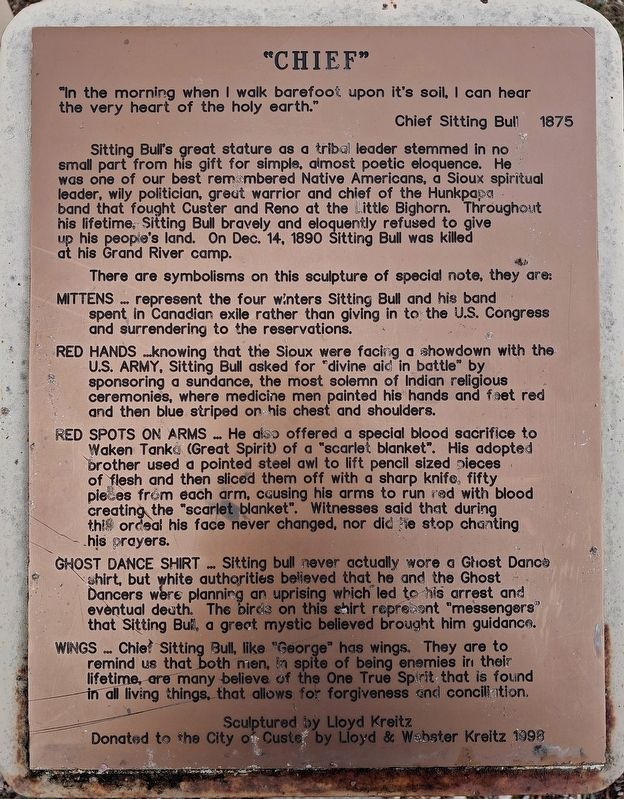
"In the morning when I walk barefoot upon it's soil, I can hear the very heart of the holy earth."
Chief Sitting Bull 1875
Sitting Bull's great stature as a tribal leader stemmed in no small part from his gift for simple, almost poetic eloquence. He was one of our best remembered Native Americans, a Sioux spiritual leader, wily politician, great warrior and chief of the Hunkpapa band that fought Custer and Reno at the Little Bighorn. Throughout his lifetime, Sitting Bull bravely and eloquently refused to give up his people's land. On Dec. 14, 1890 Sitting Bull was killed at his Grand River camp.
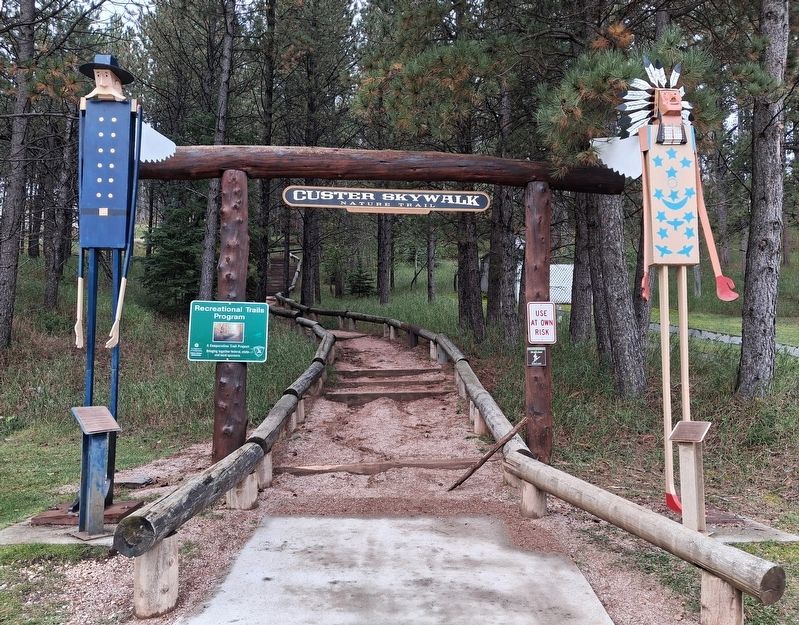
There are symbolisms on this sculpture of special note, they are:
MITTENS... represent the four winters Sitting Bull and his band spent in Canadian exile rather than giving in to the U.S. Congress and surrendering to the reservations.
RED HANDS...knowing that the Sioux were facing a showdown with the U.S. ARMY, Sitting Bull asked for "divine aid in battle" by sponsoring a sundance, the most solemn of Indian religious ceremonies, where medicine men painted his hands and feet red and then blue striped on his chest
this page online
RED SPOTS ON ARMS. He also offered a special blood sacrifice to Waken Tanka (Great Spirit) of a "scarlet blanket". His adopted brother used a pointed steel awl to lift pencil sized pieces of flesh and then sliced them off with a sharp knife, fifty pieces from each arm, causing his arms to run red with blood creating the "scarlet blanket". Witnesses said that during this ordeal his face never changed, nor did he stop chanting his prayers.
GHOST DANCE SHIRT... Sitting bull never actually wore a Ghost Dance shirt, but white authorities believed that he and the Ghost Dancers were planning an uprising which led to his arrest and eventual death. The birds on this shirt represent "messengers" that Sitting Bull, a great mystic believed brought him guidance.
WINGS... Chief Sitting Bull, like "George" has wings. They are to remind us that both men, in spite of being enemies in their lifetime, are many believe of the One True Spirit that is found in all living things, that allows for forgiveness and conciliation.
Sculptured by Lloyd Kreitz
Donated to the City of Custer by Lloyd & Webster Kreitz 1998
Erected by City
Photographed by William Fischer, Jr., September 22, 2026
2. Chief Sitting Bull Marker
Topics. This historical marker is listed in these topic lists: Indigenous Peoples and Communities • Patriots & Patriotism • Wars, US Indian. A significant historical date for this entry is December 14, 1890.
Location. 43° 45.879′ N, 103° 35.861′ W. Marker is in Custer, South Dakota, in Custer County. It is at the intersection of French Creek Drive and 6th Street, on the right when traveling east on French Creek Drive. Marker and sculpture are part of the Custer Skywalk Trailhead entrance arch, south of Harbach Centennial Park. Touch for map. Marker is in this post office area: Custer SD 57730, United States of America. Touch for directions.

Regionally, this marker is in West River and in Greater Rapid City. It is also in the American Black Hills, in the Lewis & Clark Corridor, on the prairies, and on the Northern Plains. Globally, it is in North America, the Western Hemisphere, the Western World, and the Anglosphere. Historically, it finds itself in what was once Rupert’s Land and also the Louisiana Purchase.
Other nearby markers. At least 8 other markers are within walking distance of this marker: George Armstrong Custer (here, next to this marker); Big Rock Park & Pageant Hill (here, next to this marker); Welcome to the Harbach Trailhead (about 300 feet away, measured in a direct line); General George A. Custer (about 400 feet away); a different marker also named Big Rock Park & Pageant Hill (about 400 feet away); Custer Veterans Memorial (about 500 feet away); L. Cpl. Cody Glenn Engen (about 600 feet away); First National Bank of Dakota Territory (about 700 feet away). Touch for a list and map of all markers in Custer.
Credits. This page was last revised on October 5, 2026. It was originally submitted on October 5, 2026, by William Fischer, Jr. of Reynoldsburg, Ohio. This page has been viewed 3 times since then. Photos: 1, 2. submitted on October 5, 2026, by William Fischer, Jr. of Reynoldsburg, Ohio.
