Near Massive in Banff National Park, Alberta — Canada’s Prairie Region (North America)
The Bigger Picture
⎯⎯⎯
La situation dans son ensemble
Photographed by Cosmos Mariner, July 4, 2022
1. The Bigger Picture / La situation dans son ensemble Marker

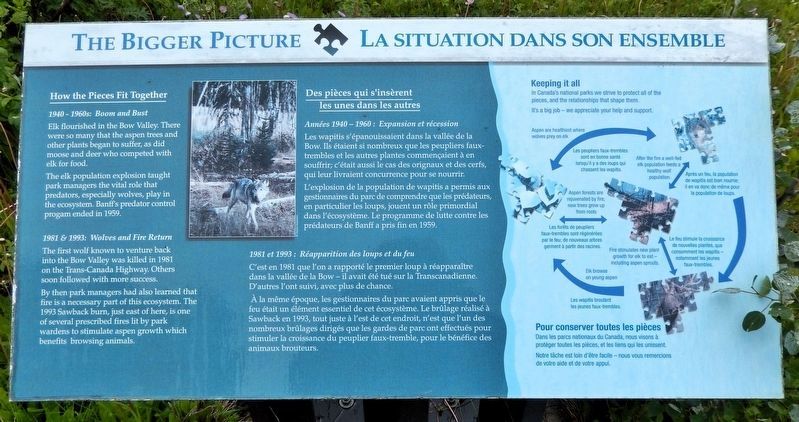
How the Pieces Fit Together
1940 — 1960s: Boom and Bust
Elk flourished in the Bow Valley. There were so many that the aspen trees and other plants began to suffer, as did moose and deer who competed with elk for food.
The elk population explosion taught park managers the vital role that predators, especially wolves, play in the ecosystem. Banff's predator control program ended in 1959.
1981 & 1993: Wolves and Fire Return
The first wolf known to venture back into the Bow Valley was killed in 1981 on the Trans-Canada Highway. Others soon followed with more success.
By then park managers had also learned that fire is a necessary part of this ecosystem. The 1993 Sawback burn, just east of here, is one of several prescribed fires lit by park wardens to stimulate aspen growth which benefits browsing animals.
Keeping it all
In Canada's national parks we strive to protect all of the pieces, and the relationships that shape them. It’s a big job — we appreciate your help and support.
• Aspen are healthiest where wolves prey on elk.
• Aspen forests are rejuvenated by fire; new trees grow up from roots.
• Fire stimulates
this page online
• Elk browse on young aspen.
• After the fire a well-fed elk population feeds a healthy wolf population.
Des pièces qui s'insèrent les unes dans les autres
Années 1940 — 1960 : Expansion et récession
Les wapitis s'épanouissaient dans la vallée de la Bow. Ils étaient si nombreux que les peupliers faux-trembles et les autres plantes commençaient à en souffrir; c'était aussi le cas des orignaux et des cerfs, qui leur livraient concurrence pour se nourrir.
L'explosion de la population de wapitis a permis aux gestionnaires du parc de comprendre que les prédateurs, en particulier les loups, jouent un rôle primordial dans l'écosystème. Le programme de lutte contre les prédateurs de Banff a pris fin en 1959.
1981 et 1993 : Réapparition des loups et du feu
C'est en 1981 que l'on a rapporté le premier loup à réapparaître dans la vallée de la Bow — il avait été tué sur la Transcanadienne. D'autres l'ont suivi, avec plus de chance.
À la même époque, les gestionnaires du parc avaient appris que le feu était un élément essentiel de cet écosystème. Le brûlage réalisé à Sawback en 1993,
Photographed by Cosmos Mariner, July 4, 2022
2. The Bigger Picture / La situation dans son ensemble Marker
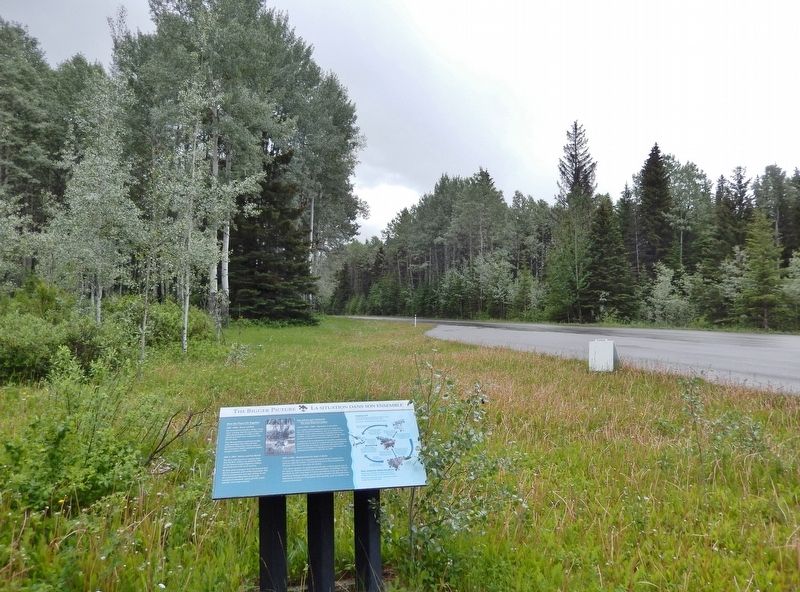
Looking east along Bow Valley Parkway.
Pour conserver toutes les pièces
Dans les parcs nationaux du Canada, nous visons à protéger toutes les pièces, et les liens qui les unissent. Notre tâche est loin d'être facile — nous vous remercions de votre aide et de votre appui.
• Les peupliers faux-trembles sont en bonne santé lorsqu'il y a des loups qui chassent les wapitis.
• Les forêts de peupliers faux-trembles sont régénérées par le feu; de nouveaux arbres germent à partir des racines.
• Le feu stimule la croissance de nouvelles plantes, que consomment les wapitis — notamment les jeunes faux-trembles.
• Les wapitis broutent les jeunes faux-trembles.
• Après un feu, la population de wapitis est bien nourrie; il en va donc de même pour la population de loups.
Erected by Parks Canada / Parcs Canada.
Topics. This historical marker is listed in these topic lists: Animals • Environment • Horticulture & Forestry • Parks & Recreational Areas.
Location. 51° 12.989′ N, 115° 46.078′ W. Marker is near Massive, Alberta, in Banff National Park. It is on Bow Valley Parkway (Provincial Highway 1A) 12.6 kilometers east of Banff-Windermere Highway (Provincial Highway 93), on the left when traveling east. The marker is beside a pull-out on the north side of Bow Valley Parkway. Touch for map. Marker is in this post office area: Massive AB T0L 1E0, Canada. Touch for directions.

Regionally, this marker is in the Canadian Rockies. It is also in the Prairies. Globally, it is in North America, the Rocky Mountains, the Western Hemisphere, the Western World, and the Anglosphere. Historically, it finds itself in what was once a British colony and also Rupert’s Land.
Other nearby markers. At least 8 other markers are within 14 kilometers of this marker, measured as the crow flies: Sawback (here, next to this marker); Past Visitors / Visiteurs du passé (approx. 1.3 kilometers away); Era of the Automobile / L'ère de l'automobile (approx. 1.3 kilometers away); Prescribed Burn / Brûlage dirigé (approx. 3.4 kilometers away); Flames of Life / Flammes de la vie (approx. 3.4 kilometers away); Pilot Pond / Étang Pilot (approx. 3.5 kilometers away); The Cave and Basin (approx. 13.5 kilometers away); An Architectural Landmark (approx. 13.9 kilometers away). Touch for a list and map of all markers in Massive.
Also see . . . The National Parks Where Wolves Have Returned (World Atlas).
Excerpt: Government predator-control programs systematically reduced wolves across the Canadian Rockies. Wolves were extirpated from Banff National Park during the late 1940s and remained absent for several decades. They returned naturally during the mid-1980s as animals moved into the park from surrounding landscapes.(Submitted on October 9, 2026, by Cosmos Mariner of Cape Canaveral, Florida.)
A successful return requires breeding packs, sufficient prey, genetic diversity, and safe movement beyond park borders. Wolves can reshape food webs by affecting elk, deer, and moose. Their ecological influence also depends on climate, hunting, other predators, and habitat conditions. Their recovery is therefore both a conservation success and an ongoing management challenge.
Several packs now use Banff, including wolves that travel through the lower Bow Valley near roads, railway lines, campgrounds, and the Banff townsite. Parks Canada estimates that Banff and the surrounding area support roughly 60 to 70 wolves, although pack numbers and territories change over time. Wildlife corridors and seasonal closures around denning areas help wolves cross busy sections of the valley while avoiding people.
Credits. This page was last revised on October 9, 2026. It was originally submitted on October 8, 2026, by Cosmos Mariner of Cape Canaveral, Florida. This page has been viewed 6 times since then. Photos: 1, 2. submitted on October 9, 2026, by Cosmos Mariner of Cape Canaveral, Florida.
