Rapid City in Pennington County, South Dakota — The American Midwest (Upper Plains)
The Inconvenient Truth
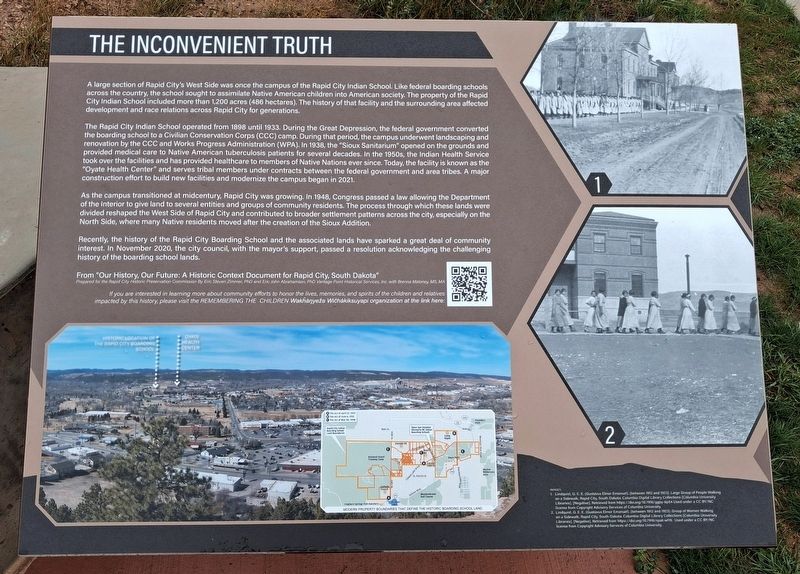
Photographed by William Fischer, Jr., September 20, 2026
1. The Inconvenient Truth Marker
A large section of Rapid City's West Side was once the campus of the Rapid City Indian School. Like federal boarding schools across the country, the school sought to assimilate Native American children into American society. The property of the Rapid City Indian School included more than 1,200 acres (486 hectares). The history of that facility and the surrounding area affected development and race relations across Rapid City for generations.
The Rapid City Indian School operated from 1898 until 1933. During the Great Depression, the federal government converted the boarding school to a Civilian Conservation Corps (CCC) camp. During that period, the campus underwent landscaping and renovation by the CCC and Works Progress Administration (WPA). In 1938, the "Sioux Sanitarium" opened on the grounds and provided medical care to Native American tuberculosis patients for several decades. In the 1950s, the Indian Health Service took over the facilities and has provided healthcare to members of Native Nations ever since. Today, the facility is known as the "Oyate Health Center" and serves tribal members under contracts between
this page online
As the campus transitioned at midcentury, Rapid City was growing. In 1948, Congress passed a law allowing the Department of the Interior to give land to several entities and groups of community residents. The process through which these lands were divided reshaped the West Side of Rapid City and contributed to broader settlement patterns across the city, especially on the North Side, where many Native residents moved after the creation of the Sioux Addition.
Recently, the history of the Rapid City Boarding School and the associated lands have sparked a great deal of community interest. In November 2020, the city council, with the mayor's support, passed a resolution acknowledging the challenging history of the boarding school lands.
From "Our History, Our Future: A Historic Context Document for Rapid City, South Dakota"
Prepared for the Rapid City Historic Preservation Commission By Eric Steven Zimmer, PhD and Eric John Abrahamson, PhD Vantage Point Historical Services, Inc. with Brenna Maloney, MS, MA
If you are interested in learning more about community efforts to honor the lives, memories, and spirits of the children and relatives impacted by this history, please visit the REMEMBERING THE CHILDREN Wakhányeza Wichákiksuyapi organization at the link here: [QR Code]
[Photo captions read]
1
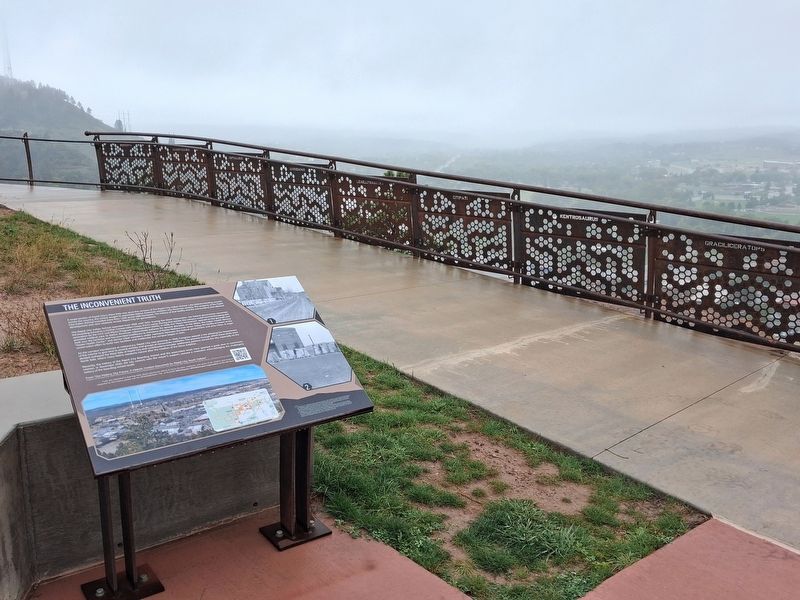
Photographed by William Fischer, Jr., September 20, 2026
2. The Inconvenient Truth Marker
2 Group of People Walking on a Sidewalk, Rapid City, South Dakota (between 1912 and 1923)
[Aerial photo and inset map showing] Historic location of the Rapid City Boarding School [and] Oyate Health Center
Erected by City of Rapid City.
Topics. This historical marker is listed in these topic lists: Civil Rights • Education • Indigenous Peoples and Communities. A significant historical month for this entry is November 2020.
Location. 44° 4.696′ N, 103° 14.763′ W. Marker is in Rapid City, South Dakota, in Pennington County. Marker is in Dinosaur Park, along the walking path. Touch for map. Marker is at or near this postal address: 940 Skyline Drive, Rapid City SD 57701, United States of America. Touch for directions.

Regionally, this marker is in West River and in the Badlands. It is also in the American Black Hills, in the Lewis & Clark Corridor, on the prairies, and on the Northern Plains. Globally, it is in North America, the Western Hemisphere, the Western World, and the Anglosphere. Historically, it finds itself in what was once Rupert’s Land and also the Louisiana Purchase.
Other nearby markers. At least 8 other markers are within walking distance of this marker: Local Lakota: Osh Kosh Camp (a few steps from this marker); Tyrannosaurus Rex (a few steps from this marker); Triceratops (a few steps from this marker); The Great Race/Black Hills Geology (a few steps from this marker); Hangman's Hill (a few steps from this marker); Apatosaurus (within shouting distance of this marker); Stegosaurus (within shouting distance of this marker); Trachodon (within shouting distance of this marker). Touch for a list and map of all markers in Rapid City.
Credits. This page was last revised on October 10, 2026. It was originally submitted on October 10, 2026, by William Fischer, Jr. of Reynoldsburg, Ohio. This page has been viewed 3 times since then. Photos: 1, 2. submitted on October 10, 2026, by William Fischer, Jr. of Reynoldsburg, Ohio.
