Vienna in Dorchester County, Maryland — The American Northeast (Mid-Atlantic)
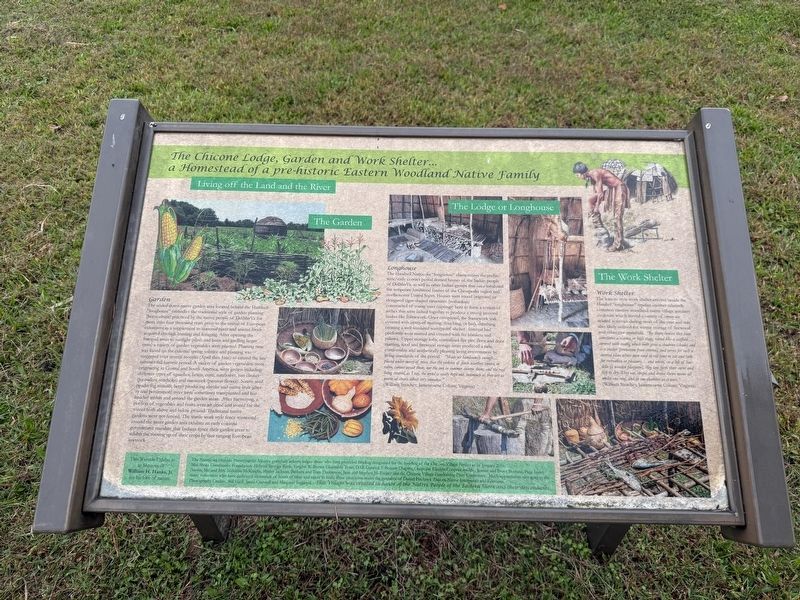
The Chicone Lodge, Garden and Work Shelter…
a Homestead of a pre-historic Eastern Woodland Native Family
| — | Living off the Land and the River | — |
Photographed by Devry Becker Jones (CC0), October 11, 2026
1. The Chicone Lodge, Garden and Work Shelter… Marker
Garden
The scaled down native garden area located behind the Handsell "longhouse" embodies the traditional style of garden planting (horticulture) practiced by the native people of DelMarVa for more than four thousand years prior to the arrival of European colonizers as a supplement to seasonal plant and animal foods acquired through hunting and foraging. After opening the forested areas to sunlight (slash and burn and girdling larger trees) a variety of garden vegetables were planted. Planting time was based on the celestial spring solstice and planting was staggered over several months (April thru June) to extend the late summer-fall harvest period. A variety of garden vegetables, most originating in Central and South America, were grown including different types of squashes, beans, corn, sunflower, sun chokes (Jerusalem artichoke) and maracock (passion flower). Native seed producing annuals, berry producing shrubs and native fruit (cherry and persimmon) trees were sometimes transplanted and husbanded within and around the garden areas. After harvesting, a portion of vegetables and fruits were air dried and stored
this page online
Longhouse
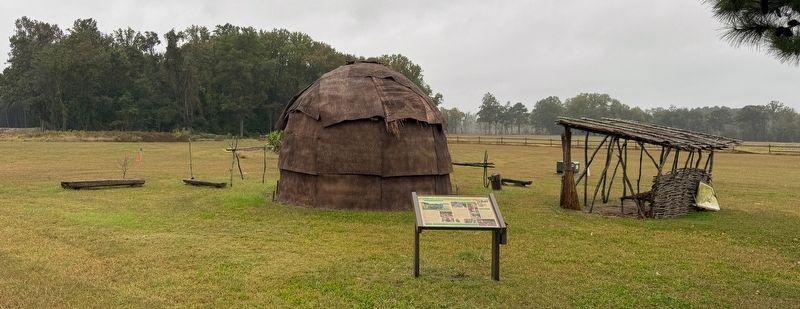
The Handsell Nanticoke "longhouse" characterizes the prehistoric/early contact period domed houses of the Indian people of DelMarVa, as well as other Indian groups that once inhabited the temperature hardwood forests of the Chesapeake region and northeastern United States. Houses wer eround (wigwam) or elongated cigar-shaped structures (yeahaukan) constructed of young trees (saplings) bent to form a system of arches that were lashed together to produce a strong inverted basket-like framework. Once completed, the framework was covered with layers of matting, thatching, or bark sheathing creating a well-insulated waterproof shelter. Internal bed platforms were matted and covered with fur blankets and pillows. Upper storage lofts, centralized fire pits, floor and door matting, food and firewood storage areas produced
Photographed by Devry Becker Jones (CC0), October 11, 2026
2. The Chicone Lodge, Garden and Work Shelter… Marker
(William, Strachey, Jamestowne Colony, Virginia)
Work Shelter
The lean-to style work shelter erected beside the Handsell "longhouse" typifies another relatively common eastern woodland native village auxiliary structure which served a variety of open-air related activities during most of the year and was also likely utilized for winter storage of firewood and other raw materials. "By theire howses they have sometimes a scaena, or high stage, raised like a scaffold…- covered with matts, which both gives a shadowe (shade) and is a shelter (protection from storms), and serves for such as covered place where men used in old tyme to sitt and talk for recreation or pleasure… and where, on a loft of hurdells (a wooden platform), they laye forth their corne and fish to dry. They eat, sleep, and dresse their meate all under one roof, and in one chamber as it were."
(William Strachey, Jamestown Colony, Virginia)
This Wayside Exhibit is in Memory of
The Nanticoke Historic Preservation Alliance gratefully acknowledges those who have provided funding designated for the building of the Chicone Village Project as of January 2016:
Mid-Shore Community Foundation, Hebron Savings Bank, Vaughn W. Brown Charitable Trust, DAR-General P. Benson Chapter, Choptank Electric Cooperative Inc., Jeanne and Bruce Bernard, Page Insley Austin, Mr. and Mrs. Malcolm McKnight, Shirley Jackson, Barbara and Tom Thompson, Jane and Stephen M. Escher and the Chicone Village Fundraising Party Committee. Much appreciation also goes to the many volunteers who have dedicated thousands of hours of time and talent to build these structures under the guidance of Daniel Firehawk Abbott, Native Interpreter and Educator.
Photography Credits: Bill Cecil, Jamie Crannell and Margaret Ingersoll.
Erected 2016 by Maryland Heritage Areas Authority.
Topics. This historical marker is listed in these topic lists: Anthropology & Archaeology • Horticulture & Forestry • Indigenous Peoples and Communities • Settlements & Settlers. A significant historical month for this entry is January 2016.
Location. 38° 30.513′ N, 75° 48.737′ W. Marker is in Vienna, Maryland, in Dorchester County. It is on Indiantown Road 1.6 miles east of Rhodesdale Vienna Road (Maryland Route 331), on the right when traveling east. Touch for map. Marker is at or near this postal address: 4835 Indiantown Rd, Vienna MD 21869, United States of America. Touch for directions.

Regionally, this marker is on the Eastern Shore. It is also in the American Mid-Atlantic, on the Delmarva Peninsula, in the Tidewater, in the Chesapeake Bay Region, and on the Eastern Seaboard. Globally, it is in the North Atlantic Region, North America, the Western Hemisphere, the Western World, and the Anglosphere. Historically, it finds itself in what was once one of the original Thirteen Colonies and also the Antebellum South.
Other nearby markers. At least 8 other markers are within 2 miles of this marker, measured as the crow flies: The Nature Trail at Handsell…walk the footsteps of the Native People of Chicone and find these trees (within shouting distance of this marker); Handsell (within shouting distance of this marker); The African American Story in the Indian Town… (within shouting distance of this marker); The native people of the Chicacone Village…the Nanticokes (within shouting distance of this marker); The Nanticoke Historic Preservation Alliance (within shouting distance of this marker); Unnacokossimmon (approx. 1.6 miles away); John Smith Explores the Chesapeake (approx. 1.7 miles away); Discover: Vienna Heritage (approx. 1.8 miles away). Touch for a list and map of all markers in Vienna.
Credits. This page was last revised on October 11, 2026. It was originally submitted on October 11, 2026, by Devry Becker Jones of Washington, District of Columbia. This page has been viewed 10 times since then. Photos: 1, 2. submitted on October 11, 2026, by Devry Becker Jones of Washington, District of Columbia.
