Tifton in Tift County, Georgia — The American South (South Atlantic)
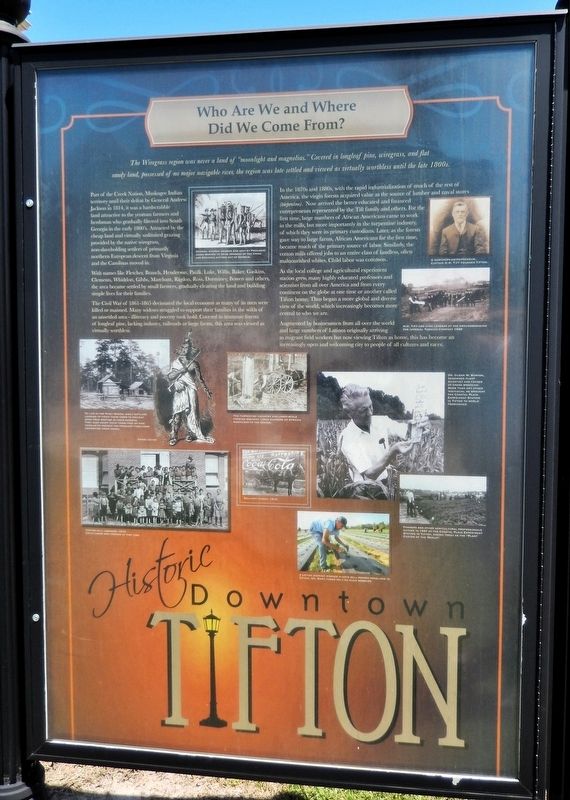
Who Are We and Where Did We Come From?
| — | Historic Downtown Tifton | — |
Photographed by Cosmos Mariner, April 19, 2022
1. Who Are We and Where Did We Come From? Marker
The Wiregrass region was never a land of “moonlight and magnolias.” Covered in longleaf pine, wiregrass, and flat sandy land, possessed of no major navigable river, the region was late settled and viewed as virtually worthless until the late 1800s.
Part of the Creek Nation, Muskogee Indian territory until their defeat by General Andrew Jackson in 1814, it was a hardscrabble land attractive to the yeoman farmers and herdsman who gradually filtered into South Georgia in the early 1800's. Attracted by the cheap land and virtually unlimited grazing provided by the native wiregrass, non-slaveholding settlers of primarily northern European descent from Virginia and the Carolinas moved in.
With names like Fletcher, Branch, Henderson, Paulk, Luke, Willis, Baker, Gaskins, Clements, Whiddon, Gibbs, Marchant, Rigdon, Ross, Dorminey, Bowen and others, the area became settled by small farmers, gradually clearing the land and building simple lives for their families.
The Civil War of 1861-1865 decimated the local economy as many of its men were killed or maimed. Many widows struggled to support their families in the wilds of an unsettled
this page online
In the 1870s and 1880s, with the rapid industrialization of much of the rest of America, the virgin forests acquired value as the source of lumber and naval stores (turpentine). Now arrived the better educated and financed entrepreneurs represented by the Tift family and others. For the first time, large numbers of African Americans came to work in the mills but more importantly in the turpentine industry, of which they were its primary custodians. Later, as the forests gave way to large farms, African Americans for the first time, became much of the primary source of labor. Similarly, the cotton mills offered jobs to an entire class of landless, often malnourished whites. Child labor was common.
As the local college and agricultural experiment station grew, many highly educated professors and scientists from all over America and from every continent on the globe at one time or another called Tifton home. Thus began a more global and diverse view of the world,
Photographed by Cosmos Mariner, April 19, 2022
2. Who Are We and Where Did We Come From? Marker
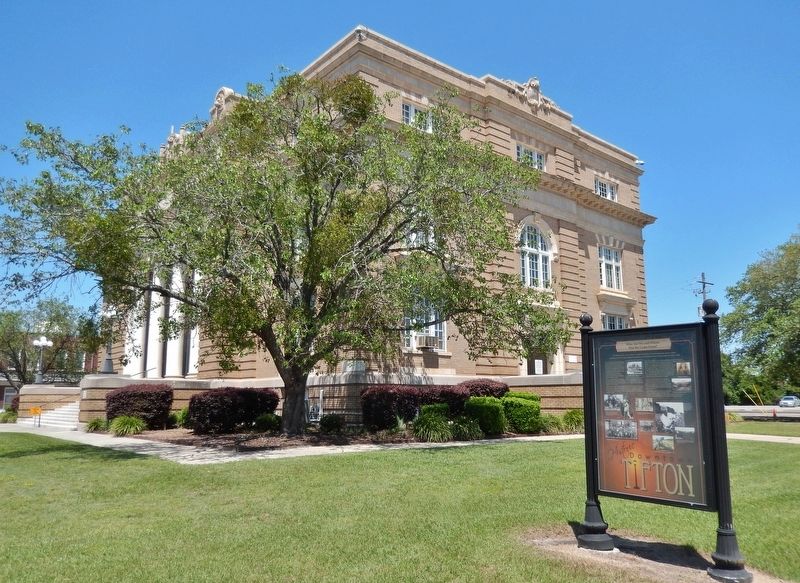
Looking northwest from Tift Avenue North. The Tift County Courthouse is in the background.
Augmented by businessmen from all over the world and large numbers of Latinos originally arriving as migrant field workers but now viewing Tifton as home, this has become an increasingly open and welcoming city to people of all cultures and races.
[image captions]
• General Andrew Jackson was sent by President James Monroe to drive members of the Creek and Seminole Nations out of Georgia.
• A northern entrepreneur, Captain H.H. Tift founded Tifton.
• H.H. Tift and civic leaders at the groundbreaking for Imperial Tobacco Company, 1920.
• To live in the Piney Woods, early settlers learned to fence their yards to prevent hogs from rooting in their gardens. They also swept their yards free of pine needles to prevent the frequent fires from destroying their homes.
• Creek Indian
• The turpentine industry and large-scale farming brought large numbers of African Americans to the region.
• Dr. Glenn W. Burton, renowned plant scientist and father of grass breeding. More than any other individual he brought the Coastal Plain Experiment Station in Tifton to world prominence.
• Cotton Mill Laborers, 1910. Child labor was common at that time.
• Delivery wagon, 1910.
• Farmers and other agricultural professionals gather in 1987 at the Coastal Plain Experiment Station in Tifton, known today as the “Plant Center of the World.”
• A Latino migrant worker plants bell pepper seedlings in Tifton, GA. Many farms rely on such workers.
Topics. This historical marker is listed in these topic lists: African Americans • Hispanic Americans • Indigenous Peoples and Communities • Settlements & Settlers.
Location. 31° 27.25′ N, 83° 30.467′ W. Marker is in Tifton, Georgia, in Tift County. It is at the intersection of Tift Avenue North and 2nd Street East, on the left when traveling north on Tift Avenue North. The marker is near the southeast corner of the Tift County Courthouse grounds. Touch for map. Marker is at or near this postal address: 237 2nd Street East, Tifton GA 31794, United States of America. Touch for directions.

Regionally, this marker is on the Coastal Plain. It is also in the American South, specifically in the Deep South, and in the Wiregrass. Globally, it is in North America, the Western Hemisphere, the Western World, and the Anglosphere. Historically, it finds itself in what was once the territory of the Mississippian Culture, one of the original Thirteen Colonies, one of the Confederate States of America, and the Antebellum South.
Other nearby markers. At least 8 other markers are within walking distance of this marker: Tift County (a few steps from this marker); Tift-Lee Building (within shouting distance of this marker); Guns, Churches and a Museum (about 500 feet away, measured in a direct line); Tifton: A Railroad Town (about 600 feet away); The Olympic Torch Paused at this Site (about 700 feet away); From Mystic to Wiregrass (about 700 feet away); Love Avenue: Tifton's Silk Stocking Row (about 800 feet away); Purple Heart Memorial (approx. 0.2 miles away). Touch for a list and map of all markers in Tifton.
Credits. This page was last revised on October 13, 2026. It was originally submitted on October 12, 2026, by Cosmos Mariner of Cape Canaveral, Florida. This page has been viewed 7 times since then. Photos: 1. submitted on October 12, 2026, by Cosmos Mariner of Cape Canaveral, Florida. 2. submitted on October 13, 2026, by Cosmos Mariner of Cape Canaveral, Florida.
