Cupertino in Santa Clara County, California — The American West (Pacific Coastal)
Cupertino Morion Scuplture
Photographed by Alice Mansell, October 13, 2026
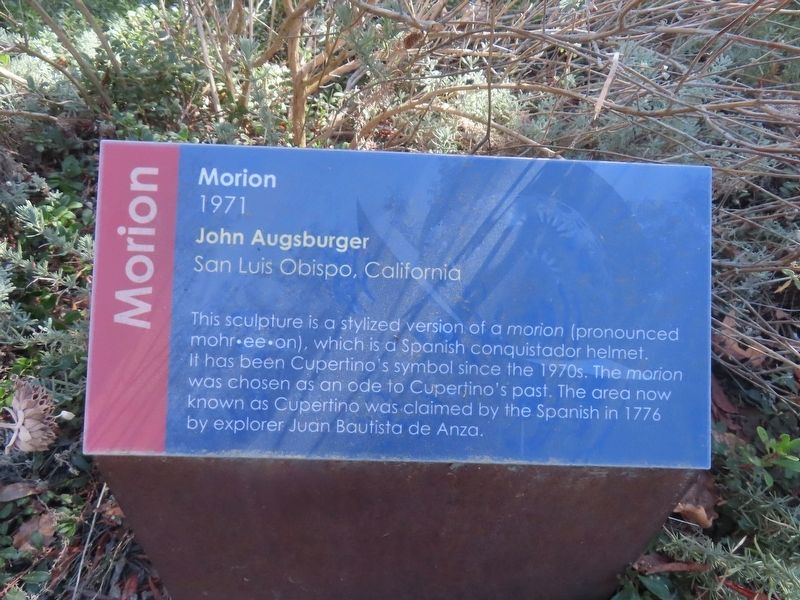
1. Cupertino Morion Scuplture Marker
Morion
1971
John Augsburger
San Luis Obispo, California
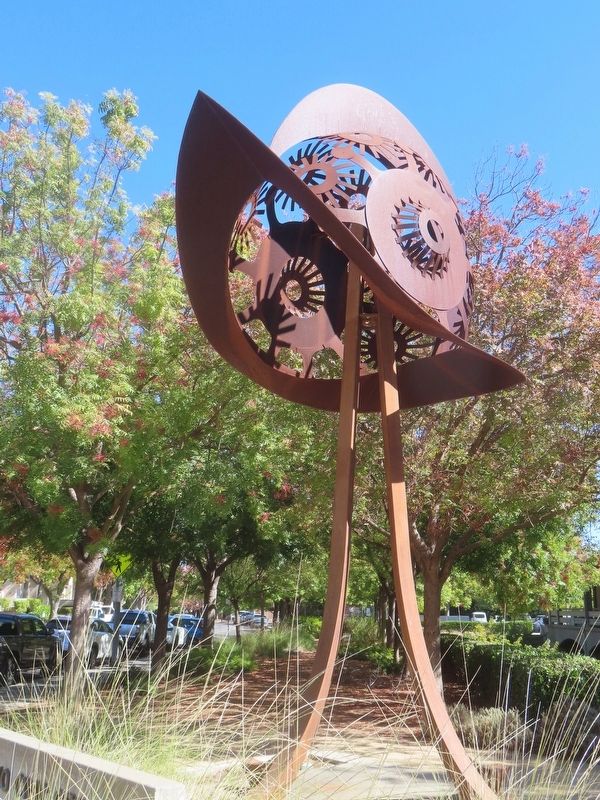
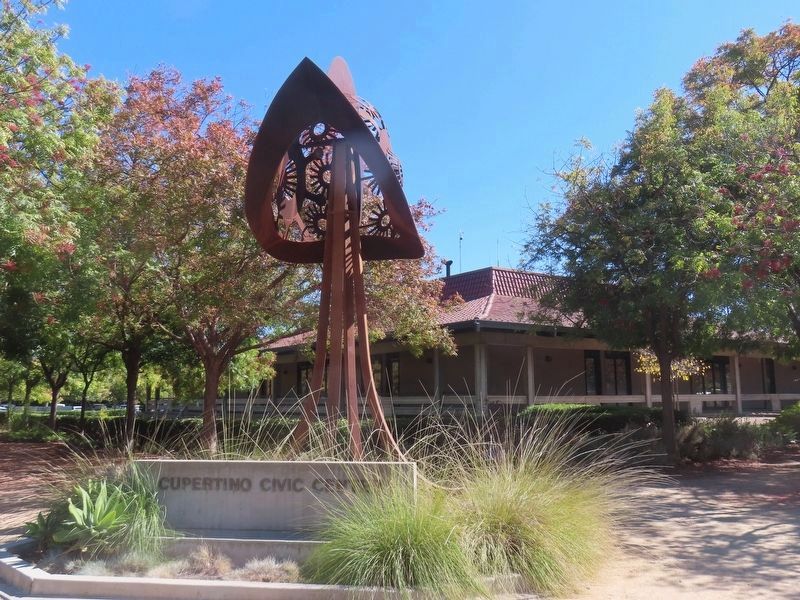
This sculpture is a stylized version of a morion (pronounced mohr·ee·on), which is a Spanish conquistador helmet. It has been Cupertino's symbol since the 1970s. The morion was chosen as an ode to Cupertino's past. The area now known as Cupertino was claimed by the Spanish in 1776 by explorer Juan Bautista de Anza.
Erected 1971 by City of Cupertino.
Topics. This historical marker is listed in these topic lists: Arts, Letters, Music • Colonial Era • Exploration • Hispanic Americans.
Location. 37° 19.15′ N, 122° 1.746′ W. Marker is in Cupertino, California, in Santa Clara County. It is at the intersection of Torre Avenue and Rodrigues Avenue, on the left when traveling south on Torre Avenue. Located at Cupertino Civic Center. Touch for map. Marker is in this post office area: Cupertino CA 95014, United States of America. Touch for directions.

Regionally, this marker is in the San Francisco Bay Area, in Silicon Valley, and on the Coast Ranges. It is also on the American Pacific Coast.
this page online
Other nearby markers. At least 8 other markers are within 3 miles of this marker, measured as the crow flies: De Anza Expedition 1775 - 1776 (approx. 0.9 miles away); Arroyo de San Joseph Cupertino (approx. 1.6 miles away); Captain Elisha Stephens (approx. 1.7 miles away); Collins-Scott Winery (approx. 2.2 miles away); Charles Clifton Spalding House (approx. 2.3 miles away); Vintage Sundial (approx. 2.6 miles away); Yugoslavian Orchardists of Sunnyvale (approx. 2.6 miles away); Pippin Clay Glazed Tiles (approx. 2.6 miles away). Touch for a list and map of all markers in Cupertino.
More about this marker. The sculpture was installed on the Civic Center Plaza in 1971. In 1988, it was moved to a site presently occupied by the Cupertino Library and in 2004 after another Civic Center remodel, it was moved to its present location.
Regarding Cupertino Morion Scuplture. A “morion” is
Photographed by Alice Mansell, October 13, 2026
2. Cupertino Morion Scuplture
Photographed by Alice Mansell, October 13, 2026
3. Cupertino Morion Sculpure
City Hall is behind the sculpture

Photographed by Alice Mansell, October 13, 2026
4. Cupertino City Hall foyer morion painting
Photographed by Alice Mansell, October 13, 2026
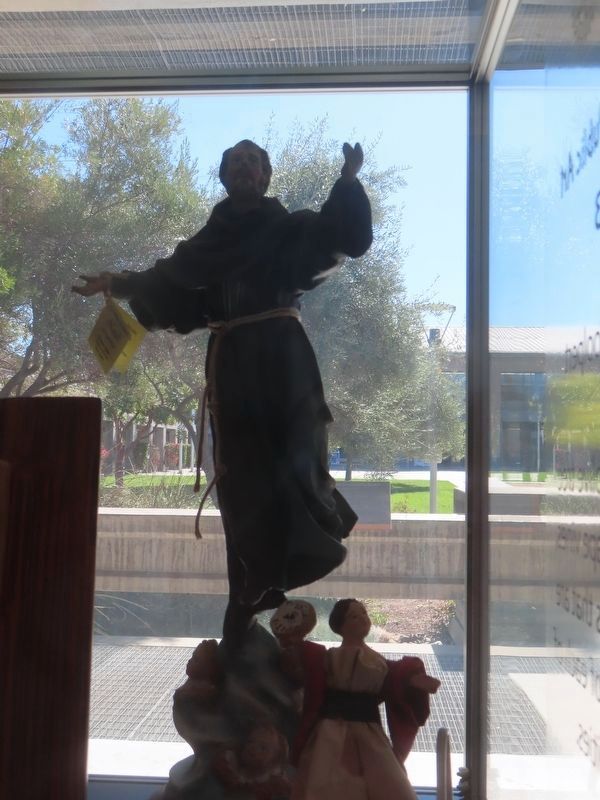
5. San Jose de Cupertino inside City Hall foyer
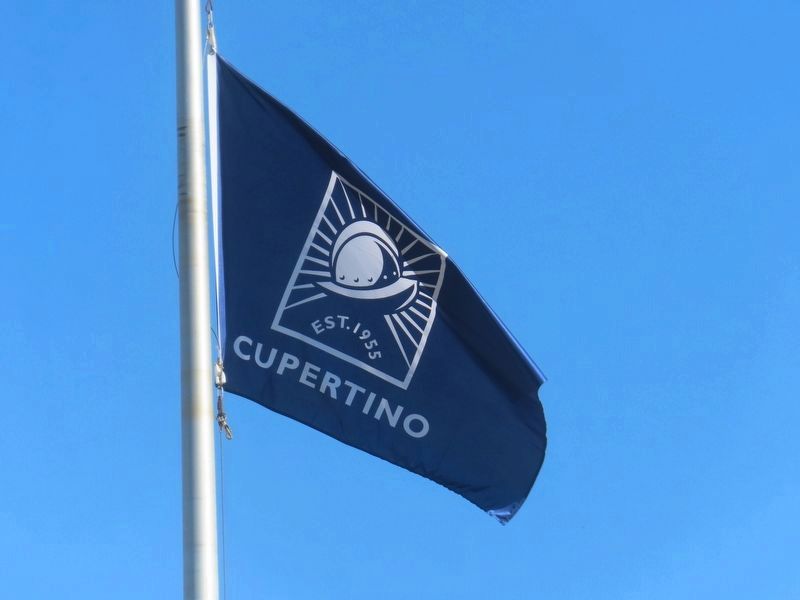
Photographed by Alice Mansell, October 13, 2026
6. Cupertino Flag at Civic Center with motion logo
Credits. This page was last revised on November 1, 2026. It was originally submitted on October 18, 2026, by Alice Mansell of Los Altos, California. This page has been viewed 16 times since then. Photos: 1, 2, 3, 4, 5, 6. submitted on October 18, 2026, by Alice Mansell of Los Altos, California. • Andrew Ruppenstein was the editor who published this page.
