Near Cottonwood in Jackson County, South Dakota — The American Midwest (Upper Plains)
A Landscape Lost to Time
Photographed by William Fischer, Jr., September 19, 2026
1. A Landscape Lost to Time Marker
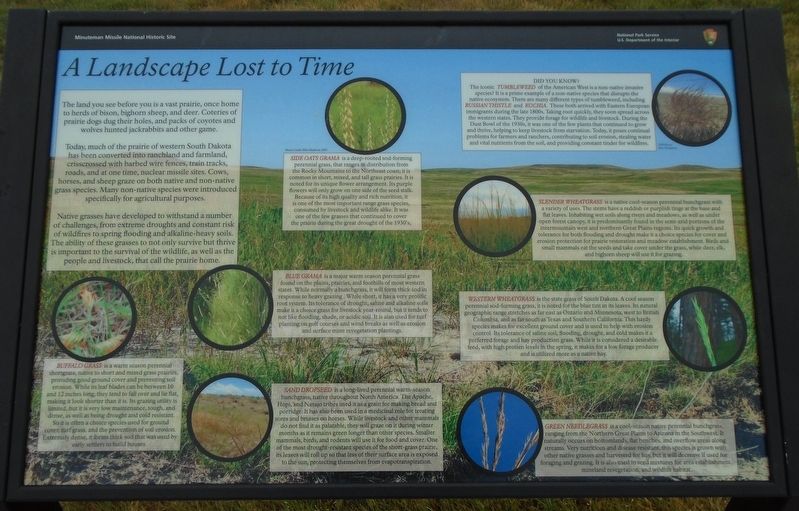
The land you see before you is a vast prairie, once home to herds of bison, bighorn sheep, and deer. Coteries of prairie dogs dug their holes, and packs of coyotes and wolves hunted jackrabbits and other game.
Today, much of the prairie of western South Dakota has been converted into ranchland and farmland, crisscrossed with barbed wire fences, train tracks, roads, and at one time, nuclear missile sites. Cows, horses, and sheep graze on both native and non-native grass species. Many non-native species were introduced specifically for agricultural purposes.
Native grasses have developed to withstand a number of challenges, from extreme droughts and constant risk of wildfires to spring flooding and alkaline-heavy soils. The ability of these grasses to not only survive but thrive is important to the survival of the wildlife, as well as the people and livestock, that call the prairie home.
BUFFALO GRASS is a warm season perennial shortgrass, native to short and mixed grass prairies, providing good ground cover and preventing soil erosion. While its leaf blades can be between 10 and 12 inches long, they tend
this page online
So it is often a choice species used for ground cover, turf grass, and the prevention of soil erosion. Extremely dense, it forms thick sod that was used by early settlers to build houses.
SIDE OATS GRAMA is a deep-rooted sod-forming perennial grass, that ranges in distribution from the Rocky Mountains to the Northeast coasts; it is common in short, mixed, and tall grass prairies. It is noted for its unique flower arrangement. Its purple flowers will only grow on one side of the seed stalk.
Because of its high quality and rich nutrition, it is one of the most important range grass species, consumed by livestock and wildlife alike. It was one of the few grasses that continued to cover the prairie during the great drought of the 1930's.
BLUE GRAMA is a major warm season perennial grass found on the plains, prairies, and foothills of most western states. While normally a bunchgrass, it will form thick sod in response to heavy grazing. While short,
Photographed by William Fischer, Jr., September 19, 2026
2. A Landscape Lost to Time Marker
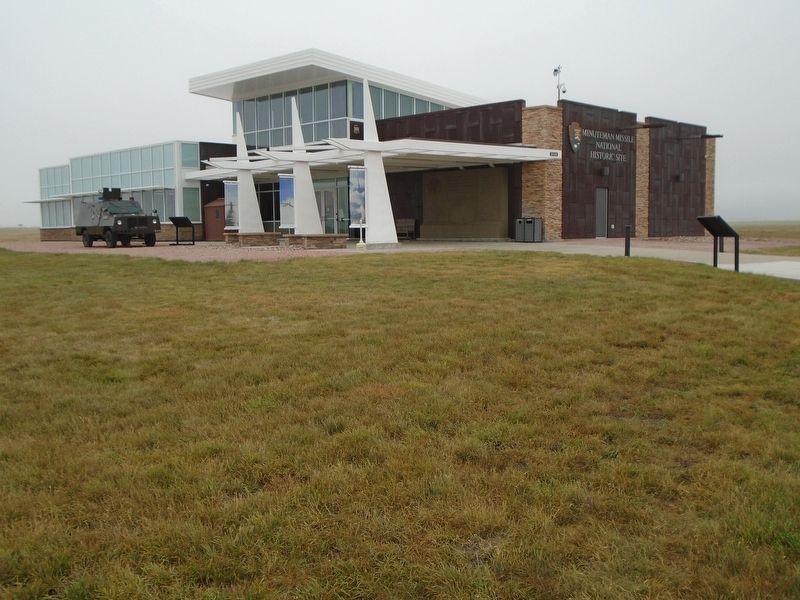
At far right of photo, facing other direction
SAND DROPSEED is a long-lived perennial warm-season bunchgrass, native throughout North America. The Apache, Hopi, and Navajo tribes used it as a grain for making bread and porridge. It has also been used in a medicinal role for treating sores and bruises on horses. While livestock and other mammals do not find it as palatable, they will graze on it during winter months as it remains green longer than other species. Smaller mammals, birds, and rodents will use it for food and cover. One of the most drought-resistant species of the short-grass prairie, its leaves will roll up so that less of their surface area is exposed to the sun, protecting themselves from evapotranspiration.
DID YOU KNOW?
The iconic TUMBLEWEED of the American West is a non-native invasive species? It is a prime example of a non-native species that disrupts the native ecosystem. There are many different types of tumbleweed, including RUSSIAN THISTLE and KOCHIA. These both arrived with Eastern European immigrants during the late 1800s. Taking root quickly, they soon spread across the western states. They provide forage for wildlife and livestock. During the Dust Bowl of the 1930s, it was one of the few plants that continued to grow and thrive, helping to keep livestock from starvation. Today, it poses continual problems for farmers and ranchers, contributing to soil erosion, stealing water and vital nutrients from the soil, and providing constant tinder for wildfires.
SLENDER WHEATGRASS is a native cool-season perennial bunchgrass with a variety of uses. The stems have a reddish or purplish tinge at the base and flat leaves. Inhabiting wet soils along rivers and meadows, as well as under open forest canopy, it is predominantly found in the semi-arid portions of the intermountain west and northern Great Plains regions. Its quick growth and tolerance for both flooding and drought make it a choice species for cover and erosion protection for prairie restoration and meadow establishment. Birds and small mammals eat the seeds and take cover under the grass, while deer, elk, and bighorn sheep will use it for grazing.
WESTERN WHEATGRASS is the state grass of South Dakota. A cool season perennial sod-forming grass, it is noted for the blue tint in its leaves. Its natural geographic range stretches as far east as Ontario and Southern California. This hardy species makes for excellent ground cover and is used to help with erosion control. Its tolerance of saline soil, flooding, drought, and cold makes it a preferred forage and hay production grass. While it is considered a desirable feed, with high protein levels in the spring, it makes for a low forage producer and is utilized more as a native hay.
GREEN NEEDLEGRASS is a cool-season native perennial bunchgrass, ranging from the Northern Great Plains to Arizona in the Southwest. It naturally occurs on bottomlands, flat benches, and overflow areas along streams. Very nutritious and disease resistant, this species is grown with other native grasses and harvested for hay, but it will decrease if used for foraging and grazing. It is also used in seed mixtures for area establishment, mineland revegetation, and wildlife habitat.
Erected by National Park Service.
Topics. This historical marker is listed in these topic lists: Animals • Environment • Indigenous Peoples and Communities • Settlements & Settlers.
Location. 43° 50.663′ N, 101° 54.055′ W. Marker is near Cottonwood, South Dakota, in Jackson County. Marker is near the Minuteman Missile National Historic Site Visitor Center. Touch for map. Marker is at or near this postal address: 24545 CottonWood Road, Philip SD 57567, United States of America. Touch for directions.

Regionally, this marker is in the Rosebud Sioux Tribe, in West River, and in the Badlands. It is also in the American Lewis & Clark Corridor, on the prairies, and on the Northern Plains. Globally, it is in North America, the Western Hemisphere, the Western World, and the Anglosphere. Historically, it finds itself in what was once Rupert’s Land and also the Louisiana Purchase.
Other nearby markers. At least 8 other markers are within 4 miles of this marker, measured as the crow flies: Sun Tzu's Nuclear Missile Prophecy (a few steps from this marker); "At War Every Day" (a few steps from this marker); Peacekeeper (within shouting distance of this marker); Civilian Conservation Corps Camps (approx. 1.3 miles away); Typical Sod House Homesteader (approx. 1.6 miles away); Invisible Warriors (approx. 3.8 miles away); The Badlands Wall (approx. 4 miles away); The Big Badlands (approx. 4.1 miles away). Touch for a list and map of all markers in Cottonwood.
Another marker is no longer nearby. Closer than You Imagined (was approx. ¾ mile away but has been confirmed missing).
Regarding A Landscape Lost to Time. Marker is primarily natural history but does include limited historical information.
Credits. This page was last revised on October 19, 2026. It was originally submitted on October 18, 2026, by William Fischer, Jr. of Reynoldsburg, Ohio. This page has been viewed 12 times since then. Photos: 1, 2. submitted on October 18, 2026, by William Fischer, Jr. of Reynoldsburg, Ohio.
