Near Cottonwood in Jackson County, South Dakota — The American Midwest (Upper Plains)
Peacekeeper
Cadillac-Gage 'Ranger'
| — | Truck, Security Police, Armored Response/Convoy | — |
Photographed by William Fischer, Jr., September 19, 2026
1. Peacekeeper Marker
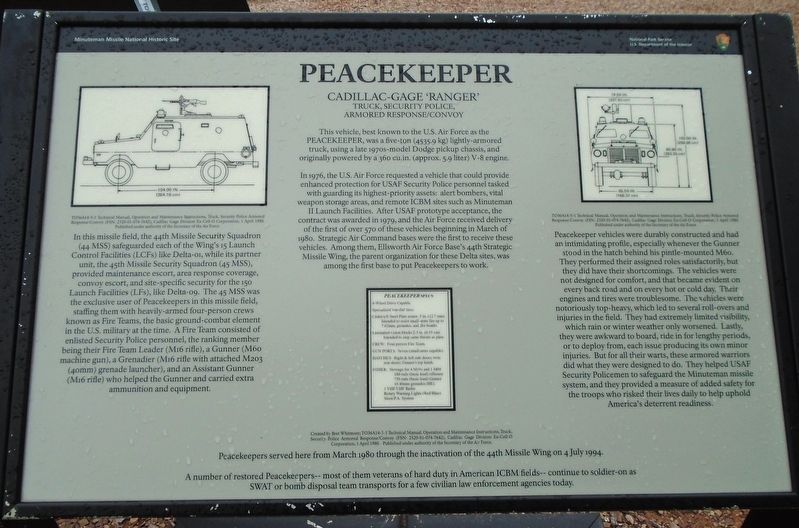
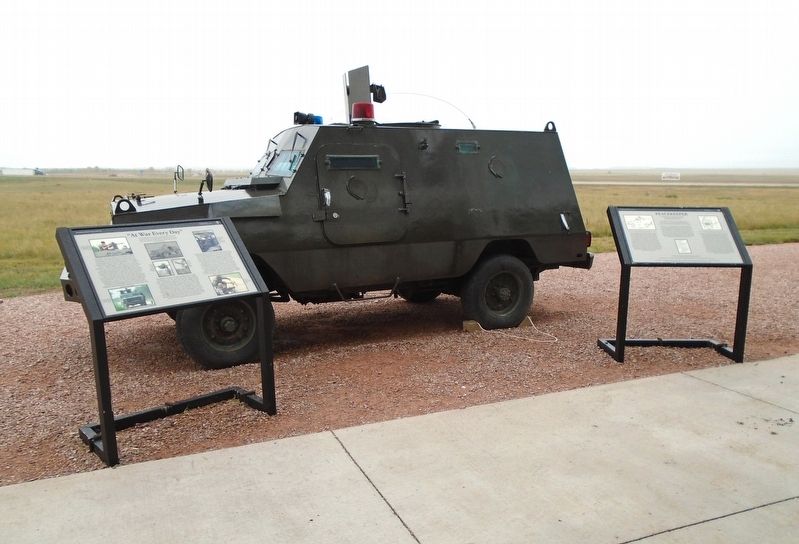
This vehicle, best known to the US Air Force as the PEACEKEEPER, was a five-ton (4535.9 kg) lightly-armored truck, using a late 1970s-model Dodge pickup chassis, and originally powered by a 360 cu.in. (approx. 5.9 liter) V-8 engine.
In 1976, the US Air Force requested a vehicle that could provide enhanced protection for USAF Security Police personnel tasked with guarding its highest-priority assets: alert bombers, vital weapon storage areas, and remote ICBM sites such as Minuteman II Launch Facilities. After USAF prototype acceptance, the contract was awarded in 1979, and the Air Force received delivery of the first of over 570 of these vehicles beginning in March of 1980. Strategic Air Command bases were the first to receive these vehicles. Among them, Ellsworth Air Force Base's 44th Strategic Missile Wing, the parent organization for these Delta sites, was among the first base to put Peacekeepers to work.
In this missile field, the 44th Missile Security Squadron (44 MSS) safeguarded each of the Wing's 15 Launch Control Facilities (LCFs) like Delta-01, while its partner unit, the 45th Missile Security
this page online
Peacekeeper vehicles were durably constructed and had an intimidating profile, especially whenever the Gunner stood in the hatch behind his pintle-mounted M60. They performed their assigned roles satisfactorily, but they did have their shortcomings. The vehicles were not designed for comfort, and that became evident on every back road and on every hot or cold day. Their engines and tires were troublesome. The vehicles were notoriously
Photographed by William Fischer, Jr., September 19, 2026
2. Peacekeeper Marker
Right marker
Peacekeepers served here from March 1980 through the inactivation of the 44th Missile Wing on 4 July 1994.
A number of restored Peacekeepers--most of them veterans of hard duty in American ICBM fields continue to soldier-on as SWAT or bomb disposal team transports for a few civilian law enforcement agencies today.
[Marker includes a Spec Sheet and two Peacekeeper line drawings from its TO36A14-5-1 Technical Manual]
Erected by National Park Service.
Topics. This historical marker is listed in these topic lists: Roads & Vehicles • War, Cold. A significant historical month for this entry is March 1980.
Location. 43° 50.662′ N, 101° 54.075′ W. Marker is near Cottonwood, South Dakota, in Jackson County. Marker and Peacekeeper are adjacent to the Minuteman Missile National Historic Site Visitor Center. Touch for map. Marker is at or near this postal address: 24545 CottonWood Road, Philip SD 57567, United States of America. Touch for directions.

Regionally, this marker is in the Rosebud Sioux Tribe, in West River, and in the Badlands. It is also in the American Lewis & Clark Corridor, on the prairies, and on the Northern Plains. Globally, it is in North America, the Western Hemisphere, the Western World, and the Anglosphere. Historically, it finds itself in what was once Rupert’s Land and also the Louisiana Purchase.
Other nearby markers. At least 8 other markers are within 4 miles of this marker, measured as the crow flies: "At War Every Day" (here, next to this marker); Sun Tzu's Nuclear Missile Prophecy (a few steps from this marker); A Landscape Lost to Time (within shouting distance of this marker); Civilian Conservation Corps Camps (approx. 1.3 miles away); Typical Sod House Homesteader (approx. 1.6 miles away); Invisible Warriors (approx. 3.8 miles away); The Badlands Wall (approx. 4 miles away); The Big Badlands (approx. 4.1 miles away). Touch for a list and map of all markers in Cottonwood.
Another marker is no longer nearby. Closer than You Imagined (was approx. ¾ mile away but has been confirmed missing).
Also see . . . Minuteman Missile National Historic Site. (Submitted on October 19, 2026, by William Fischer, Jr. of Reynoldsburg, Ohio.)
Credits. This page was last revised on October 19, 2026. It was originally submitted on October 19, 2026, by William Fischer, Jr. of Reynoldsburg, Ohio. This page has been viewed 6 times since then. Photos: 1, 2. submitted on October 19, 2026, by William Fischer, Jr. of Reynoldsburg, Ohio.
