Greater Grand Crossing in Chicago in Cook County, Illinois — The American Midwest (Great Lakes)
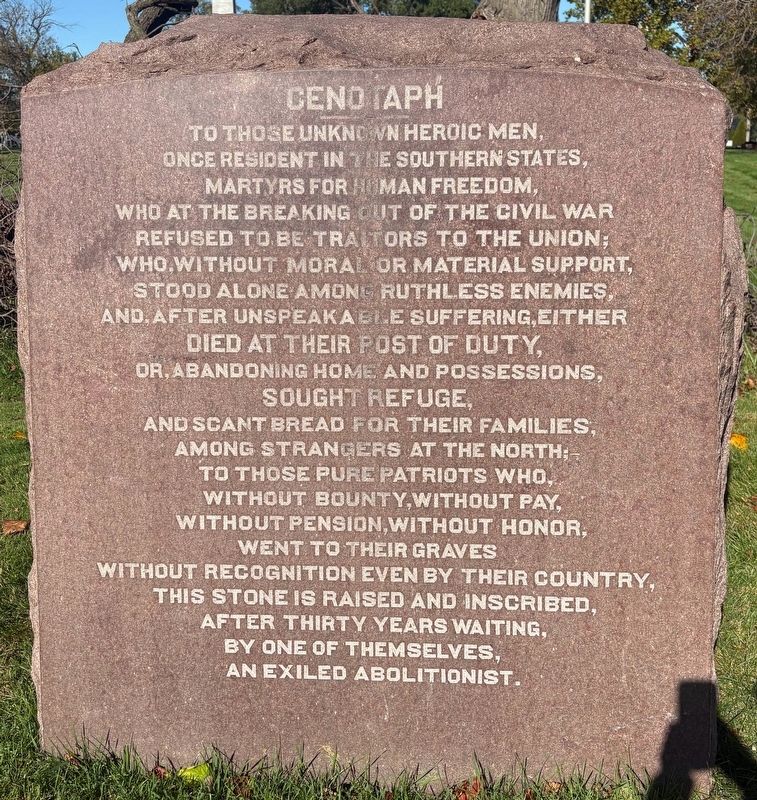
Memorial to Union Supporters from Southern States
Photographed by Sean P. Flynn, October 17, 2026
1. Memorial to Union Supporters from Southern States Marker
Erected 1896 by Thomas D. Lowther.
Topics. This memorial is listed in these topic lists: Cemeteries & Burial Sites • War, US Civil.
Location. 41° 46.01′ N, 87° 36.119′ W. Memorial is in Chicago, Illinois, in Cook County. It is in Greater Grand Crossing. It is on Magnolia Road half a mile south of East 67th Street, on the right when traveling west. The marker is just
this page online

Regionally, this memorial is on Chicago’s South Side. It is also in the American Midwest. Globally, it is in North America, on the Great Lakes, in the Western Hemisphere, in the Western World, and in the Anglosphere. Historically, it finds itself in what was once the Viceroyalty of New France, the territory of the Mississippian Culture, and the Northwest Territory.
Other nearby markers. At least 8 other markers are within walking distance of this marker: Confederate Mound Monument (within shouting distance of this marker); Confederate Mound (within shouting distance of this marker); The Confederate Dead at Oak Woods Cemetery (within shouting distance of this marker); Roland W. Burris, Esq. (approx. 0.3 miles away); Jesse Owens (approx. 0.3 miles away); Cold Storage Warehouse Fire Memorial (approx. 0.4 miles away); 9/11 Memorial (approx. 0.4 miles away); Relic of the Chicago Fire (approx. 0.4 miles away). Touch for a list and map
Photographed by Sean P. Flynn, October 17, 2026
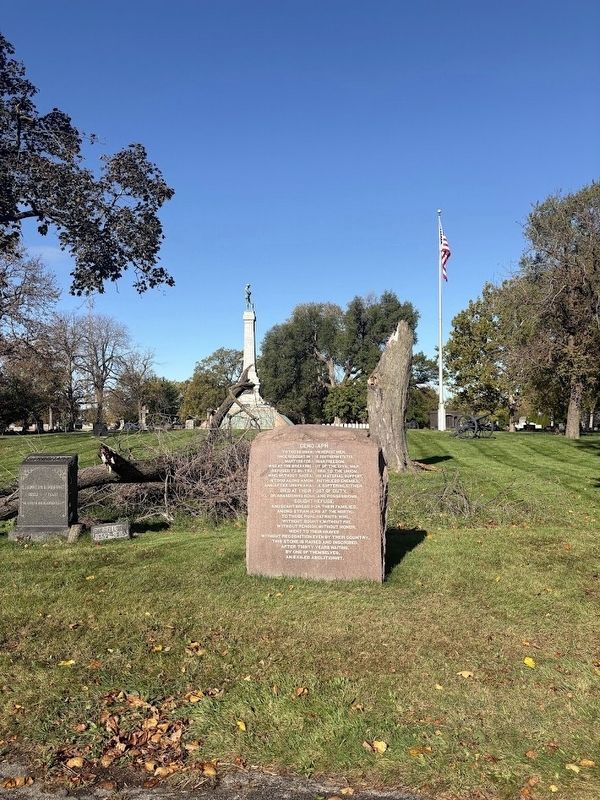
2. Memorial to Union Supporters from Southern States
The memorial is a short distance from the Confederate Mound, the burial site of roughly 4,000 Confederate POWs who died at Camp Douglas in Chicago.
Regarding Memorial to Union Supporters from Southern States. The nearby Confederate Mound Monument was erected in 1895 atop the mass burial site of roughly 4,000 unknown Confederate soldiers who died at Chicago's Camp Douglas prison. In opposition to what he believed to be that memorial's perpetuation of the "Lost Cause" myth, Thomas Lowther, an English-born abolitionist who spent much of life in Florida, Lowther erected this granite memorial a short distance to the southeast. Many sources refer to this memorial as the "Ugly Rock Cenotaph." Lowther died on the last day of 1903 at age 85 and is buried here at Oak Woods.
Also see . . . Monuments are for the Living: The Confederate Mound Monument and Falsehood of Reconciliation Statues. A 2022 academic paper by a student at Northern Illinois University includes a look at the "Ugly Rock Cenotaph," which was erected as a counterpoint to the massive Confederate Mound Monument nearby.
Excerpt: “Lowther’s main objective in erecting this monument was two fold: education of future generations and breaking up the Lost Cause narrative. He stated, ‘I know that in their schools and in other ways they are educating their children to look forward to a time when they shall lift again the banner of the ‘lost cause’. By allowing the erection of such a monument in Chicago was emboldening Southerners to perpetuate their Lost Cause mythos and assert their righteousness about the war. ‘The fact is, the Confederates have been treated so magnanimously by the North that they have come to assume the position that they were entirely right in the war, and that anything which can be construed into a criticism of their attitude is contemptible and unpatriotic.’”(Submitted on October 19, 2026, by Sean P. Flynn of Oak Park, Illinois.)
Additional keywords. Ugly Rock Cenotaph
Credits. This page was last revised on October 19, 2026. It was originally submitted on October 19, 2026, by Sean P. Flynn of Oak Park, Illinois. This page has been viewed 23 times since then. Photos: 1, 2. submitted on October 19, 2026, by Sean P. Flynn of Oak Park, Illinois.
