Hot Springs in Fall River County, South Dakota — The American Midwest (Upper Plains)
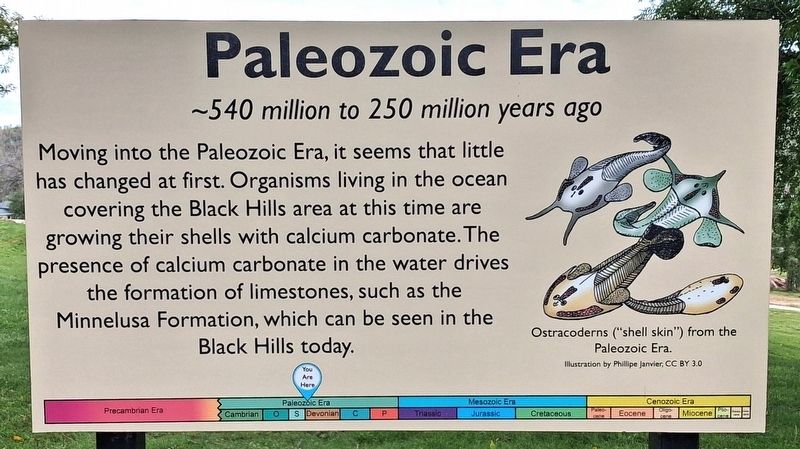
Paleozoic Era
~540 to 250 million years ago
Photographed by William Fischer, Jr., September 25, 2026
1. Paleozoic Era Marker
Moving into the Paleozoic Era, it seems that little has changed at first. Organisms living in the ocean covering the Black Hills area at this time are growing their shells with calcium carbonate. The presence of calcium carbonate in the water drives the formation of limestones, such as the Minnelusa Formation, which can be seen in the Black Hills today.
[Illustration caption reads]
Ostracoderns ("shell skin") from the Paleozoic Era.
Erected by The Mammoth Site of Hot Springs, Inc.
Topics. This historical marker is listed in these topic lists: Animals • Environment • Paleontology • Waterways & Vessels.
Location. 43° 25.462′ N, 103° 29.021′ W. Marker is in Hot Springs, South Dakota, in Fall River County. It can be reached from no nearby street. Marker is along the Mammoth Site entrance walkway. Touch for map. Marker is at or near this postal address: 1800 US Highway 18 Bypass, Hot Springs SD 57747, United States of America. Touch for directions.

Regionally, this marker is in West River. It is also in the American Black Hills, in the Lewis
this page online
Other nearby markers. At least 8 other markers are within walking distance of this marker: Precambrian Era (here, next to this marker); Paleozoic-Mesozoic Era (a few steps from this marker); Late Mesozoic Era (a few steps from this marker); Mid-Cenozoic Era (a few steps from this marker); Pleistocene Epoch (within shouting distance of this marker); Mammoth Site of Hot Springs, SD (about 500 feet away, measured in a direct line); Woodward Field (approx. 0.4 miles away); Black Hills College (approx. 0.4 miles away). Touch for a list and map of all markers in Hot Springs.
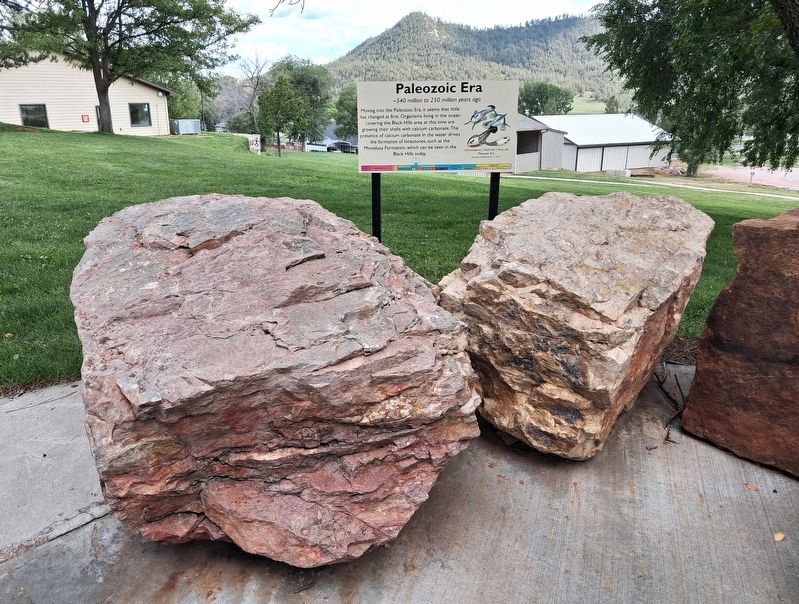
Regarding Paleozoic Era. Markers and rocks are part of the walk through Black Hills geology leading to the Mammoth Site.
Related markers. Click here for a list of markers that are related to this marker. Follow the markers chronologically through the geologic timeline
Photographed by William Fischer, Jr., September 25, 2026
2. Paleozoic Era Marker
Credits. This page was last revised on October 24, 2026. It was originally submitted on October 21, 2026, by William Fischer, Jr. of Reynoldsburg, Ohio. This page has been viewed 11 times since then. Photos: 1, 2. submitted on October 21, 2026, by William Fischer, Jr. of Reynoldsburg, Ohio.
