Liverpool Waterfront in Merseyside, England, United Kingdom — Northwestern Europe (the British Isles)
If These Stones Could Speak…
Photographed by Ian Lefkowitz, September 13, 2026
1. If These Stones Could Speak… Marker
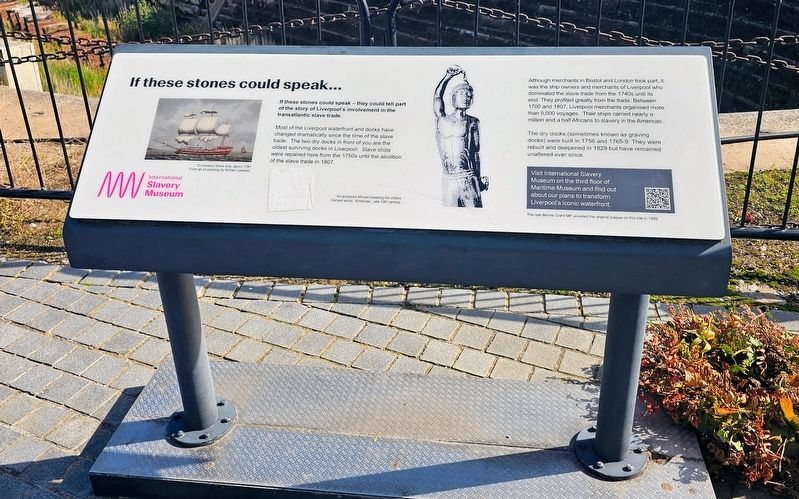
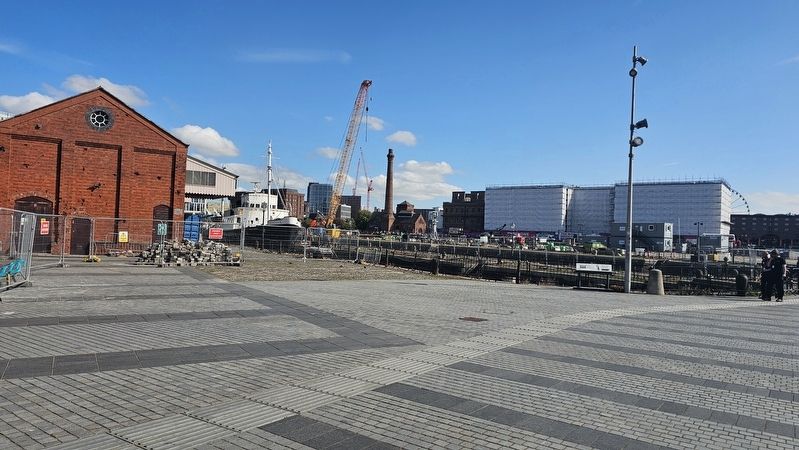
Most of the Liverpool waterfront and docks have changed dramatically since the time of the slave trade. The two dry docks in front of you are the oldest surviving docks in Liverpool. Slave ships were repaired here from the 1750s until the abolition of the slave trade in 1807.
Although merchants in Bristol and London took part, it was the ship owners and merchants of Liverpool who dominated the slave trade from the 1740s until its end. They profited greatly from the trade. Between 1700 and 1807, Liverpool merchants organised more than 5,000 voyages. Their ships carried nearly a million and a half Africans to slavery in the Americas.
The dry docks (sometimes known as graving docks) were built in 1756 and 1765–9. They were rebuilt and deepened in 1829 but have remained unaltered ever since.
Visit International Slavery Museum on the third floor of Maritime Museum and find out about our plans to transform Liverpool’s iconic waterfront.
The late Bernie Grant MP unveiled the original plaque on this site in 1999.
(Captions)
A Liverpool slave ship, about 1780. From an oil painting by William Jackson.
An enslaved African breaking his chains. Carved wood, American, late 19th century.
Erected by International
this page online
Topics. This historical marker is listed in these topic lists: African Americans • Civil Rights • Industry & Commerce • Waterways & Vessels. A significant historical year for this entry is 1807.
Location. 53° 24.165′ N, 2° 59.688′ W. Marker is in Liverpool, England, in Merseyside. It is in Liverpool Waterfront. It is on Mann Island south of Canada Boulevard, on the left when traveling south. Touch for map. Marker is at or near this postal address: 25 Mann Island, Liverpool, England L3 1BP, United Kingdom. Touch for directions.

Regionally, this marker is in North West England. Globally, it is on the Atlantic Ocean, in the North Atlantic Region, in Europe, in Atlantic Europe, on one of the British Isles, in the Western World, and in the Anglosphere. Historically, it finds itself in what was once the Roman Empire.
Other nearby markers. At least 8 other markers are within walking distance of this marker: Lusitania Propeller, 1909 (within shouting distance of this marker); Waiting (within shouting distance of this marker); Remember the Great Famine / Coinnigh Cuimhne ar an Gorta Mór (within
Photographed by Ian Lefkowitz, September 13, 2026
2. If These Stones Could Speak… Marker
In 2026, the Graving Docks and International Slavery Museum were closed for construction.
Another marker is no longer nearby. Sculpture of Billy Fury (1940–1983) (was about 150 meters away but has been confirmed missing).
Also see . . . Uncovering the history of the Canning Graving Docks (National Museums Liverpool).
For Liverpool merchants, of course, success was often at huge human cost: much of the mercantile trade involved the trade in enslaved African people, abducted in West African countries and forcibly transported across the Atlantic. Through the 18th century around 200 merchants controlled this trade in Liverpool, and a further 1400 invested in them or were employed through them. A wider network of mercantile activity was built on slavery and the products of the work of enslaved people. Liverpool’s economy was so intricately linked to slavery that in 1806 it was described as ‘The metropolis of slavery’. The first graving dock in Liverpool - which now no longer exists - was built in 1718 and was overseen by Richard Norris who was a slave trader.(Submitted on October 21, 2026, by Ian Lefkowitz of New York, New York.)
Credits. This page was last revised on October 24, 2026. It was originally submitted on October 21, 2026, by Ian Lefkowitz of New York, New York. This page has been viewed 6 times since then. Photos: 1, 2. submitted on October 21, 2026, by Ian Lefkowitz of New York, New York. • Andrew Ruppenstein was the editor who published this page.
