Wabash Township near West Lafayette in Tippecanoe County, Indiana — The American Midwest (Great Lakes)
Native American Living Village
Photographed by Craig Doda, September 13, 2026
1. Native American Living Village Marker
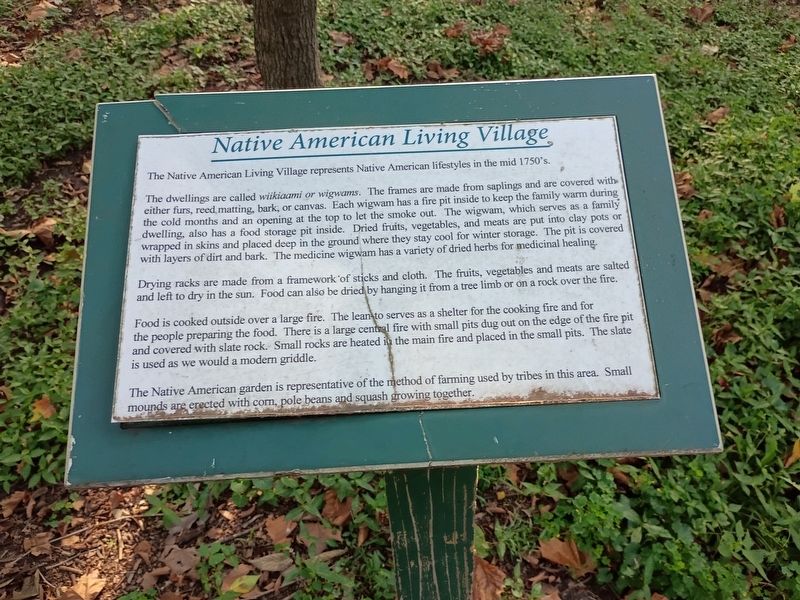
The dwellings are called wiikiaami or wigwams. The frames are made from saplings and are covered with either furs, reed matting, bark, or canvas. Each wigwam has a fire pit inside to keep the family warm during the cold months and an opening at the top to let the smoke out. The wigwam, which serves as a family dwelling, also has a food storage pit inside. Dried fruits, vegetables, and meats are put into clay pots or wrapped in skins and placed deep in the ground where they stay cool for winter storage. The pit is covered with layers of dirt and bark. The medicine wigwam has a variety of dried herbs for medicinal healing.
Drying racks are made from a framework of sticks and cloth. The fruits, vegetables and meats are salted and left to dry in the sun. Food can also be dried by hanging it from a tree limb or on a rock over the fire.
Food is cooked outside over a large fire. The lean-to serves as a shelter for the cooking fire and for the people preparing the food. There is a large central fire with small pits dug out on the
this page online
The Native American garden is representative of the method of farming used by tribes in this area. Small mounds are erected with corn, pole beans and squash growing together.
Topics. This historical marker is listed in these topic lists: Agriculture • Architecture • Indigenous Peoples and Communities • Settlements & Settlers.
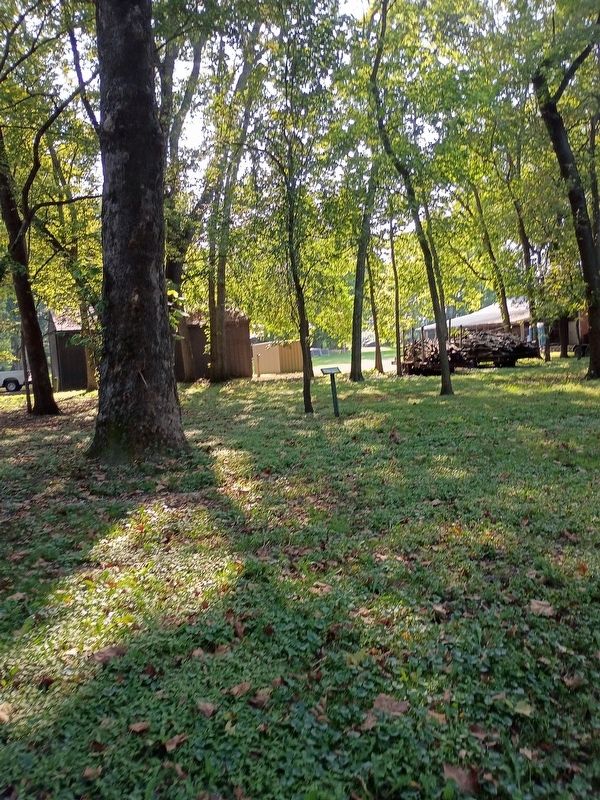
Location. 40° 24.343′ N, 86° 57.744′ W. Marker is near West Lafayette, Indiana, in Tippecanoe County. It is in Wabash Township. It is at the intersection of South River Road and South Newman Road, on the right when traveling east on South River Road. Touch for map. Marker is at or near this postal address: 2971 S River Rd, West Lafayette IN 47906, United States of America. Touch for directions.

Regionally, this marker is in Central Indiana. It is also in the American Midwest and in the Corn Belt. Globally, it is in North America, the Western Hemisphere, the Western World,
Photographed by Craig Doda, September 13, 2026
2. Native American Living Village Marker
Other nearby markers. At least 8 other markers are within walking distance of this marker: Liberty Tree (within shouting distance of this marker); Shelter House (within shouting distance of this marker); Blacksmith History at Ouiatenon (about 300 feet away, measured in a direct line); Bread Baking Oven (about 300 feet away); Le Jardin des Herbes (about 300 feet away); Madame Godare's Flag (about 400 feet away); Fort Ouiatenon (about 400 feet away); Anthony Wayne's Flag (about 400 feet away). Touch for a list and map of all markers in West Lafayette.
Credits. This page was last revised on November 3, 2026. It was originally submitted on October 22, 2026, by Craig Doda of Napoleon, Ohio. This page has been viewed 6 times since then. Photos: 1, 2. submitted on October 22, 2026, by Craig Doda of Napoleon, Ohio. • Devry Becker Jones was the editor who published this page.
