Westchester Township near Porter in Porter County, Indiana — The American Midwest (Great Lakes)
Bess Sheehan
1882-1968
Photographed by Daniel Barriball, October 23, 2026
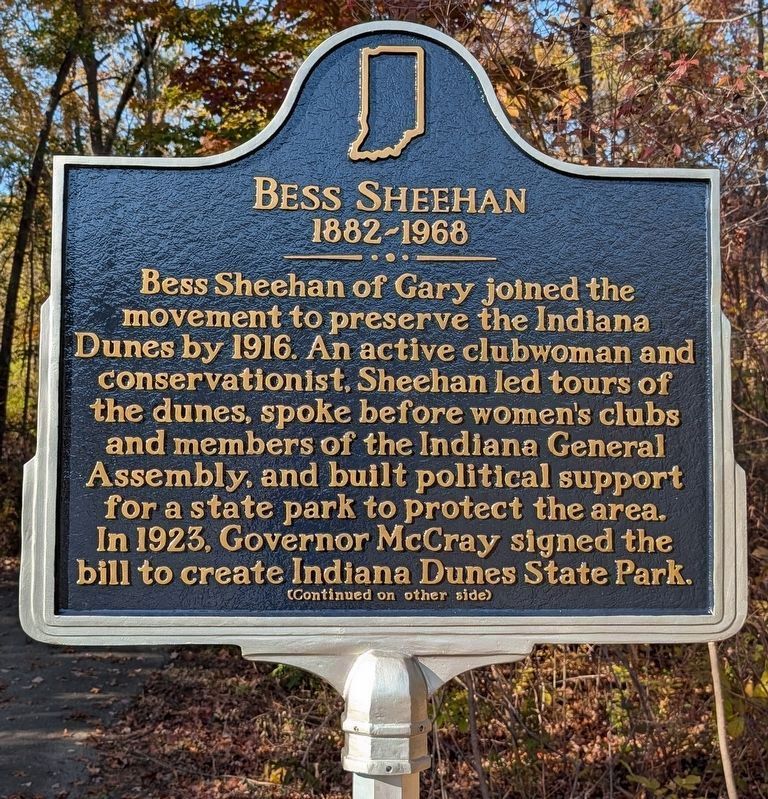
1. Bess Sheehan Marker, Side One
Bess Sheehan of Gary joined the movement to preserve the Indiana Dunes by 1916. An active clubwoman and conservationist, Sheehan led tours of the dunes, spoke before women's clubs and members of the Indiana General Assembly, and built political support for a state park to protect the area. In 1923, Governor McCray signed the bill to create Indiana Dunes State Park.
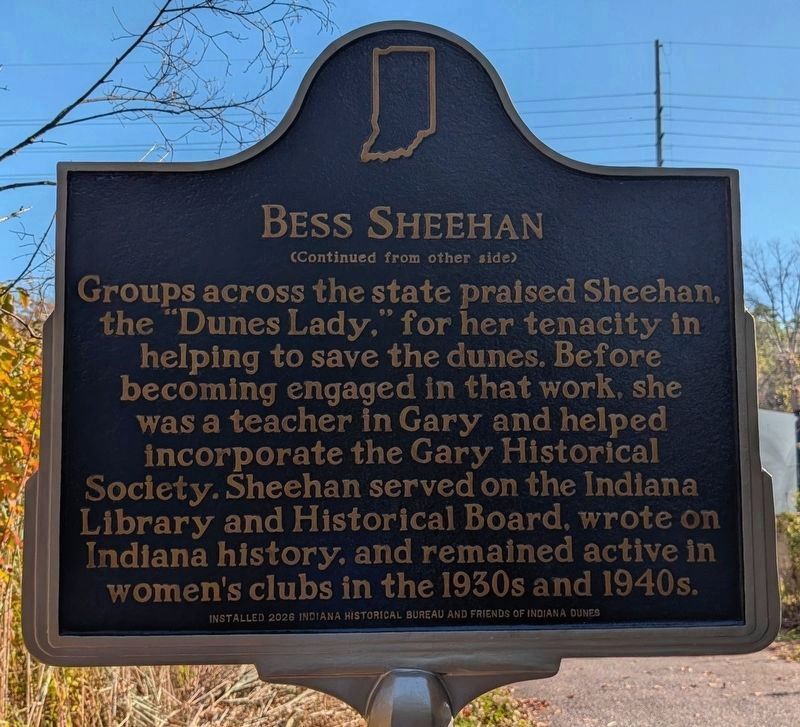
Groups across the state praised Sheehan, the "Dunes Lady,” for her tenacity in helping to save the dunes. Before becoming engaged in that work, she was a teacher in Gary and helped incorporate the Gary Historical Society. Sheehan served on the Indiana Library and Historical Board, wrote on Indiana history, and remained active in women's clubs in the 1930s and 1940s.
Erected 2026 by Indiana Historical Bureau, Friends of Indiana Dunes. (Marker Number 64.2026.1.)
Topics and series. This historical marker is listed in these topic lists: Charity & Public Work • Parks & Recreational Areas • Women. In addition, it is included in the Indiana Historical Bureau Markers series list. A significant historical year for this entry is 1916.
Location. 41° 38.708′ N, 87° 3.72′ W.
this page online

Regionally, this marker is in Northwest Indiana, specifically on the Indiana Dunes and Lake Michigan Shore, and in the Calumet Region. It is also in the American Midwest and in the Corn Belt. Globally, it is in North America, on the Great Lakes, in the Western Hemisphere, in the Western World, and in the Anglosphere. Historically, it finds itself in what was once the territory of the Mississippian Culture and also the Northwest Territory.
Other nearby markers. At least 8 other markers are within one mile of this marker, measured as the crow flies: History of the Dunes (a few steps from this marker); Dunes Hi-Way (approx. 0.2 miles away); Indiana State Police Dunes Park Post #1
Photographed by Daniel Barriball, October 23, 2026
2. Bess Sheehan Marker, Side Two
Regarding Bess Sheehan.
Bess May Vrooman was born near Jackson, Michigan, on April 16, 1882. She was raised in Dowagiac, Michigan. After graduating from high school, she earned a bachelor's degree in history at the University of Michigan. She won a scholarship from the Colonial Dames to study for her master's degree, which she completed in 1905. She taught for two years at the high school in Big Rapids, Michigan. In 1908, she moved to the new "Magic City," Gary, Indiana, to teach history at the Gary High School.
In 1912, she married lawyer Frank Sheehan, a fellow University of Michigan alumnus. At that time, a married woman was not allowed to teach, so she had to leave Gary High School. She began participating in women's clubs. She became involved in the Pioneer
Photographed by Daniel Barriball, October 23, 2026
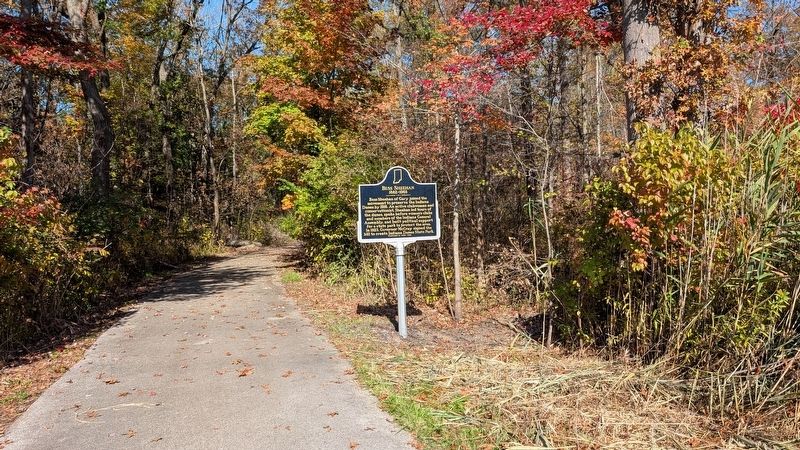
3. Bess Sheehan Marker in context
This photo was shot looking north along the Dunes Kankakee Trail.
At this time, many of residents of Chicago and of the Indiana Dunes country were working for the creation of a park in the Indiana Dunes. In 1916, many of these locals formed the National Dunes Park Association. Bess Sheehan was named the first secretary of the NDPA, a position she would hold for decades. All of these advocates worked together to try to get a national park established in the Indiana Dunes. In September 1916, they convinced Senator Thomas Taggert to introduce a resolution to require the brand-new National Park Service to write a report on the feasibility of creating a Sand Dunes National Park in Indiana. The resolution passed. Mather's report was released in December, and was favorable to a national
Public Domain, circa 1920
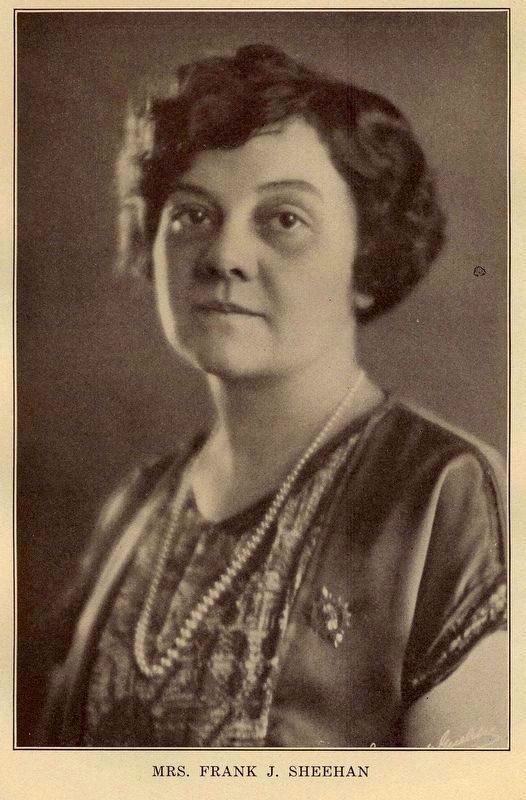
4. Bess Sheehan, ca. 1920
Over the next couple of years, park advocates realized that there was not enough support to get Congress to pass a bill creating a national park. Efforts turned to creating a state park. Bess Sheehan was a rising star in the women's club movement in Indiana. She was named the chair of the Dunes Park committee of the Indiana Federation of Clubs, a statewide organization of many local women's clubs. In that capacity, she crisscrossed the state for several years, speaking to women's clubs and anyone else who would listen about the urgent need to preserve the Indiana Dunes before development destroyed them. She built political support among Indiana women for a Dunes park.
Richard Lieber, the father of Indiana State Parks, had been a supporter of a Sand Dunes National Park, but once that effort faltered, he began working for a Dunes state park. He began lobbying legislators and the business community to establish a state park in the Indiana Dunes.
Dunes advocates tried to get a Dunes park bill passed through the Indiana General Assembly in its 1921 session but were unable to get a bill introduced. In the 1920s, the General Assembly met every other year. Sheehan, Lieber, and others began laying the groundwork for the 1923 session. When that session opened, Bess Sheehan went to Indianapolis and stayed there for five weeks to work for passage of a state park bill. A Hammond legislator introduced a bill to create Indiana Dunes State Park. Sheehan and Lieber lobbied for passage. The women of the Seventh District of the Indiana Federation of Clubs arranged for Sheehan to speak to the members of the General Assembly on the evening of January 29, 1923, in the House chamber of the Indiana Statehouse. She spoke for two hours and impressed upon the legislators the urgent need to preserve the Indiana Dunes before they were gone. In the remaining weeks of the session, Lieber and Sheehan worked to convince reluctant legislators to vote for the bill. In early March the Indiana General Assembly passed the Dunes park bill after it squeaked by in the Indiana House. Governor Warren McCray signed the bill to create Indiana Dunes State Park on March 6, 1923. He gave the pen he used to sign the bill to Bess Sheehan in recognition of her work to get the bill passed. Sheehan was ever after known as the Dunes Lady.
Shortly after the bill passed, Sheehan wrote to her friend and fellow conservationist Catherine Mitchell, "The people here all gave up the struggle; seemed I was the only one who stuck. Had I known how discouraged the others were I guess I would have given up too. I only began to sense it about the time I began to dare to hope for success and that was the eleventh hour… So we were very lucky. Providence surely saw us through an almost impossible situation."
It was one thing to get the bill passed and another thing to get the land purchased. Sheehan worked to get the purchasing process started, at one point giving Indiana's governor a tour of the dunes. Land acquisition began in 1925 and Indiana Dunes State Park opened to the public in 1926.
In 1925, Sheehan was elected as the president of the Indiana Federation of Clubs. During her two-year term, Sheehan worked for improvements in education and for the establishment and improvement of libraries. Toward the end of her term, Sheehan wrote to the Indianapolis Star, saying, "Membership in a local club gives us the opportunity to work for community betterment…With invisible voice the womanhood of the world is calling upon us for service. Have you answered that call? If you have not, then come join the woman’s army."
Also in 1925, Indiana Governor Edward Jackson appointed Sheehan to the Indiana Library and Historical Board. During her service on the board, the Indiana State Library was built. In 1930, she was elected president of the board.
In 1928, Sheehan wrote "The Northern Boundary of Indiana." She documented how the border of Indiana was pushed north by 10 miles when Indiana became a state so that some of the shoreline of Lake Michigan would be within Indiana. It was published by the Indiana Historical Society.
As World War II was ending in 1945, the state of Indiana proposed giving the federal government part of Indiana Dunes State Park for a veteran's hospital. Sheehan assailed the proposal, "Utterly ridiculous and dangerous, certainly!" She said, "If we start giving away land out of any of our parks, we shall have set a most dangerous precedent." The federal government did not take Indiana up on its offer and the hospital was never built.
Postwar development pressure again threatened the remaining Indiana dunes that were outside the state park. Dorothy Buell founded the Save the Dunes Council to fight for protection of the remaining dunes. Sheehan spoke with the group about her struggle to establish the state park 30 years earlier. She joined the new organization's advisory council. In 1953, 56 acres of Cowles Bog went up for auction in a tax sale. Save the Dunes determined to buy it. Sheehan took the remaining funds of the National Dunes Park Association and gave it to Save the Dunes. Those funds made up about half of the purchase price of the land. This was the first parcel of land saved for what became Indiana Dunes National Park.
In 1956, the Sheehans moved to Florida in order to be closer to family. Bess Sheehan died in Winter Park, Florida on April 24, 1968.
Also see . . .
1. Bess Sheehan. Indiana Dunes National Park Official website
Dunes are not dumb-bells. They are intensely human. They organize, mobilize, get together, decide to move, and overnight are gone. Those changing, shifting, restless, age-old, ever-new, exotic possessions of Hoosierland that lie away up along the southern shores of Lake Michigan, in Porter, Lake, and Laporte counties, soon pass away before the rising tide of industrialism unless the state of Indiana gets busy immediately and creates a state dunes park…(Submitted on October 23, 2026, by Daniel Barriball of Chesterton, Indiana.)
We had to give up the national park idea because of the necessity of immediate action so we turned to the state… Now is the time to act. Later will be too late.
2. The Northern Boundary of Indiana. Internet Archive This work was written by Bess Sheehan and published by the Indiana Historical Society.
Fortunate, indeed, was Indiana, that our forefathers were far-sighted enough to secure for us approximately forty-one miles of frontage on beautiful Lake Michigan and provide space within her confines for this great industrial center. Fortunate, indeed, is Indiana, that the present generation has been far-sighted enough to establish the Indiana Dunes Park, thus preserving three miles of this lake frontage and there establishing one of the most inspiring playgrounds in the world for the use and enjoyment of her citizens throughout all the generations that are to come.(Submitted on October 23, 2026, by Daniel Barriball of Chesterton, Indiana.)
Credits. This page was last revised on November 3, 2026. It was originally submitted on October 23, 2026, by Daniel Barriball of Chesterton, Indiana. This page has been viewed 19 times since then. Photos: 1, 2, 3, 4. submitted on October 23, 2026, by Daniel Barriball of Chesterton, Indiana. • Devry Becker Jones was the editor who published this page.
