Sheridan Hollow in Albany in Albany County, New York — The American Northeast (Mid-Atlantic)
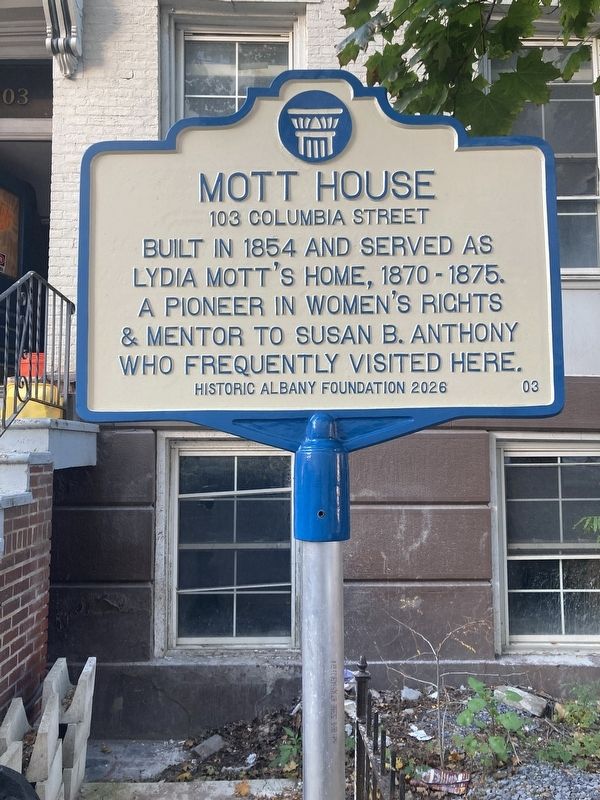
Mott House
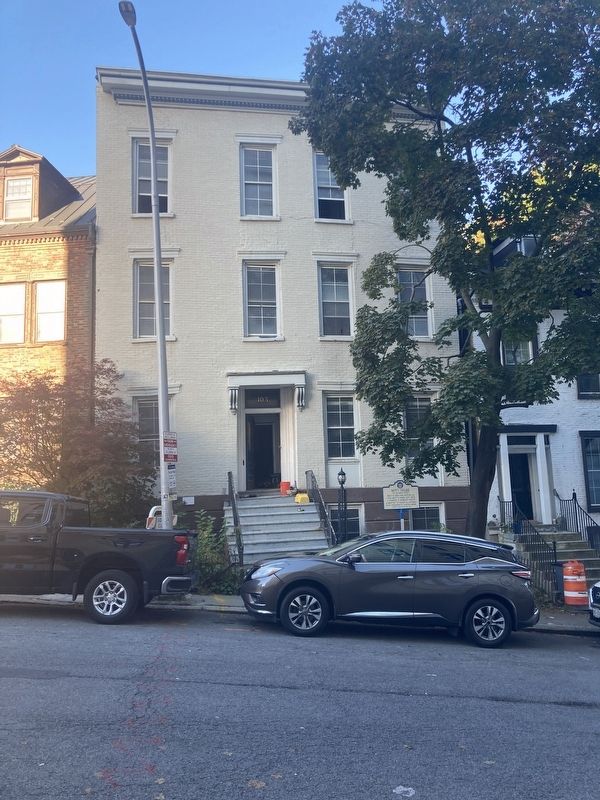
103 Columbia Street
| — | 🏛️ | — |
Photographed by Thomas Johnston, October 15, 2026
1. Mott House Marker
Built in 1854 and served as Lydia Mott’s home, 1870-1875. A pioneer in women’s rights & mentor to Susan B. Anthony who frequently visited here.
Erected 2026 by Historic Albany Foundation. (Marker Number 03.)
Topics and series. This historical marker is listed in these topic lists: Civil Rights • Women. In addition, it is included in the Historic Albany Foundation series list. A significant historical year for this entry is 1870.
Location. 42° 39.175′ N, 73° 45.2′ W. Marker is in Albany, New York, in Albany County. It is in Sheridan Hollow. It is on Columbia Street east of Eagle Street, on the right when traveling west. Touch for map. Marker is at or near this postal address: 103 Columbia Street, Albany NY 12207, United States of America. Touch for directions.

Regionally, this marker is in Upstate New York and in the Capital District. It is also in the American Northeast and in the Mid-Atlantic. Globally, it is in North America, the Western Hemisphere, the Western World, and the Anglosphere. Historically, it finds itself in what was once New Netherland and also one of the original Thirteen Colonies.
this page online
Other nearby markers. At least 8 other markers are within walking distance of this marker: Site of 1 Elk St. (within shouting distance of this marker); Court of Appeals (about 400 feet away, measured in a direct line); Joseph Henry (about 400 feet away); Kilian Van Rensselaer (about 500 feet away); 1624-1924 (about 500 feet away); Academy Park (about 600 feet away); Revolutionary Soldiers Memorial (about 600 feet away); City Hall Carillon (about 600 feet away). Touch for a list and map of all markers in Albany.
Regarding Mott House. Lydia Mott (1806–1875) was a Quaker abolitionist, women's rights advocate, and an important organizer of reform activities in Albany. She was also a businesswoman, operating a shop that sold men's clothing and accessories, first on Broadway and later on Maiden Lane. She subsequently operated a boardinghouse.
Mott played an active role in the Underground Railroad and the Albany Vigilance Committee, which assisted people escaping slavery. In 1858, she served as a vice-president of the American Anti-Slavery Society. Her Albany home welcomed abolitionists and women's rights advocates, including William
Photographed by Thomas Johnston, October 15, 2026
2. Mott House Marker
Mott's friendship with Anthony was especially close. In 1874, she gave Anthony a copy of Harriet Beecher Stowe's Uncle Tom's Cabin, originally presented to Mott in 1853 by William H. Topp, a prominent Black Albany tailor and abolitionist. The volume, now in the Library of Congress, contains Anthony's handwritten recollections of the Mott household as a gathering place for abolitionists and women's rights advocates visiting Albany.
Another important colleague was Phebe Hoag Jones, an abolitionist and women's rights organizer who lived nearby at 87 Columbia Street. Together, Jones and Mott helped support reform efforts directed toward the New York State Legislature.
Mott died of tuberculosis on August 20, 1875, at her Columbia Street home, where Anthony had come to care for her during her final illness. She is buried in the Quaker section of Albany Rural Cemetery.
Sources
Albany Rural Cemetery Explorer. Lydia Mott (1806–1875).
Albany Rural Cemetery Explorer. Phebe Hoag Jones (1812–1881).
Library of Congress. The Library of Susan B. Anthony: Annotated Bibliography. See the entry for Harriet Beecher Stowe's Uncle Tom's Cabin.
Credits. This page was last revised on October 25, 2026. It was originally submitted on October 15, 2026, by Thomas Johnston of Kenmore, New York. This page has been viewed 44 times since then. Last updated on October 24, 2026, by Trudi Jacobson of Slingerlands, New York. Photos: 1, 2. submitted on October 15, 2026, by Thomas Johnston of Kenmore, New York. • Devry Becker Jones was the editor who published this page.
