The National Mall in Southwest Washington in Washington, District of Columbia — The American Northeast (Mid-Atlantic)
Farmers on the Front Lines
Protecting America's Food from Pest, Weeds, and Disease
| — | Voice of the Farmer Garden at the U.S. Department of Agriculture | — |
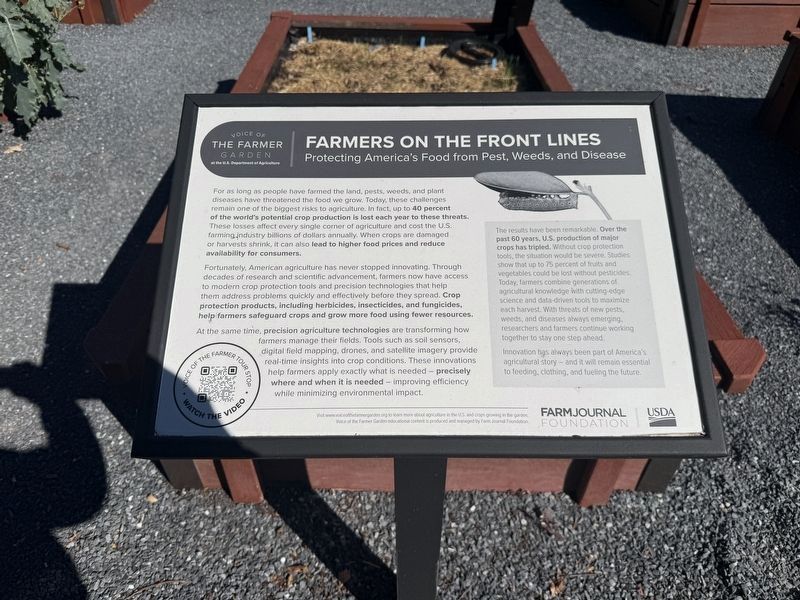
For as long as people have farmed the land, pests, weeds, and plant diseases have threatened the food we grow. Today, these challenges remain one of the biggest risks to agriculture. In fact, up to 40 percent of the world's potential crop production is lost each year to these threats. These losses affect every single corner of agriculture and cost the U.S. farming industry billions of dollars annually. When crops are damaged or harvests shrink, it can also lead to higher food prices and reduce availability for consumers.
Fortunately, American agriculture has never stopped innovating. Through decades of research and scientific advancement , farmers now have access to modern crop protection tools and precision technologies that help them address problems quickly and effectively before they spread. Crop protection products, including herbicides, insecticides, and fungicides, help farmers safeguard crops and grow more food using fewer resources.
At the same time, precision agriculture technologies are transforming how farmers managed their fields. Tools such as soil sensors, digital field mapping, drones, and satellite
this page online
[Sidebar:]
The results have been remarkable. Over the past 60 years, U.S. production of major crops has tripled. Without crop protection tools, the situation would be severe. Studies show that up to 75 percent of fruits and vegetables could be lost without pesticides. Today, farmers combine generations of agricultural knowledge with cutting-edge science and data-driven tools to maximize each harvest. With threats of new pests, weeks, and diseases always emerging, researchers and farmers continue working together to stay one step ahead.
Innovation has always been part of America's agricultural story - and it will remain essential to feeding, clothing, and fueling the future.
Visit www.voiceofthefarmergarden.org to learn more about agriciculture here in the U.S. and crops growing in the garden. Voice of the Farmer Garden educational content is produced and managed by Farm Journal Foundation.
Erected by Farm
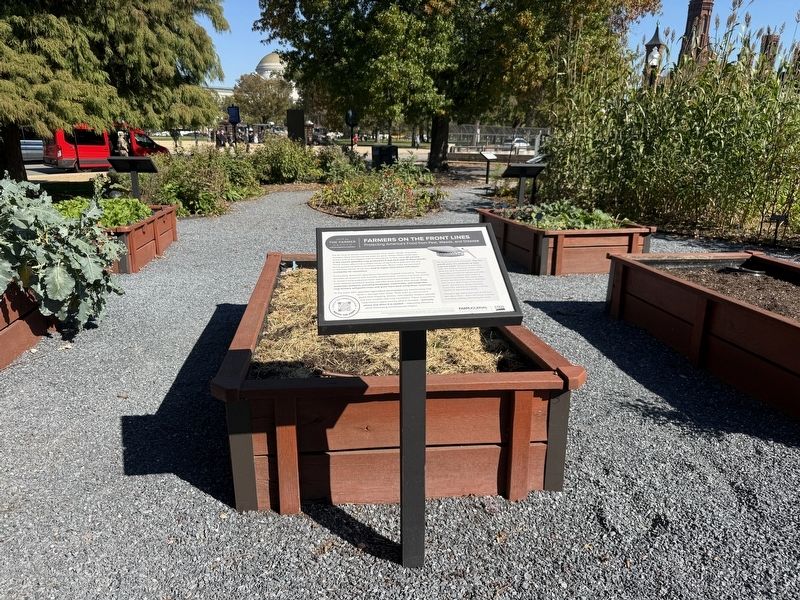
Topics. This historical marker is listed in these topic lists: Agriculture • Food & Drink • Science & Medicine.
Location. 38° 53.301′ N, 77° 1.71′ W. Marker is in Southwest Washington in Washington, District of Columbia. It is in The National Mall. It can be reached from the intersection of Jefferson Drive Southwest and 12th Street Southwest, on the right when traveling east. Touch for map. Marker is at or near this postal address: 1203 Jefferson Dr SW, Washington DC 20003, United States of America. Touch for directions.

Regionally, this marker is in the Washington Metropolitan Area. It is also in the American Northeast, in the Upper South, in the Mid-Atlantic, in the Tidewater, and in the Chesapeake Bay Region. Globally, it is in North America, the Western Hemisphere, the Western World, and the Anglosphere.
Other nearby markers. At least 8 other markers are within walking distance of this marker: Livestock, Dairy, and Poultry (a few steps from this marker); Federal Grain Inspection Service (a few steps from this marker); Bald Cypress (a few steps from this marker); USDA Holocaust Memorial Tree (a few steps from this marker); Dr. Martin Luther King, Jr. Memorial Tree (within shouting distance of this marker); Bradford Pear Tree (within shouting distance of this marker); USDA Veterans Memorial (within shouting distance of this marker); Steven Thomas Stefani IV (about 300 feet away, measured in a direct line). Touch for a list and map of all markers in Southwest Washington.
Other markers no longer nearby. Growing in the Garden (was here, next to this marker but has been permanently removed); Virginia Peanuts (was here, next to this marker but has been permanently removed); a different marker also named Growing in the Garden (was a few steps from this marker but has been permanently removed); Sunflowers (was a few steps from this marker but has been permanently removed); Welcome to the People's Garden (was a few steps from this marker but has been replaced with another marker now near it); Stewardship of Natural Resources (was a few steps from this marker but has been permanently removed).
Credits. This page was last revised on October 26, 2026. It was originally submitted on October 26, 2026, by Devry Becker Jones of Washington, District of Columbia. This page has been viewed 2 times since then. Photos: 1, 2. submitted on October 26, 2026, by Devry Becker Jones of Washington, District of Columbia.
