Chorlton-on-Medlock in Manchester in Greater Manchester, England, United Kingdom — Northwestern Europe (the British Isles)
Coupland Building 3
Photographed by Ian Lefkowitz, September 14, 2026
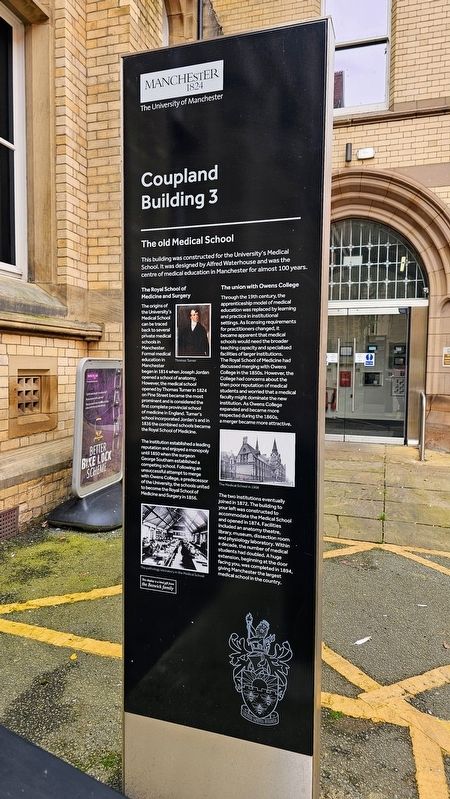
1. Coupland Building 3 Marker, Side One
The Old Medical School
This building was constructed for the University’s Medical School. It was designed by Alfred Waterhouse and was the centre of medical education in Manchester for almost 100 years.
The Royal School of Medicine and Surgery
The origins of the University’s Medical School can be traced back to several private medical schools in Manchester. Formal medical education in Manchester began in 1814 when Joseph Jordan opened a school of anatomy. However, the medical school opened by Thomas Turner in 1824 on Pine Street became the most prominent and is considered the first complete provincial school of medicine in England. Turner’s school incorporated Jordan’s and in 1836 the combined schools became the Royal School of Medicine.
The institution established a leading reputation and enjoyed a monopoly until 1850 when the surgeon George Southam established a competing school. Following an unsuccessful attempt to merge with Owens College, a predecessor of the University, the schools united to become the Royal School of Medicine and Surgery in 1856.
The Union with Owens College
Through the 19th century, the apprenticeship model of medical education was replaced by learning and practice in institutional settings. As licensing requirements for practitioners changed, it became apparent that medical schools would need the broader teaching capacity and specialised facilities of larger institutions. The Royal School of Medicine had discussed merging with Owens College in the 1850s. However, the College had concerns about the then poor reputation of medical students and worried that a medical faculty might dominate the new institution. As Owens College expanded and became more respected during the 1860s, a merger became more attractive.
The two institutions eventually joined in 1872. The building to your left
this page online
(Captions)
Thomas Turner
The pathology laboratory in the Medical School
The Medical School in 1908
(side two)
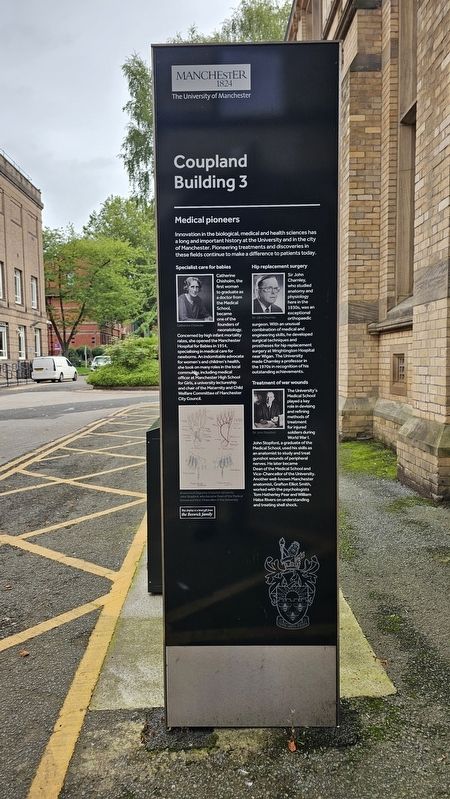
Medical Pioneers
Innovation in the biological, medical and health sciences has a long and important history at the University and in the city of Manchester. Pioneering treatments and discoveries in these fields continue to make a difference to patients today.
Specialist care for babies
Catherine Chisholm, the first woman to graduate as a doctor from the Medical School, became one of the founders of neonatology. Concerned by high infant mortality rates, she opened the Manchester Hospital for Babies in 1914, specialising in medical care for newborns. An indomitable advocate for women’s and children’s health, she took on many roles in the local community, including medical officer
Photographed by Ian Lefkowitz, September 14, 2026
2. Coupland Building 3 Marker, Side Two
Hip replacement surgery
Sir John Charnley, who studied anatomy and physiology here in the 1930s, was an exceptional orthopaedic surgeon. With an unusual combination of medical and engineering skills, he developed surgical techniques and prostheses for hip replacement surgery at Wrightington Hospital near Wigan. The University made Charnley a professor in the 1970s in recognition of his outstanding achievements.
Treatment of war wounds
The University’s Medical School played a key role in devising and refining methods of treatment for injured soldiers during World War I. John Stopford, a graduate of the Medical School, used his skills as an anatomist to study and treat gunshot wounds of peripheral nerves. He later became Dean of the Medical School and Vice-Chancellor of the University. Another well-known Manchester anatomist, Grafton Elliot Smith, worked with the psychologists Tom Hatherley Pear and William Halse Rivers on understanding and treating shell shock.
(Captions)
Catherine Chisholm
Sir John Charnley
Sir John Stopford
Anatomical diagrams of plantar nerves by John Stopford, who became Dean of the Medical School and Vice-Chancellor of the University
Erected by The University of Manchester.
Topics. This historical marker is listed in these topic lists: Education • Science & Medicine • War, World I • Women. A significant historical year for this entry is 1874.
Location. 53° 27.927′ N, 2° 14.152′ W. Marker is in Manchester, England, in Greater Manchester. It is in Chorlton-on-Medlock. It is at the intersection of Coupland Street and Higher Chatham Street, on the left when traveling west on Coupland Street. Touch for map. Marker is at or near this postal address: 1750
Photographed by Ian Lefkowitz, September 14, 2026
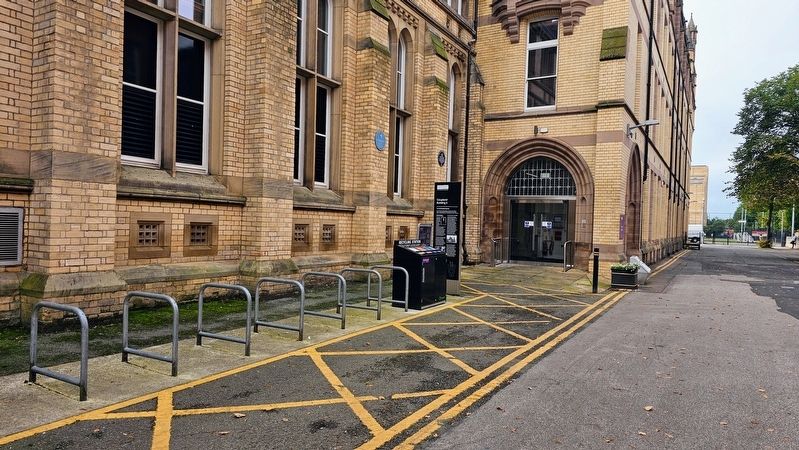
3. Coupland Building 3 Marker
The interpretive marker is found near the entrance to Coupland Building 3, along with two plaques.

Regionally, this marker is in North West England. Globally, it is on the Atlantic Ocean, in the North Atlantic Region, in Europe, in Atlantic Europe, on one of the British Isles, in the Western World, and in the Anglosphere. Historically, it finds itself in what was once the Roman Empire.
Other nearby markers. At least 8 other markers are within walking distance of this marker: Peter Mark Roget (here, next to this marker); A.V. Hill (here, next to this marker); Sir Lawrence Bragg (within shouting distance of this marker); Coupland Building 1 (within shouting distance of this marker); Alan Mathison Turing (within shouting distance of this marker); Ernest Rutherford (about 90 meters away, measured in a direct line); The Rutherford Building (about 90 meters away); The University of Manchester World War II Memorial (about 90 meters away). Touch for a list and map of all markers in Manchester.
Photographed by Ian Lefkowitz, September 14, 2026
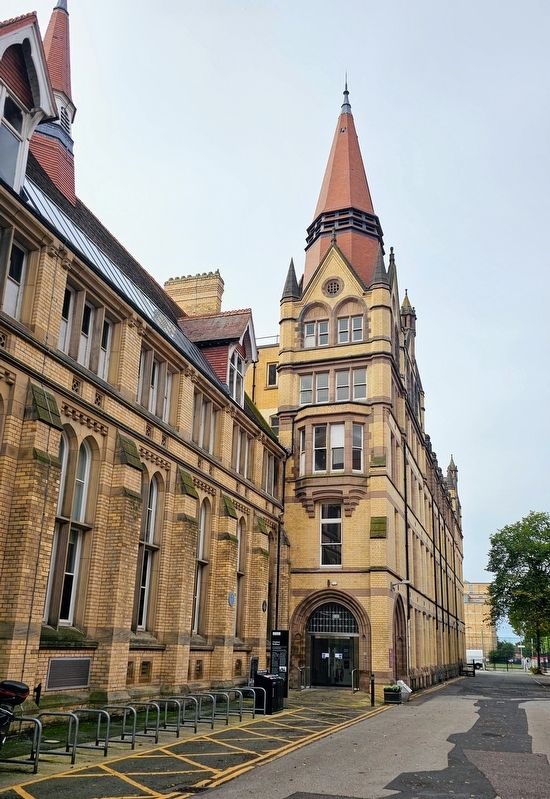
4. Coupland Building 3
Coupland Building 3, constructed in 1874, and expanded in 1894.
Credits. This page was last revised on October 28, 2026. It was originally submitted on October 27, 2026, by Ian Lefkowitz of New York, New York. This page has been viewed 7 times since then. Photos: 1, 2, 3, 4. submitted on October 27, 2026, by Ian Lefkowitz of New York, New York. • Andrew Ruppenstein was the editor who published this page.
