Minatare in Scotts Bluff County, Nebraska — The American Midwest (Upper Plains)
Minatare
Photographed by Cosmos Mariner, August 13, 2023
1. Minatare Marker
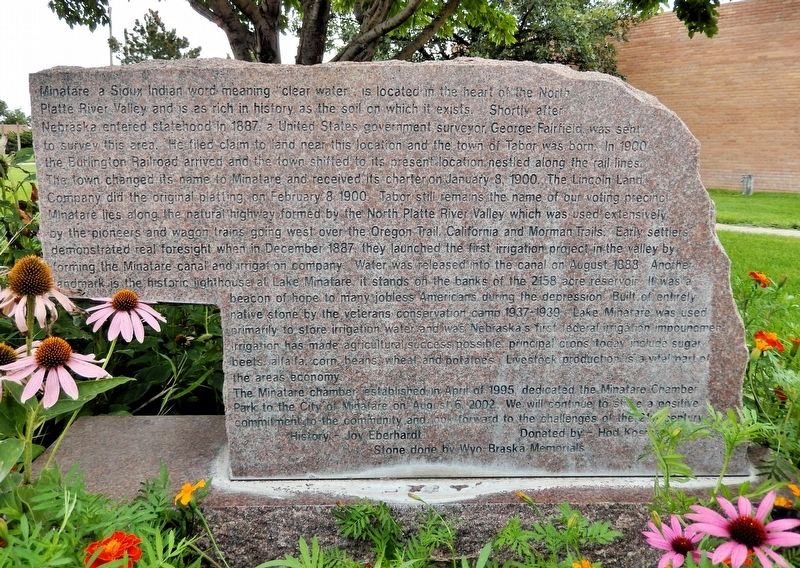
Minatare, a Sioux Indian word meaning “clear water”, is located in the heart of the North Platte River Valley and is as rich in history as the soil on which it exists. Shortly after Nebraska entered statehood in 1887, a United States government surveyor, George Fairfield, was sent to survey this area. He filed claim to land near this location and the town of Tabor was born. In 1900 the Burlington Railroad arrived and the town shifted to its present location nestled along the rail lines. The town changed its name to Minatare and received its charter on January 8, 1900. The Lincoln Land Company did the original platting on February 8, 1900. Tabor still remains the name of our voting precinct. Minatare lies along the natural highway formed by the North Platte River Valley which was used extensively by the pioneers and wagon trains going west over the Oregon Trail, California and Morman Trails. Early settlers demonstrated real foresight when in December 1887 they launched the first irrigation project in the valley by forming the Minatare canal and irrigation company. Water was released into the canal on August 1888. Another
this page online
The Minatare chamber established in April of 1995, dedicated the Minatare Chamber Park to the City of Minatare on August 6, 2002. We will continue to strive a positive commitment to the community and look forward to the challenges of the 21st century.
History — Joy Eberhardt Donated by Hod Kosman Stone done by Wyo-Braska Memorials
Topics and series. This historical marker is listed in these topic lists: Agriculture • Railroads & Streetcars • Settlements & Settlers • Waterways & Vessels. In addition, it is included in the Civilian Conservation Corps (CCC)
Photographed by Cosmos Mariner, August 13, 2023
2. Minatare Marker
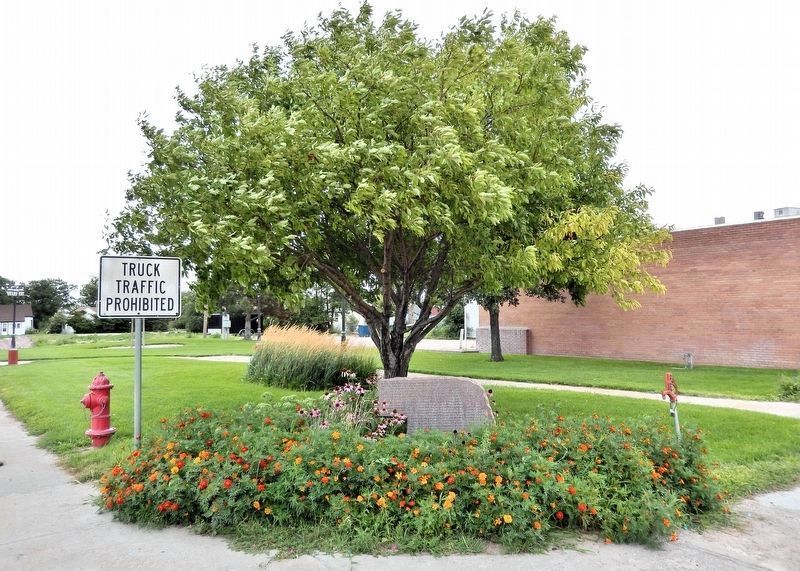
The marker is in Minatare Chamber Park, at the southeast corner of the intersection.
Location. 41° 48.563′ N, 103° 30.192′ W. Marker is in Minatare, Nebraska, in Scotts Bluff County. It is at the intersection of Main Street and 4th Street, on the right when traveling north on Main Street. The marker is beside the sidewalk at the southeast corner of the intersection. Touch for map. Marker is at or near this postal address: 320 Main Street, Minatare NE 69356, United States of America. Touch for directions.

Regionally, this marker is in the Nebraska Panhandle. It is also in the American Midwest, in the Corn Belt, and on the prairies. Globally, it is in North America, the Western Hemisphere, the Western World, and the Anglosphere. Historically, it finds itself in what was once the Louisiana Purchase.
Other nearby markers. At least 8 other markers are within 9 miles of this marker, measured as the crow flies: Ficklin Springs Pony Express Station (approx. 2.1 miles away); Scottsbluff Army Air Field (approx. 6.2 miles away); Veterans Memorial (approx. 6.2 miles away); Rebecca Winters (approx. 6.3 miles away); Winters (approx. 6.3 miles away); The Road to Zion (approx. 6.3 miles away); A Grand & Splendid Formation (approx. 6.3 miles away); Griswold Carillon (approx. 8.2 miles away).
Also see . . .
1. Lake Minatare State Recreation Area (Nebraska Game & Parks).
Excerpt: Lake Minatare State Recreation Area is the Panhandle’s largest body of water, attracting thousands of anglers, campers, water skiers and swimmers each year. Lake Minatare boasts excellent outdoor recreation opportunities, while irrigating thousands of acres in the North Platte Valley. It’s surrounded by notable historic and recreational sites such as North Platte National Wildlife Refuge, Chimney Rock National Historic Site, Scotts Bluff National Monument and Wildcat Hills State Recreation Area.(Submitted on October 30, 2026, by Cosmos Mariner of Cape Canaveral, Florida.)
Plains Lighthouse
Lake Minatare’s landmark lighthouse was a beacon of hope during the dark days of the Great Depression, when many Americans were jobless. It was built entirely of native stone between 1937 and 1939 by the Veterans Conservation Corps Camp BR-1. The structure stands 55 feet tall and was intended to serve as a combination shelter house and observation tower. Many decades later, it still stands watch over the area. Open to the public, the historic tower continues to offer a spectacular view of the lake and picturesque river valley.
2. Nebraska CCC Research Information (TheFencePost.com).
(By Peggy Sanders, Jul 24, 2026) Excerpt: The Civilian Conservation Corps existed from March 1933 through June 1942, and during those years there were 57 camps in Nebraska, each one listed under their project number. A veterans’ camp was made up of World War I veterans. As projects were completed, the men were transferred to other camps, but they retained their company number. A CCCer might have served in several camps.(Submitted on October 30, 2026, by Cosmos Mariner of Cape Canaveral, Florida.)
A camp that stands out in a landlocked area is Camp Minatare, where the CCCs built a lighthouse on the shore of Lake Minatare State Recreation Area. The lake also supplies irrigation water to area farmers.
Credits. This page was last revised on October 30, 2026. It was originally submitted on October 27, 2026, by Cosmos Mariner of Cape Canaveral, Florida. This page has been viewed 5 times since then. Photos: 1, 2. submitted on October 30, 2026, by Cosmos Mariner of Cape Canaveral, Florida.
