
South Downtown in Atlanta in Fulton County, Georgia — The American South (South Atlantic)
Commission to Honor the Atlanta Student Movement
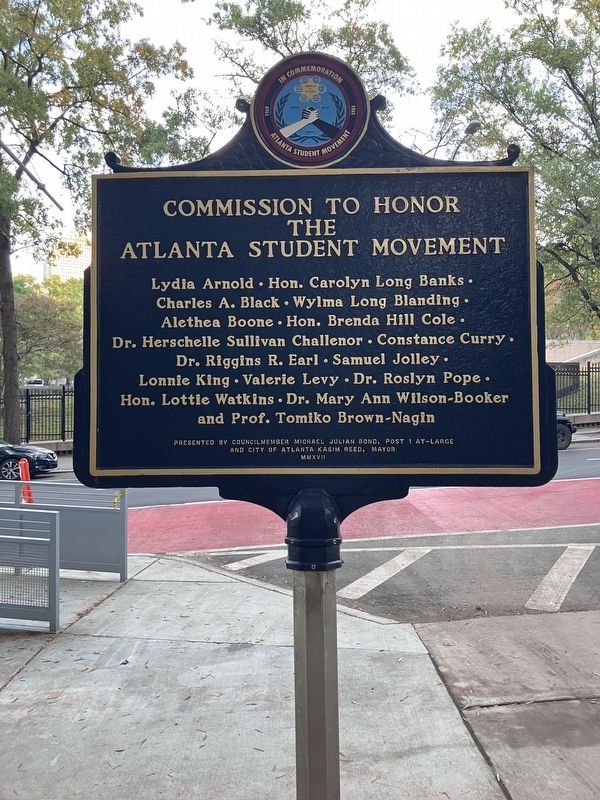
Photographed by Tracy Andersen Roberts, October 28, 2026
1. Commission to Honor the Atlanta Student Movement Marker
Lydia Arnold • Hon. Carolyn Long Banks • Charles A. Black • Wylma Long Blanding • Alethea Boone • Hon. Brenda Hill Cole • Dr. Herschelle Sullivan Challenor • Constance Curry • Dr. Riggins R. Earl • Samuel Jolley • Lonnie King • Valerie Levy • Dr. Roslyn Pope • Hon. Lottie Watkins • Dr. Mary Ann Wilson-Booker • and Prof. Tomiko Brown-Nagin
Erected 2017 by Council Member Michael Julian Bond, Post 1 At-Large and City of Atlanta, Kasim Reed, Mayor.
Topics. This historical marker is listed in these topic lists: African Americans • Civil Rights • Education. A significant historical year for this entry is 1960.
Location. 33° 44.963′ N, 84° 23.428′ W. Marker is in Atlanta, Georgia, in Fulton County. It is in South Downtown. It is on Mitchell Street Southwest east of Shriley C. Franklin Boulevard, on the right when traveling east. Touch for map. Marker is at or near this postal address: 55 Trinity Ave SW, Atlanta GA 30303, United States of America. Touch for directions.

Regionally, this marker is in the Piedmont. It is also in the American South and specifically in the Deep South. Globally, it
this page online
Other nearby markers. At least 8 other markers are within walking distance of this marker: Desegregation of Municipal Facilities (1961) (a few steps from this marker); In memory of Father Thomas O'Reilly (within shouting distance of this marker); History Culture and the Arts on the street (about 300 feet away, measured in a direct line); The March to the Sea (about 400 feet away); Second Baptist Church of Atlanta (about 400 feet away); Joseph Emerson Brown (about 500 feet away); Central Presbyterian Church (about 500 feet away); Immaculate Conception Church (about 500 feet away). Touch for a list and map of all markers in Atlanta.
Related markers. Click here for a list of markers that are related to this marker.
Also see . . .
1. Student Nonviolent Coordinating Committee Digital Gateway's entry on Atlanta Student Movement.
Atlanta Student Movement(Submitted on October 28, 2026, by Tracy Andersen Roberts of Atlanta, Georgia.)
“We want to state clearly and unequivocally that we cannot tolerate, in a nation professing democracy and among people professing Christianity, the discriminatory conditions under which the Negro is living today in Atlanta, Georgia—-supposedly one of the most progressive cities in the South.” –An Appeal for Human Rights, released March 1960 by the Atlanta Committee on Appeal for Human Rights
After reading about the Greensboro sit-ins in the Atlanta Daily World, the city’s Black daily newspaper, Morehouse college student Lonnie King knew Black people in Atlanta faced similar oppressive conditions and thought that what took place in Greensboro should happen in Atlanta. At a campus hangout he told fellow students, Joseph Pierce and Julian Bond, “Let’s make it happen here.” The three of them began to organize Atlanta students. They formed the Committee on Appeal for Human Rights (COAHR).
On March 15, 1960, Spelman students Ruby Doris Smith and Gwen Isles along with Bond and other students organized the first sit-ins. Over two hundred students sat in at eleven stores in downtown Atlanta; 83 of them were arrested. Six days earlier, their ad, “An Appeal for Human Rights,” had been published–an opening salvo in what would be a sustained campaign of sit-ins and boycotts by COAHR demanding an end to segregation and racist practices.
The Atlanta University community was ripe for mass political engagement. It included six Historically Black Colleges and Universities (HBCUs)–Clark, Morehouse, Morris Brown, Spelman College, Atlanta University, and the Interdenominational Theological Center. Although four out of the six presidents encouraged students not to sit-in, encouraging them to focus on their school work and “let the NAACP fight the racial battle,” the students had support from faculty like Howard Zinn who was chair of the History Department at Spelman College. Annette Jones remembered, “Dr. Zinn often protested with the students and took his classes to trials and legislative proceedings.” This support from faculty made student efforts to challenge segregation possible. In fact, some adults formed The Student-Adult Liaison Committee to build a coalition of two important resistance groups.
Although COAHR challenged segregation in the local Atlanta community, they also had organizing ties to SNCC. Julian Bond and Lonnie King were delegates to SNCC’s founding conference. The Atlanta students would go on to play an important role in SNCC’s work. Ruby Doris Smith became one of SNCC’s most important leaders and ultimately its program secretary. Julian Bond became SNCC’s Communications Director.
And it was in Atlanta where SNCC transitioned from the temporary student nonviolent coordinating committee to a permanent organization during a conference in October 1960. SNCC’s national headquarters in Atlanta served as a vital resource center supporting organizing efforts across the South. Those early efforts of COHAR laid the foundation for SNCC’s future work, as well as laid the framework for the Atlanta project in 1966.
2. Kennesaw State University's Atlanta Student Movement Project.
Discover History in Sit-Ins & Student Protests(Submitted on October 29, 2026, by Tracy Andersen Roberts of Atlanta, Georgia.)
The Atlanta Student Movement Project is a research project funded by a generous grant from the Rich Foundation, conducted by Kennesaw State University undergraduate and graduate students, and led by Dr. Jeanne Law Bohannon (KSU English Department) along with Dr. Lonnie King, the project's senior community partner. The oral histories in this collection represent the goal of the project: uncovering and preserving the history of Atlanta sit-ins and student protests that were pivotal in the success of the Student Movement, the Civil Rights movement, and the history of the city of Atlanta as a whole. Videos and transcripts in this collection have been archived at the KSU Archives.
Formed early in 1960, the Atlanta Student Movement was one part of the larger Civil Rights Movement. The group was comprised of students from university campuses that were part of the Atlanta University Center (AUC), a consortium of higher education centers for African-Americans that included Atlanta University, Clark College, Interdenominational Theological Center, Morehouse College, Morris Brown, and Spelman College.
The students also depended on advocates such as Sarah Stevens, Senator LeRoy and Cleopatra Johnson, and many others in communities both local and nationwide.
The digital reproductions on this site are provided for research consultation and educational purposes. To request permission to publish, reproduce, publicly display, broadcast, or distribute this material in any format outside of fair use, please contact the Kennesaw State University Archives.
Credits. This page was last revised on November 10, 2026. It was originally submitted on October 28, 2026, by Tracy Andersen Roberts of Atlanta, Georgia. This page has been viewed 12 times since then. Photo 1. submitted on October 28, 2026, by Tracy Andersen Roberts of Atlanta, Georgia. • Devry Becker Jones was the editor who published this page.
