Lewes Historic District in Milton in Sussex County, Delaware — The American Northeast (Mid-Atlantic)
Nanticoke Indian Tribe's Lasting Legacy
Nanticoke Indian Tribe
| — | Delaware | — |
Photographed by Devry Becker Jones (CC0), October 29, 2026
1. Nanticoke Indian Tribe's Lasting Legacy Marker
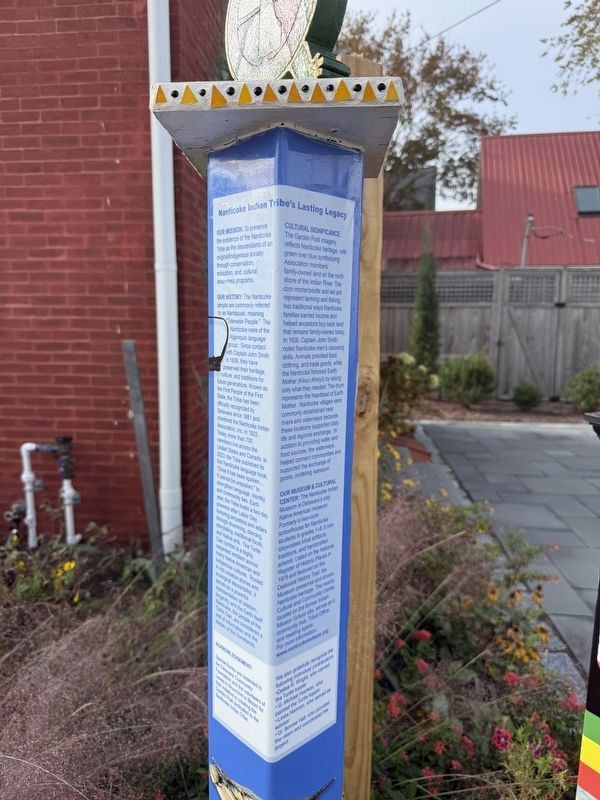
Our mission: To preserve the existence of the Nanticoke Tribe as the descendants of an original/indigenous society through conservation, education, and cultural awareness programs.
Our history: The Nanticoke people are commonly referred to as Nantaquak, meaning "Tidewater People." The Nanticoke were of the Algonquin language group. Since contact with Captain John Smith in 1608, they have preserved their heritage, culture, and traditions for future generations. Known as the First Poeple of the First State, the Tribe has been officially recognized by Delaware since 1881 and chartered the Nanticoke Indian Association, Inc. in 1922. Today, more than 700 members live across the United States and Canada. In 2023, the Tribe published its first Nanticoke language book, "Once it has been spoken… It cannot be unspoken," to strengthen language, identity and community ties. Each year, the Tribe hosts a two-day powwow after Labor Day, honoring ancestors and elders through drumming, dancing, storytelling, traditional foods, and Native arts. The Turtle Clan symbol is a highly respected emblem across many Native American and Indigenous
this page online
Cultural significance: The Garden Post imagery reflects Nanticoke heritage, with green over blue symbolizing Association members' family-owned land on the north shore of the Indian River. The corn mortar/pestle and eel pot represent farming and fishing, two traditional ways Nanticoke families earned income and helped ancestors buy back land that remains family-owned today. In 1608, Captain John Smith noted Natnicoke men's canoeing skills. Animals provided food, clothing and trade goods, while the Nanticoke honored Earth Mother (Kikun Ahkiyii) by taking only what they needed. The drum represents the heartbeat of Earth Mother. Nanticoke villages were commonly established near rivers and waterways because these locations supported daily life and regional exchange. In addition to providing water and food sources, the waterways helped connect communities and supported the exchange
Photographed by Devry Becker Jones (CC0), October 29, 2026
2. Nanticoke Indian Tribe's Lasting Legacy Marker
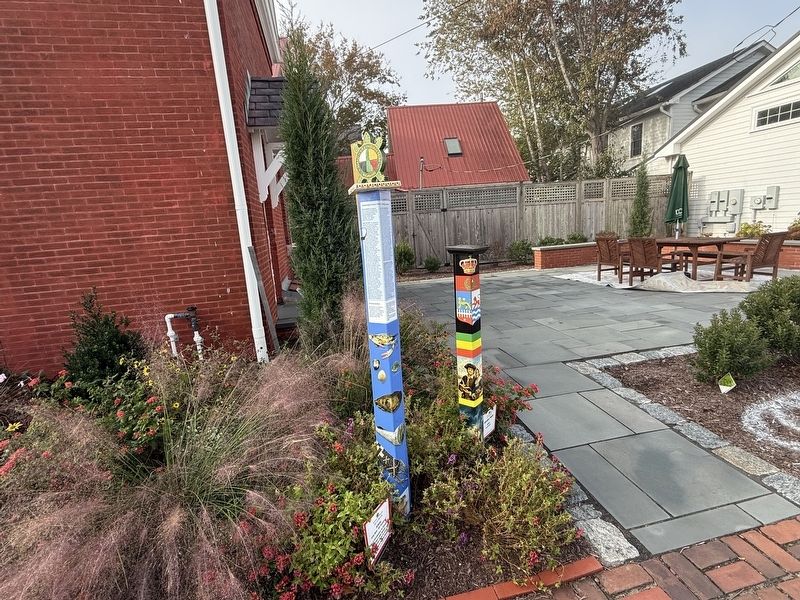
Our museum & cultural center: The Nanticoke Indian Museum is Delaware's only Native American museum. Formerly a two-room schoolhouse for Nanticoke students in grades 1-8, it now showcases tribal artifacts, traditions, and handcrafted artwork. Listed on the National Register of Historic Places in 1979 and featured on the Delaware History Trail, the Museum preserves and shares Nanticoke heritage. The nearby Cultural and Community Center, located on the former Indian Mission School site, serves as a community hub, Tribal Office, and meeting space.
For more information: www.nanticokeindians.org.
Acknowledgement:
Special thanks are extended to the Delaware Community Foundation and the volunteers of Lewes in Bloom/Art in Bloom for their initiative in creating the Garden Post dedicated to the Nanticoke Indian Tribe.
We also gratefully recognize the following individual contributions:
• Dallas R. Wright, who carved the Turtle topper
• G. Michael Harmon, who painted the Turtle topper
• Linda Harmon, who served as advisor
• Dr. Bonnie Hall, who provided the vision and coordinated the project.
Topics. This historical marker is listed in these topic lists: Anthropology & Archaeology • Arts, Letters, Music • Indigenous Peoples and Communities • Settlements & Settlers. A significant historical year for this entry is 1608.
Location. 38° 46.463′ N, 75° 8.37′ W. Marker is in Milton, Delaware, in Sussex County. It is in the Lewes Historic District. It is on 3rd Street west of Savannah Road (Business U.S. 9), on the right when traveling east. Touch for map. Marker is at or near this postal address: 16538 sweetwater Dr, Lewes DE 19958, United States of America. Touch for directions.

Regionally, this marker is on Delaware’s Beaches. It is also in the American Mid-Atlantic, on the Delmarva Peninsula, and on the Eastern Seaboard. Globally, it is in the North Atlantic Region, North America, the Western Hemisphere, the Western World, and the Anglosphere. Historically, it finds itself in what was once New Netherland, one of the original Thirteen Colonies, and the Antebellum South.
Other nearby markers. At least 8 other markers are within walking distance of this marker: The Zwaanendael Club (a few steps from this marker); Zwaanendael House (within shouting distance of this marker); Lewes (within shouting distance of this marker); Zwaanendael Museum (within shouting distance of this marker); World Wars I and II Memorial (within shouting distance of this marker); a different marker also named Lewes (within shouting distance of this marker); H.M. Brig DeBraak (within shouting distance of this marker); David Hall House (within shouting distance of this marker).
Credits. This page was last revised on October 30, 2026. It was originally submitted on October 30, 2026, by Devry Becker Jones of Washington, District of Columbia. This page has been viewed 13 times since then. Photos: 1, 2. submitted on October 30, 2026, by Devry Becker Jones of Washington, District of Columbia.
