Chorlton-on-Medlock in Manchester in Greater Manchester, England, United Kingdom — Northwestern Europe (the British Isles)
Window on Computer Science
Photographed by Ian Lefkowitz, September 14, 2026
1. Window on Computer Science Marker
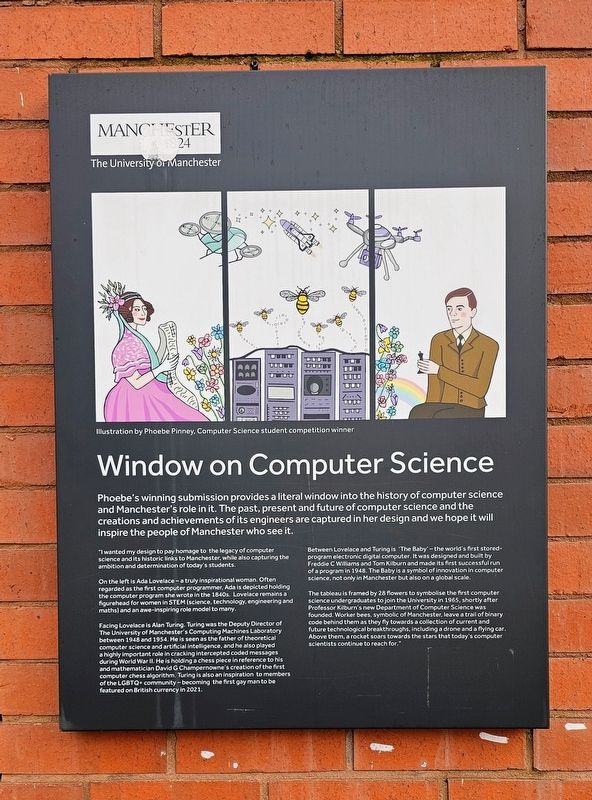
“I wanted my design to pay homage to the legacy of computer science and its historic links to Manchester, while also capturing the ambition and determination of today’s students.
On the left is Ada Lovelace — a truly inspirational woman. Often regarded as the first computer programmer, Ada is depicted holding the computer program she wrote in the 1840s. Lovelace remains a figurehead for women in STEM (science, technology, engineering and maths) and an awe-inspiring role model to many.
Facing Lovelace is Alan Turing. Turing was the Deputy Director of The University of Manchester’s Computing Machines Laboratory between 1948 and 1954. He is seen as the father of theoretical computer science and artificial intelligence, and he also played a highly important role in cracking intercepted coded messages during World War II.
this page online
Between Lovelace and Turing is ‘The Baby’ — the world’s first stored-program electronic digital computer. It was designed and built by Freddie C Williams and Tom Kilburn and made its first successful run of a program in 1948. The Baby is a symbol of innovation in computer science, not only in Manchester but also on a global scale.
The tableau is framed by 28 flowers to symbolise the first computer science undergraduates to join the University in 1965, shortly after Professor Kilburn’s new Department of Computer Science was founded. Worker bees, symbolic of Manchester, leave a trail of binary code behind them as they fly towards a collection of current and future technological breakthroughs, including a drone and a flying car. Above them, a rocket soars towards the stars that today’s computer scientists continue to reach for.”
(caption)
Illustration by Phoebe Pinney, Computer Science student competition winner
Topics.
Photographed by Ian Lefkowitz, September 14, 2026
2. Window on Computer Science Marker
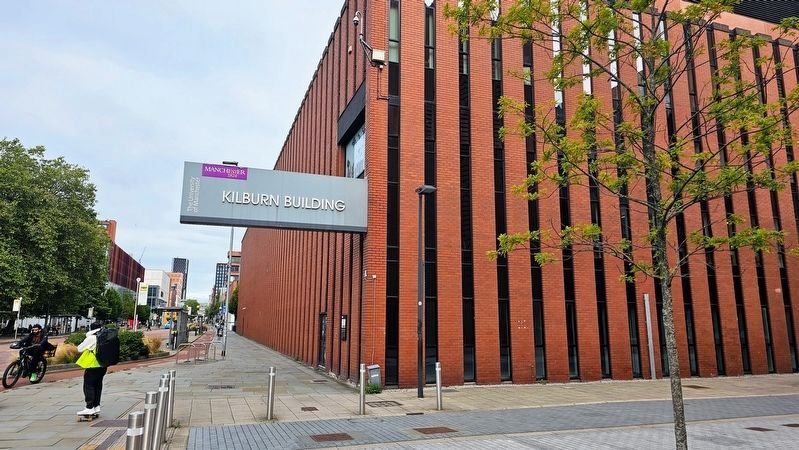
The marker is affixed to the Kilburn Building, located beneath the sign. The artwork is located above the sign.
Location. 53° 28.024′ N, 2° 14.049′ W. Marker is in Manchester, England, in Greater Manchester. It is in Chorlton-on-Medlock. It is at the intersection of Oxford Road and Wilton Street, on the left when traveling south on Oxford Road. Touch for map. Marker is at or near this postal address: 184 Oxford Road, Manchester, England M13 9GP, United Kingdom. Touch for directions.

Regionally, this marker is in North West England. Globally, it is on the Atlantic Ocean, in the North Atlantic Region, in Europe, in Atlantic Europe, on one of the British Isles, in the Western World, and in the Anglosphere. Historically, it finds itself in what was once the Roman Empire.
Other nearby markers. At least 8 other markers are within walking distance of this marker: Ernest Lord Rutherford (about 90 meters away, measured in a direct line); Alison Uttley (about 120 meters away); The Beyer Building (about 120 meters away); The Rutherford Building (about 120 meters away); Ernest Rutherford (about 120 meters away); Marie Stopes (about 120 meters away); Alan Mathison Turing (about 150 meters away); Coupland Building 1 (about 150 meters away). Touch for a list and map of all markers in Manchester.
Also see . . . 'Baby' and the birth of modern computing (Science & Industry Museum).
Arguably, the modern computer age started in Manchester in 1948. It was to Manchester that Sir Freddie Williams and some of his wartime team, notably Tom Kilburn and Geoff Tootill, relocated after their work perfecting radar during the Second World War. Williams had been appointed the head of the Electrical Engineering Department at the University of Manchester, which is where he earned his undergraduate in science before going on to get a PhD in Oxford.(Submitted on October 31, 2026, by Ian Lefkowitz of New York, New York.)
Credits. This page was last revised on October 31, 2026. It was originally submitted on October 31, 2026, by Ian Lefkowitz of New York, New York. This page has been viewed 16 times since then. Photos: 1, 2. submitted on October 31, 2026, by Ian Lefkowitz of New York, New York. • Andrew Ruppenstein was the editor who published this page.
