Cheyenne in Laramie County, Wyoming — The American West (Mountains)
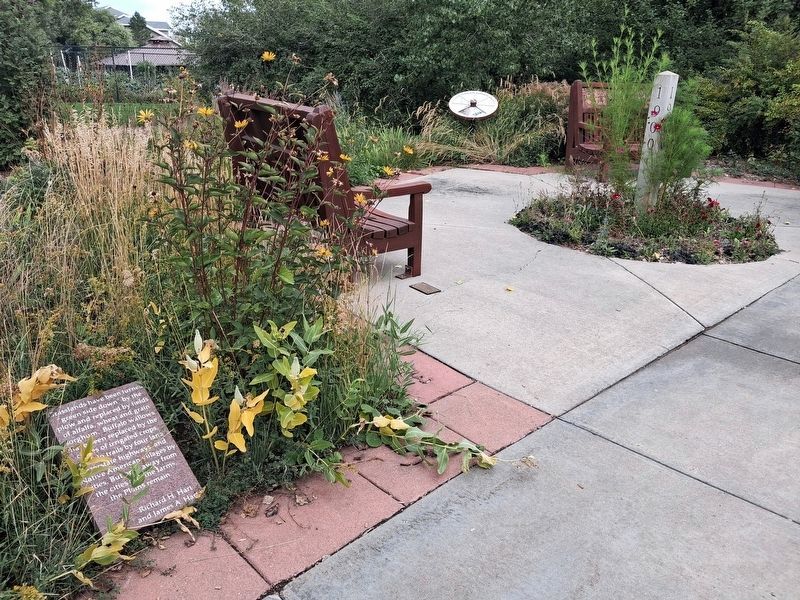
1900s Cheyenne Area Garden
Rotary Century Plaza
Photographed by William Fischer, Jr., September 28, 2026
1. 1900s Cheyenne Area Garden Marker
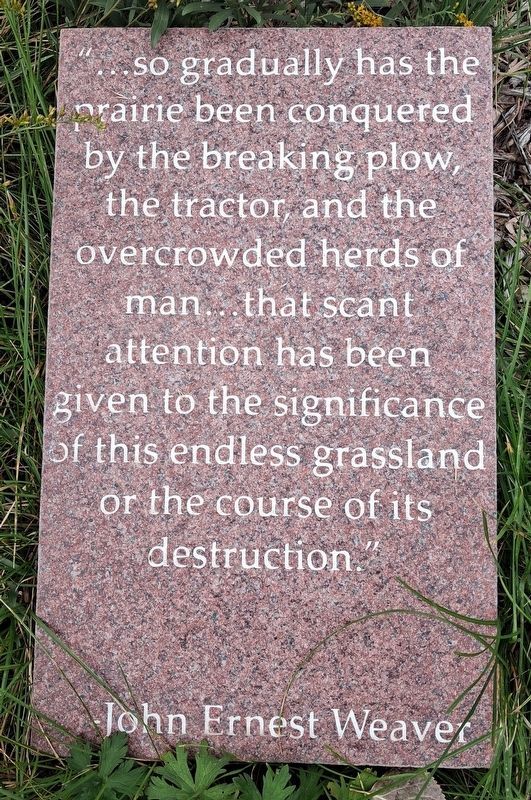
"...so gradually has the prairie been conquered by the breaking plow, the tractor, and the overcrowded herds of man...that scant attention has been given to the significance of this endless grassland or the course of its destruction."
—John Ernest Weaver
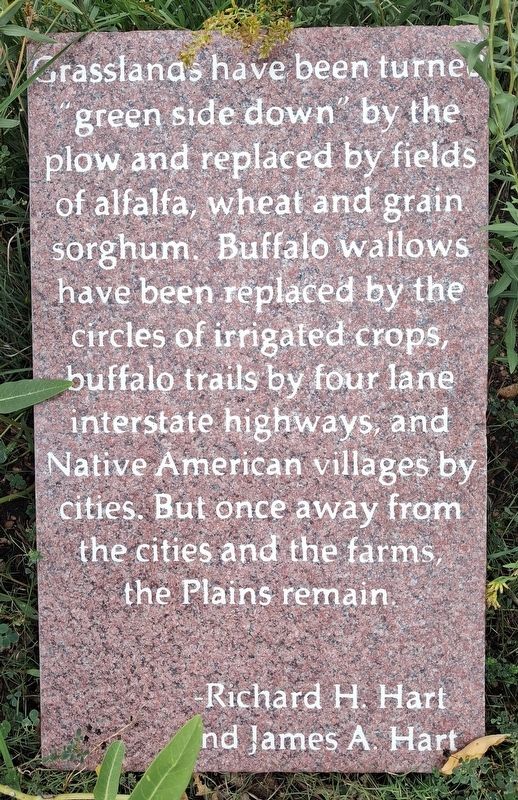
Grasslands have been turned "green side down" by the plow and replaced by fields of alfalfa, wheat and grain sorghum. Buffalo wallows have been replaced by the circles of irrigated crops, buffalo trails by four lane interstate highways, and Native American villages by cities. But once away from the cities and the farms, the Plains remain.
—Richard H. Hart and James A. Hart
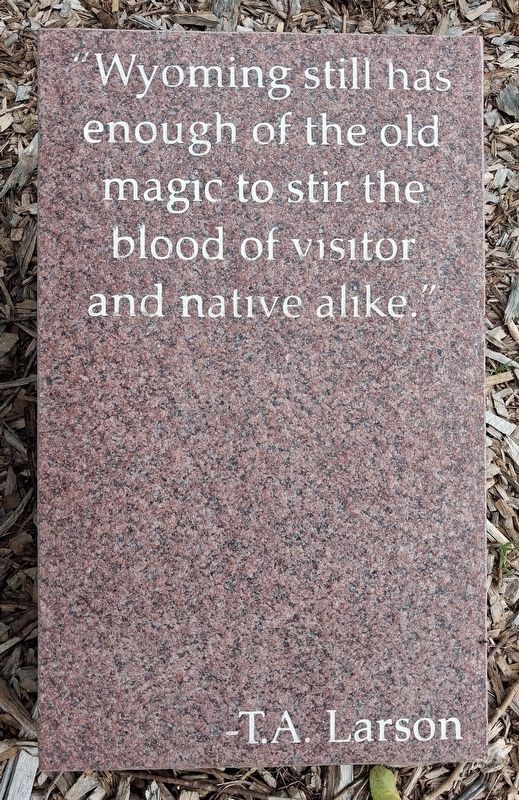
"Wyoming still has enough of the old magic to stir the blood of visitor and native alike."
—T.A. Larson
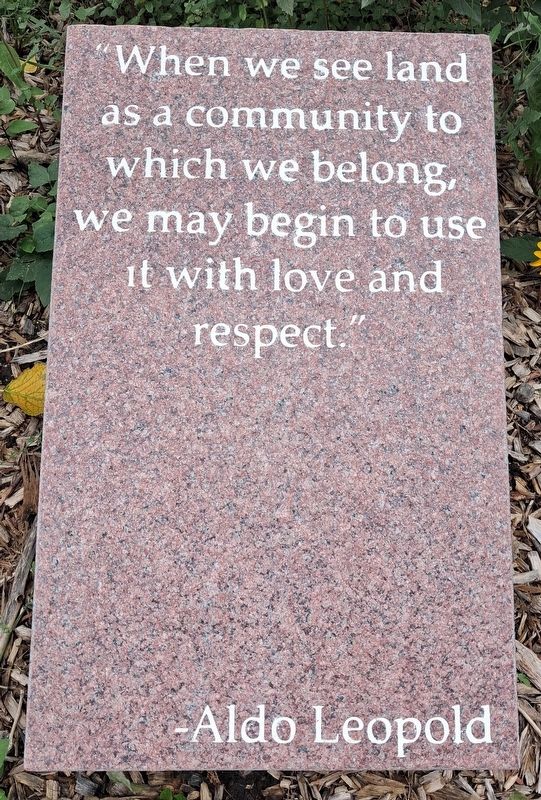
"When we see land as a community to which we belong, we may begin to use it with love and respect."
—Aldo Leopold
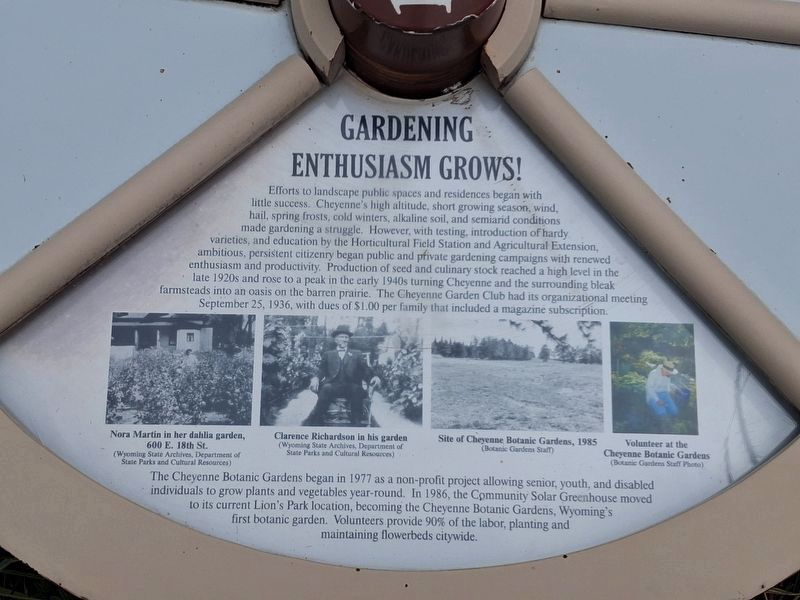
GARDENING ENTHUSIASM GROWS!
Efforts to landscape public spaces and residences began with little success. Cheyenne's high altitude, short growing season, wind, hail, spring frosts, cold winters, alkaline soil, and semiarid conditions made gardening a struggle. However, with testing, introduction of hardy varieties, and education by the Horticultural Field Station and Agricultural Extension, ambitious, persistent citizenry began public and private gardening campaigns with renewed enthusiasm and productivity. Production of seed and culinary stock reached a high level in the late 1920s and rose to a peak in the early 1940s turning Cheyenne and the surrounding bleak farmsteads into an oasis on the barren prairie.
The Cheyenne Garden Club had its organizational meeting September 25, 1936, with dues of $1.00 per family that included a magazine subscription. The Cheyenne Botanic Gardens began in 1977 as a non-profit project allowing senior, youth, and disabled individuals
this page online
[Photo captions, left to right, read]
• Nora Martin in her dahlia garden, 600 E. 18th St.
• Clarence Richardson in his garden
• Site of Cheyenne Botanic Gardens, 1985
• Volunteer at the Cheyenne Botanic Gardens
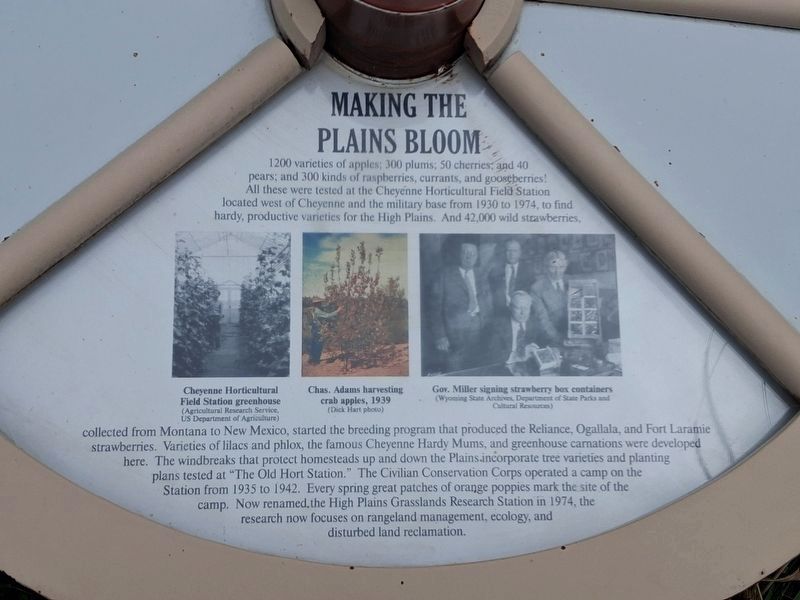
MAKING THE PLAINS BLOOM
1200 varieties of apples; 300 plums; 50 cherries; and 40 pears; and 300 kinds of raspberries, currants, and gooseberries! All these were tested at the Cheyenne Horticultural Field Station located west of Cheyenne and the military base from 1930 to 1974, to find hardy, productive varieties for the High Plains. And 42,000 wild strawberries, collected from Montana to New Mexico, started the breeding program that produced the Reliance, Ogallala, and Fort Laramie strawberries. Varieties of lilacs and phlox, the famous Cheyenne Hardy Mums, and greenhouse carnations were developed here.
The windbreaks that protect homesteads
Photographed by William Fischer, Jr., September 28, 2026
2. 1900s Cheyenne Area Garden Marker
[Photo captions, left to right, read]
• Cheyenne Horticultural Field Station greenhouse
• Chas. Adams harvesting crab apples, 1939
• Gov. Miller signing strawberry box containers
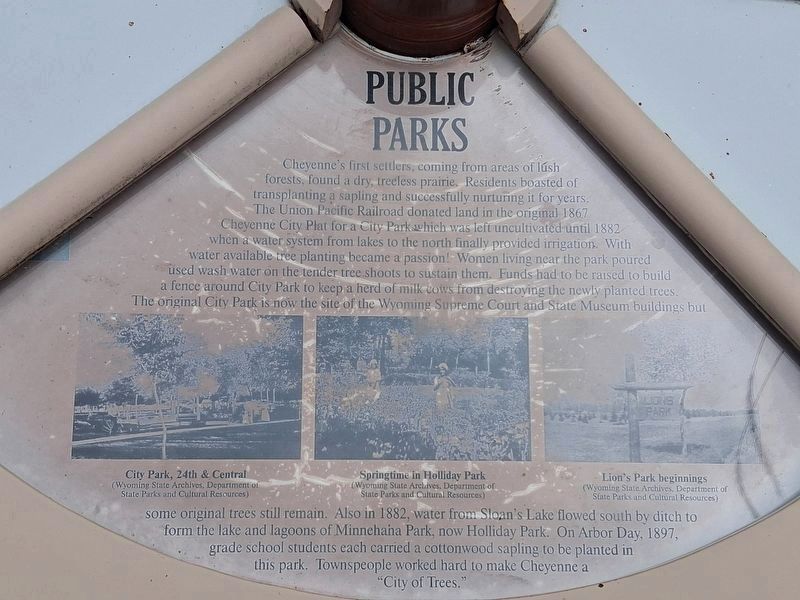
PUBLIC PARKS
Cheyenne's first settlers, coming from areas of lush forests, found a dry, treeless prairie. Residents boasted of transplanting a sapling and successfully nurturing it for years. The Union Pacific Railroad donated land in the original 1867 Cheyenne City Plat for a City Park which was left uncultivated until 1882 when a water system from lakes to the north finally provided irrigation. With water available tree planting became a passion! Women living near the park poured used wash water on the tender tree shoots to sustain them. Funds had to be raised to build a fence around City Park to keep a herd of milk cows from destroying the newly planted trees.
The original City Park is now the site of the Wyoming Supreme Court and State Museum buildings but some original trees still remain. Also in 1882, water from Sloan's Lake flowed south by ditch to form the lake and lagoons of Minnehaha Park, now Holliday Park. On Arbor Day, 1897, grade school students each carried a cottonwood sapling to be planted in this park. Townspeople worked hard to make Cheyenne a "City of Trees."
[Photo captions, left to right, read]
• City Park, 24th & Central
• Springtime in Holliday Park
• Lion's Park beginnings
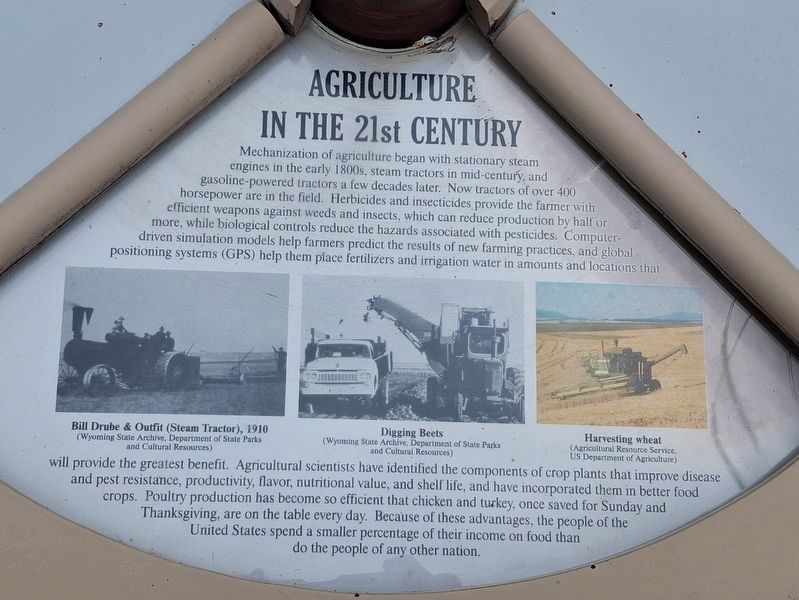
AGRICULTURE IN THE 21st CENTURY
Mechanization
Photographed by William Fischer, Jr., September 28, 2026
3. 1900s Cheyenne Area Garden Marker
Agricultural scientists have identified the components of crop plants that improve disease and pest resistance, productivity, flavor, nutritional value, and shelf life, and have incorporated them in better food crops. Poultry production has become so efficient that chicken and turkey, once saved for Sunday and Thanksgiving, are on the table every day. Because of these advantages, the people of the United States spend a smaller percentage of their income on food than do the people of any other nation.
[Photo captions, left to right, read]
• Bill Drube & Outfit (Steam Tractor), 1910
• Digging Beets
• Harvesting wheat
Erected by Cheyenne Botanic Gardens, Rotary, and Concerned Citizens and Organizations.
Topics. This historical marker is listed in these topic lists: Agriculture • Horticulture & Forestry • Settlements & Settlers • Women. A significant historical date for this entry is September 25, 1936.
Location. 41° 9.449′ N, 104° 49.936′ W. Marker is in Cheyenne, Wyoming, in Laramie County. It can be reached from no nearby street. Markers are in the Rotary 1900s Century Plaza in the Cheyenne Botanic Gardens. Touch for map. Marker is at or near this postal
Photographed by William Fischer, Jr., September 28, 2026
4. 1900s Cheyenne Area Garden Marker

Regionally, this marker is in the Laramie Basin. It is also in the American Mountain West, on the Great Plains, and specifically on the High Plains. Globally, it is in North America, the Western Hemisphere, the Western World, and the Anglosphere. Historically, it finds itself in what was once the Louisiana Purchase.
Other nearby markers. At least 8 other markers are within walking distance of this marker: Gene Howard (here, next to this marker); 1929 Farmall "Regular Series" Tractor (a few steps from this marker); 1800s Cheyenne Area Garden (a few steps from this marker); Rotary Century Plaza (a few steps from this marker); Shelterbelts (a few steps from this marker); Union Pacific Steam Engine #1242 (within shouting distance of this marker); Floyd and Edna Young Folk Art Fence (within shouting distance of this marker); 1700s Cheyenne Area Garden (within shouting distance of this marker). Touch for a list and map of all markers in Cheyenne.
Photographed by William Fischer, Jr., September 28, 2026
5. Gardening Enthusiasm Grows!
On the 1900s Cheyenne Area Garden Marker Wheel
Photographed by William Fischer, Jr., September 28, 2026
6. Making the Plains Bloom
On the 1900s Cheyenne Area Garden Marker Wheel
Photographed by William Fischer, Jr., September 28, 2026
7. Public Parks
On the 1900s Cheyenne Area Garden Marker Wheel; well worn
Photographed by William Fischer, Jr., September 28, 2026
8. Agriculture in the 21st Century
On the 1900s Cheyenne Area Garden Marker Wheel
Photographed by William Fischer, Jr., September 28, 2026
9. 1900s Cheyenne Area Garden
Credits. This page was last revised on November 1, 2026. It was originally submitted on October 31, 2026, by William Fischer, Jr. of Reynoldsburg, Ohio. This page has been viewed 9 times since then. Photos: 1, 2, 3, 4, 5, 6, 7, 8, 9. submitted on October 31, 2026, by William Fischer, Jr. of Reynoldsburg, Ohio.
