Northampton in West Northamptonshire, England, United Kingdom — Northwestern Europe (the British Isles)
The Fall of the Castle Walls
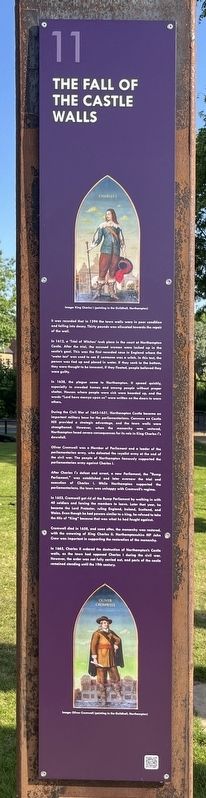
Photographed by Ray Gurganus, May 25, 2026
1. The Fall of the Castle Walls Marker
In 1612, a 'Trial of Witches' took place in the court at Northampton Castle. After the trial, the accused women were locked up in the castle's gaol. This was the first recorded case in England where the 'water test' was used to see if someone was a witch. In this test, the person was tied up and placed in water. If they sank to the bottom, they were thought to be innocent, if they floated, people believed they were guilty.
In 1638, the plague came to Northampton. It spread quickly, especially in crowded homes and among people without proper shelter. Houses where people were sick were boarded up, and the words "Lord have mercye upon us" were written on the doors to warn others.
During the Civil War of 1642-1651, Northampton Castle became an important military base for the parliamentarians. Cannons on Castle Hill provided a strategic advantage, and the town walls were strengthened. However, when the monarchy was restored, Northampton faced severe consequences for its
this page online
Oliver Cromwell was a Member of Parliament and a leader of the parliamentarian army, who defeated the royalist army at the end of the civil war. The people of Northampton famously supported the parliamentarian army against Charles I.
After Charles I's defeat and arrest, a new Parliament, the "Rump Parliament," was established and later oversaw the trial and execution of Charles I. While Northampton supported the parliamentarians, the town was unhappy with Cromwell's regime.
In 1653, Cromwell got rid of the Rump Parliament by walking in with 40 soldiers and forcing the members to leave. Later that year, he became the Lord Protector, ruling England, Ireland, Scotland, and Wales. Even though he had powers similar to a king, he refused to take the title of "King" because that was what he had fought against.
Cromwell died in 1658, and soon after, the monarchy was restored, with the crowning of King Charles II. Northamptonshire MP John Crew was important in supporting the restoration of the monarchy.
In 1662, Charles II ordered the destruction of Northampton's Castle walls, as the town had
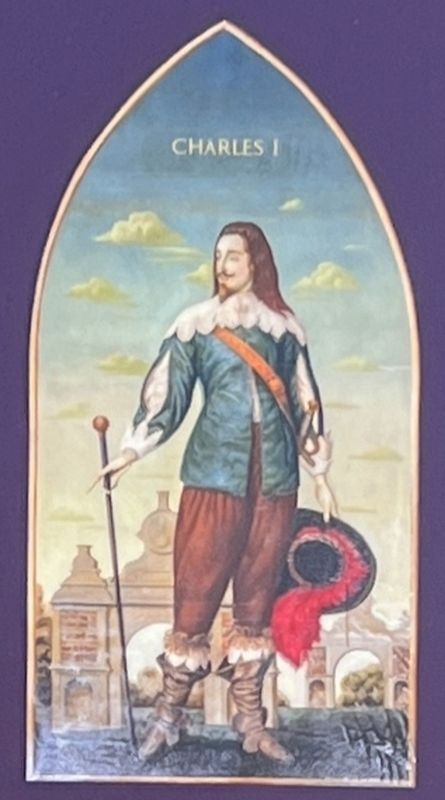
Illustration from the marker, May 25, 2026
2. Charles I
Topics. This historical marker is listed in these topic lists: Forts and Castles • Wars, Non-US • Women. A significant historical year for this entry is 1594.
Location. 52° 14.253′ N, 0° 54.243′ W. Marker is in Northampton, England, in West Northamptonshire. It is on Chalk Lane. Touch for map. Marker is at or near this postal address: 14 Chalk Lane, Northampton, England NN1 2RW, United Kingdom. Touch for directions.

Regionally, it is on the Atlantic Ocean, in the North Atlantic Region, in Europe, in Atlantic Europe, on one of the British Isles, in the Western World, and in the Anglosphere. Historically, it finds itself in what was once the Roman Empire.
Other nearby markers. At least 8 other markers are within walking distance of this marker: Hazelrigg House and the Old Black Lion (here, next to this marker); Stories from the Castle (here, next to this marker); The Great Fire of Northampton (a few steps from this marker); Royals and the Castle (a few steps from this marker); Shoe Industry (a few steps from this marker); Thomas Becket (a few steps from this marker); Archaeological Excavations (a few steps from this marker); Visitors to the Castle (a few steps from this marker). Touch for a list and map of all markers in Northampton.
Credits. This page was last revised on November 3, 2026. It was originally submitted on November 1, 2026, by Ray Gurganus of Washington, District of Columbia. This page has been viewed 5 times since then. Photos: 1, 2. submitted on November 1, 2026, by Ray Gurganus of Washington, District of Columbia. • Andrew Ruppenstein was the editor who published this page.
