Napierville in Les Jardins-de-Napierville, Québec — Central Canada (French-Canadian)
François Trépanier
| — | du rêve à l'exil — 1838 | — |
Photographed by Cosmos Mariner, May 19, 2024
1. François Trépanier Marker

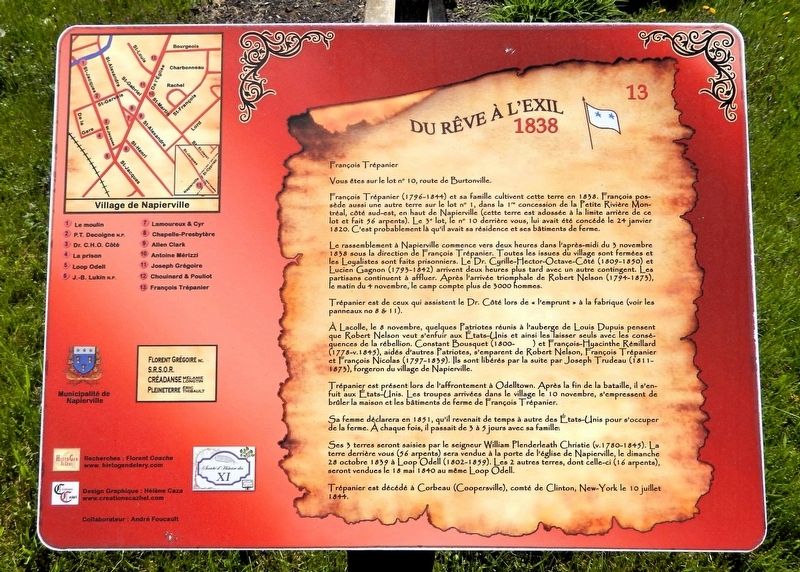
François Trépanier (1796-1844) et sa famille cultivent cette terre en 1838. François possède aussi une autre terre sur le lot n° 1, dans la 1re concession de la Petite Rivière Montréal, côté sud-est, en haut de Napierville (cette terre est adossée à la limite amère de ce lot et fait 56 arpents). Le 3e lot, le n° 10 derrière vous, lui avait été concédé le 24 janvier 1820. C'est probablement là qu'il avait sa résidence et ses bâtiments de ferme.
Le rassemblement à Napierville commence vers deux heures dans l'après-midi du 3 novembre 1838 sous la direction de François Trépanier. Toutes les issues du village sont fermées et les Loyalistes sont faits prisonniers. Le Dr. Cyrille-Hector-Octave-Côté (1809-1850) et Lucien Gagnon (1793-1842) arrivent deux heures plus tard avec un autre contingent. Les partisans continuent à affluer. Après l'arrivée triomphale de Robert Nelson (1794-1873), le matin du 4 novembre, le camp compte plus de 3000 hommes.
Trépanier est de ceux qui assistent le Dr. Côté lors de « l'emprunt » à la fabrique (voir les panneaux No 8 & 11).
À Lacolle, le
this page online
Trépanier est présent lors de l'affrontement à Odelltown. Après la fin de la bataille, il s'enfuit aux États-Unis. Les troupes arrivées dans le village le 10 novembre, s'empressent de brûler la maison et les bâtiments de ferme de François Trépanier.
Sa femme déclarera en 1851, qu'il revenait de temps à autre des États-Unis pour s'occuper de la ferme. A chaque fois, il passait de 3 à 5 jours avec sa famille.
Ses 3 terres seront saisies par le seigneur William Plenderleath Christie (v.1780-1845). La terre derrière vous (56 arpents) sera vendue à la porte de l'église de Napierville, le dimanche 28 octobre 1839 à Loop Odell (1802-1859). Les 2 autres terres, dont celle-ci (16 arpents),
Photographed by Cosmos Mariner, May 19, 2024
2. François Trépanier Marker
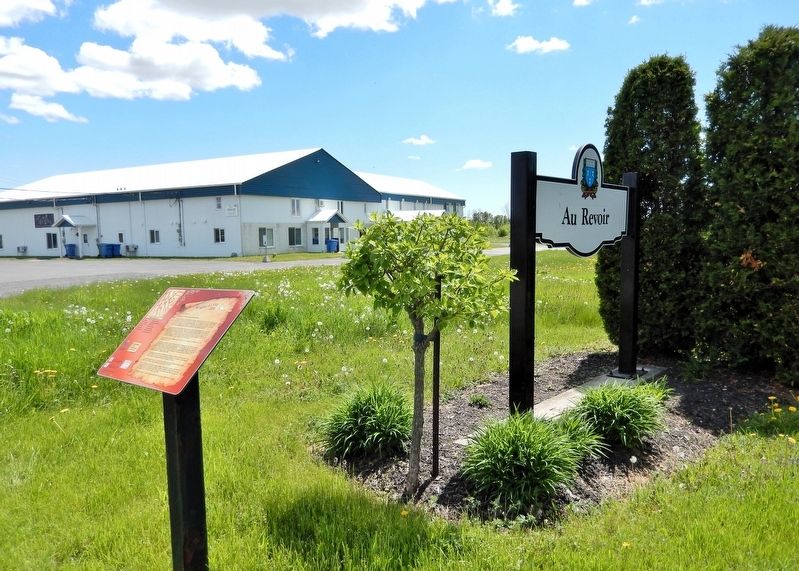
The marker is beside the highway near the southern boundary of Napierville.
Trépanier est décédé à Corbeau (Coopersville), comté de Clinton, New-York le 10 juillet 1844.
— From Dream to Exile — 1838 —
You are on lot number 10, Burtonville Road.
François Trépanier (1796-1844) and his family were farming this land in 1838. François also owned another piece of land on lot number 1, in the 1st concession of Petite Rivière Montréal, on the southeast side, at the top of Napierville (this land is adjoining the end of this lot and measures 56 acres). The 3rd lot, number 10 behind you, had been granted to him on January 24, 1820. This was probably where he had his home and farm buildings.
The gathering at Napierville started around two in the afternoon on November 3, 1838, under the leadership of François Trépanier. All exits from the village were closed, and the Loyalists were taken prisoner. Dr. Cyrille-Hector-Octave-Côté (1809-1850) and Lucien Gagnon (1793-1842) arrived two hours later with another group. Supporters kept streaming in. After Robert Nelson's triumphant arrival (1794-1873) on the morning of November 4, the camp
Photographed by Cosmos Mariner, May 19, 2024
3. François Trépanier Marker
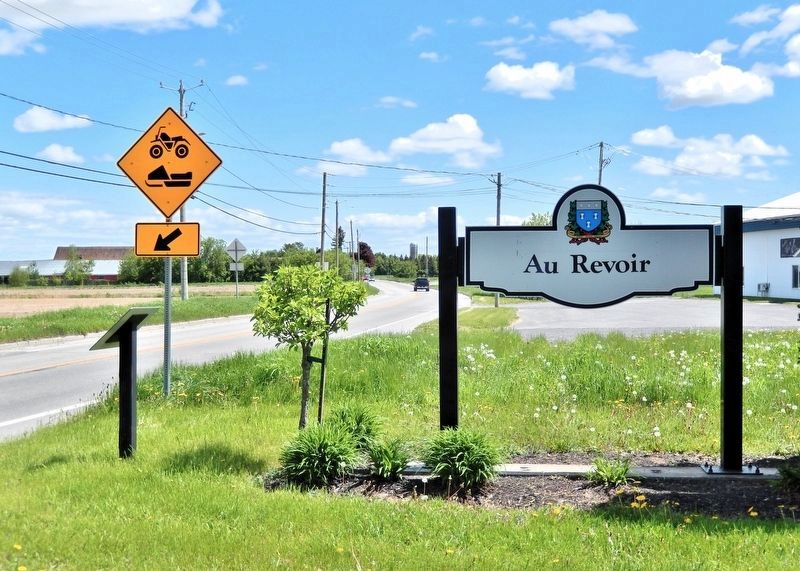
Looking south along Chemin Louis Cyr (Rue Saint-Jacques) (Québec Route 221). The marker is on the left side of the “Au Revoir” sign.
Trépanier is one of those who assist Dr. Côté during the “borrowing” from the factory (see panels numbers 8 & 11).
In Lacolle, on November 8, a few Patriots gathered at Louis Dupuis’ Inn think that Robert Nelson wants to escape to the United States, leaving them alone to face the consequences of the rebellion. Constant Bousquet (1800-) and François-Hyacinthe Rémillard (1778-c.1845), aided by other Patriots, seize Robert Nelson, François Trépanier, and François Nicolas (1797-1839). They are later freed by Joseph Trudeau (1811-1873), a blacksmith from the village of Napierville.
Trépanier is present during the clash at Odelltown. After the battle ends, he flees to the United States. The troops that arrive in the village on November 10 quickly burn down François Trépanier’s house and farm buildings.
His wife stated in 1851 that he would come back from time to time from the United States to take care of the farm. Each time, he spent 3 to 5 days with his family.
His three lands were seized by Lord William Plenderleath Christie (c.1780-1845). The land behind you (56 acres) was sold at the door of the Napierville church on Sunday, October 28, 1839, to Loop Odell (1802-1859). The other two lands, including this one (16 acres), were sold on May 18, 1840, to the same Loop Odell.
Trépanier died in Corbeau (Coopersville), Clinton County, New York, on July 10, 1844.
Erected by Municipalité de Napierville / Municipality of Napierville. (Marker Number 13.)
Topics. This historical marker is listed in these topic lists: Colonial Era • Patriots & Patriotism • Settlements & Settlers • Wars, Non-US. A significant historical year for this entry is 1838.
Location. 45° 10.781′ N, 73° 23.842′ W. Marker is in Napierville, Québec, in Les Jardins-de-Napierville. It is on Chemin Louis Cyr (Rue Saint-Jacques) (Québec Route 221) one kilometer south of Rue de l'Église, on the right when traveling south. Touch for map. Marker is at or near this postal address: 173 Rue Saint-Jacques, Napierville QC J0J 1L0, Canada. Touch for directions.

Regionally, this marker is in Central Canada. Globally, it is in North America, the Western Hemisphere, and the Western World. Historically, it finds itself in what was once a British colony, the Viceroyalty of New France, the Haudenosaunee (Iroquois) Confederacy, and Rupert’s Land.
Other nearby markers. At least 8 other markers are within walking distance of this marker: Loop Odell (approx. one kilometer away); Jean-Baptiste Lukin N.P. (approx. one kilometer away); C'est ici que fut proclamée la République du Bas-Canada (approx. one kilometer away); Napierville Historique (approx. 1.1 kilometers away); Magasin d'Allen Clark (approx. 1.1 kilometers away); La Prison (approx. 1.1 kilometers away); Palais de Justice et prison du comté de L'Acadie / Acadie County Court House and Goal (approx. 1.1 kilometers away); La Chapelle-Presbytère (1825-1886) (approx. 1.2 kilometers away). Touch for a list and map of all markers in Napierville.
Also see . . . Lower Canada Rebellion (Wikipedia).
Excerpt: The Lower Canada Rebellion, commonly referred to as the Patriots' Rebellion in French, is the name given to the armed conflict in 1837–38 between rebels and the British colonial government of Lower Canada (now southern Quebec). Together with the simultaneous rebellion in the neighbouring colony of Upper Canada (now southern Ontario), it formed the Rebellions of 1837–38. As a result of the rebellions, the Province of Canada was created from the former Lower Canada and Upper Canada.(Submitted on November 6, 2026, by Cosmos Mariner of Cape Canaveral, Florida.)
Credits. This page was last revised on November 6, 2026. It was originally submitted on November 5, 2026, by Cosmos Mariner of Cape Canaveral, Florida. This page has been viewed 7 times since then. Photos: 1, 2, 3. submitted on November 6, 2026, by Cosmos Mariner of Cape Canaveral, Florida.
