Napierville in Les Jardins-de-Napierville, Québec — Central Canada (French-Canadian)
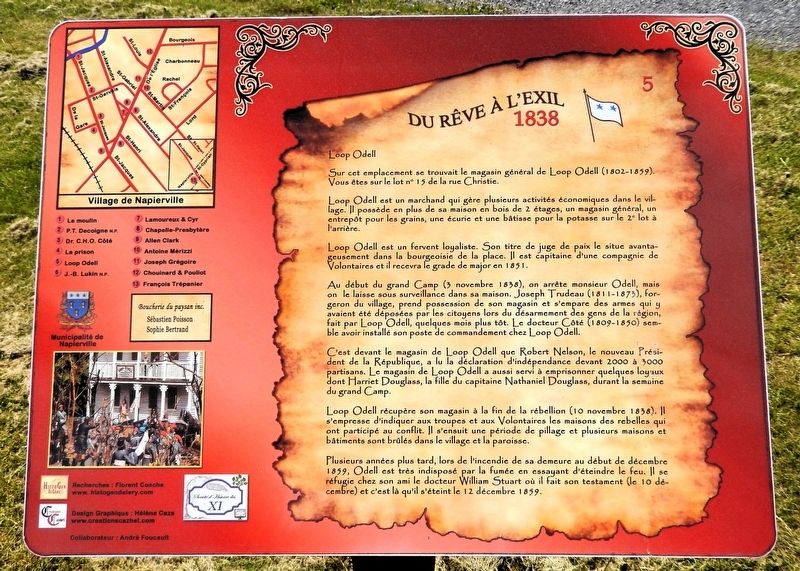
Loop Odell
| — | Du rêve à l'exil — 1838 | — |
Photographed by Cosmos Mariner, May 19, 2024
1. Loop Odell Marker

Loop Odell est un marchand qui gère plusieurs activités économiques dans le village. Il possède en plus de sa maison en bois de 2 étages, un magasin général, un entrepôt pour les grains, une écurie et une bâtisse pour la potasse sur le 2e lot à l'arrière.
Loop Odell est un fervent loyaliste. Son titre de juge de paix le situe avantageusement dans la bourgeoisie de la place. Il est capitaine d'une compagnie de Volontaires et il recevra le grade de major en 1851.
Au début du grand Camp (3 novembre 1838), on arrête monsieur Odell, mais on le laisse sous surveillance dans sa maison. Joseph Trudeau (1811-1877), forgeron du village, prend possession de son magasin et s'empare des armes qui y avaient été déposées par les citoyens lors du désarmement des gens de la région, fait par Loop Odell, quelques mois plus tôt. Le docteur Côté (1809-1850) semble avoir installé son poste de commandement chez Loop Odell.
C'est devant le magasin de Loop Odell que Robert Nelson, le nouveau président de la République,
this page online
Loop Odell récupère son magasin à la fin de la rébellion (10 novembre 1838). Il s'empresse d'indiquer aux troupes et aux Volontaires les maisons des rebelles qui ont participé au conflit. Il s'ensuit une période de pillage et plusieurs maisons et bâtiments sont brûlés dans le village et la paroisse.
Plusieurs années plus tard, lors de l'incendie de sa demeure au début de décembre 1859, Odell est très indisposé par la fumée en essayant d'éteindre le feu. Il se réfugie chez son ami le docteur William Stuart où il fait son testament (le 10 décembre) et c'est là qu'il s'éteint le 12 décembre 1859.
— From Dream to Exile — 1838 —
On this site was Loop Odell’s general store (1802-1859). You are on lot number 15 of Christie Street.
Loop Odell was a merchant who ran several businesses in the village. In addition to his two-story wooden house, he owned a general store, a grain warehouse,
Photographed by Cosmos Mariner, May 19, 2024
2. Loop Odell Marker
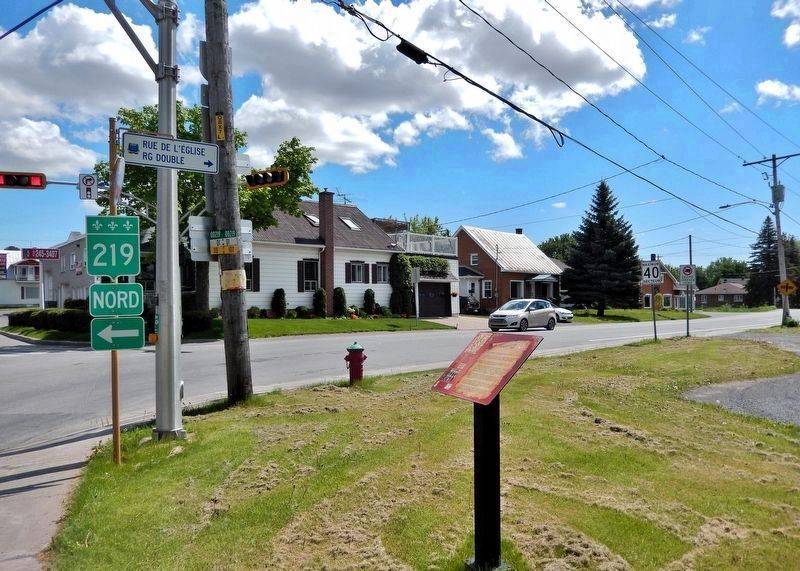
The marker is at the northwest corner of the intersection where Loop Odell’s general store stood in 1838.
Loop Odell was a staunch loyalist. His title as a justice of the peace put him in a good position within the town’s upper class. He was captain of a company of volunteers and was promoted to major in 1851.
At the start of the big Camp (November 3, 1838), Mr. Odell was arrested, but he was kept under surveillance at his home. Joseph Trudeau (1811-1877), the village blacksmith, took over his shop and seized the weapons that had been deposited there by the citizens during the disarmament of the local people, carried out by Loop Odell a few months earlier. Dr. Côté (1809-1850) seems to have set up his command post at Loop Odell's place.
It was in front of Loop Odell's shop that Robert Nelson, the new president of the Republic, read the declaration of independence in front of 2,000 to 3,000 supporters. Loop Odell's shop was also used to imprison a few loyalists, including Harriet Douglass, the daughter of Captain Nathaniel Douglass, during the week of the big Camp.
Loop Odell took back his store at the end of the rebellion (November 10, 1838). He quickly pointed out to the troops and volunteers the homes of the rebels who had taken part in the conflict. This led to a period of looting, and several houses and buildings were burned in the village and the parish.
Several years later, during the fire at his home in early December 1859, Odell was very affected by the smoke while trying to put out the fire. He took refuge at his friend Dr. William Stuart's house, where he made his will (December 10), and it was there that he passed away on December 12, 1859.
Erected by Municipalité de Napierville / Municipality of Napierville. (Marker Number 5.)
Topics. This historical marker is listed in these topic lists: Colonial Era • Industry & Commerce • Patriots & Patriotism • Wars, Non-US. A significant historical year for this entry is 1838.
Location. 45° 11.193′ N, 73° 24.314′ W. Marker is in Napierville, Québec, in Les Jardins-de-Napierville. It is at the intersection of Rue Saint-Jacques (Québec Route 221) and Rue de l'Église ( Route 219), on the right when traveling south on Rue Saint-Jacques. Touch for map. Marker is in this post office area: Napierville QC J0J 1L0, Canada. Touch for directions.

Regionally, this marker is in Central Canada. Globally, it is in North America, the Western Hemisphere, and the Western World. Historically, it finds itself in what was once a British colony, the Viceroyalty of New France, the Haudenosaunee (Iroquois) Confederacy, and Rupert’s Land.
Other nearby markers. At least 8 other markers are within walking distance of this marker: C'est ici que fut proclamée la République du Bas-Canada (within shouting distance of this marker); Jean-Baptiste Lukin N.P. (about 90 meters away, measured in a direct line); Palais de Justice et prison du comté de L'Acadie / Acadie County Court House and Goal (about 150 meters away); La Prison (about 150 meters away); Docteur C.-H.-O. Côté, m.d. (about 180 meters away); Napierville Historique (approx. 0.3 kilometers away); Magasin d'Allen Clark (approx. 0.3 kilometers away); La Chapelle-Presbytère (1825-1886) (approx. 0.3 kilometers away). Touch for a list and map of all markers in Napierville.
Related markers. Click here for a list of markers that are related to this marker.
Also see . . . Lower Canada Rebellion (Wikipedia).
Excerpt: The Lower Canada Rebellion, commonly referred to as the Patriots' Rebellion in French, is the name given to the armed conflict in 1837–38 between rebels and the British colonial government of Lower Canada (now southern Quebec). Together with the simultaneous rebellion in the neighbouring colony of Upper Canada (now southern Ontario), it formed the Rebellions of 1837–38. As a result of the rebellions, the Province of Canada was created from the former Lower Canada and Upper Canada. In Quebec, the rebellion, as well as the parliamentary and popular struggle, is now commemorated as the Journée nationale des Patriotes (National Patriots' Day) on the Canadian statutory holiday, Victoria Day.(Submitted on November 6, 2026, by Cosmos Mariner of Cape Canaveral, Florida.)
Credits. This page was last revised on November 6, 2026. It was originally submitted on November 6, 2026, by Cosmos Mariner of Cape Canaveral, Florida. This page has been viewed 7 times since then. Photos: 1, 2. submitted on November 6, 2026, by Cosmos Mariner of Cape Canaveral, Florida.
