Napierville in Les Jardins-de-Napierville, Québec — Central Canada (French-Canadian)
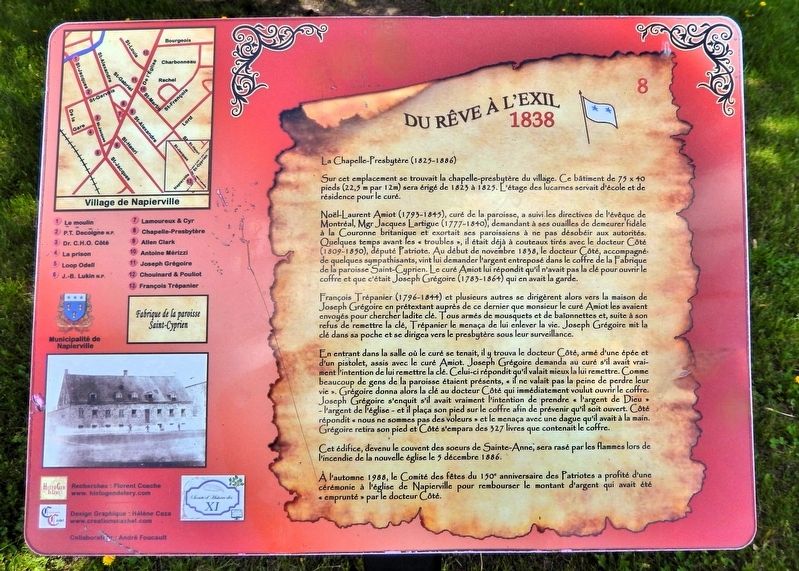
La Chapelle-Presbytère (1825-1886)
| — | Du rêve à l'exil — 1838 | — |
Photographed by Cosmos Mariner, May 19, 2024
1. La Chapelle-Presbytère (1825-1886) Marker

Noël-Laurent Amiot (1793-1845), curé de la paroisse, a suivi les directives de l'évêque de Montréal, Mgr Jacques Lartigue (1777-1840), demandant à ses ouailles de demeurer fidèle à la Couronne britannique et exhortait ses paroissiens à ne pas désobéir aux autorités. Quelques temps avant les « troubles », il était déjà à couteaux tirés avec le docteur Côté (1809-1850), député Patriote. Au début de novembre 1838, le docteur Côté, accompagné de quelques sympathisants, vint lui demander l'argent entreposé dans le coffre de la Fabrique de la paroisse Saint-Cyprien. Le curé Amiot lui répondit qu'il n'avait pas la clé pour ouvrir le coffre et que c'était Joseph Grégoire (1783-1864) qui en avait la garde.
François Trépanier (1796-1844) et plusieurs autres se dirigèrent alors vers la maison de Joseph Grégoire en prétextant auprès de ce dernier que monsieur le curé Amiot les avaient envoyés pour chercher ladite clé. Tous
this page online
En entrant dans la salle où le curé se tenait, il y trouva le docteur Côté, armé d'une épée et d'un pistolet, assis avec le curé Amiot. Joseph Grégoire demanda au curé s'il avait vraiment l'intention de lui remettre la clé. Celui-ci répondit qu’il valait mieux la lui remettre. Comme beaucoup de gens de la paroisse étaient présents, « if ne valait pas la peine de perdre leur vie ». Grégoire donna alors la clé au docteur Côté qui immédiatement voulut ouvrir le coffre. Joseph Grégoire s'enquit s'il avait vraiment l'intention de prendre « l'argent de Dieu » — l'argent de l'église — et plaça son pied sur le coffre afin de prévenir qu’il soit ouvert. Côté répondit « nous ne sommes pas des voleurs » et le menaça avec une dague qu’il avait à la main. Grégoire retira son pied et Côté s’empara des 327 livres que contenait le coffre.
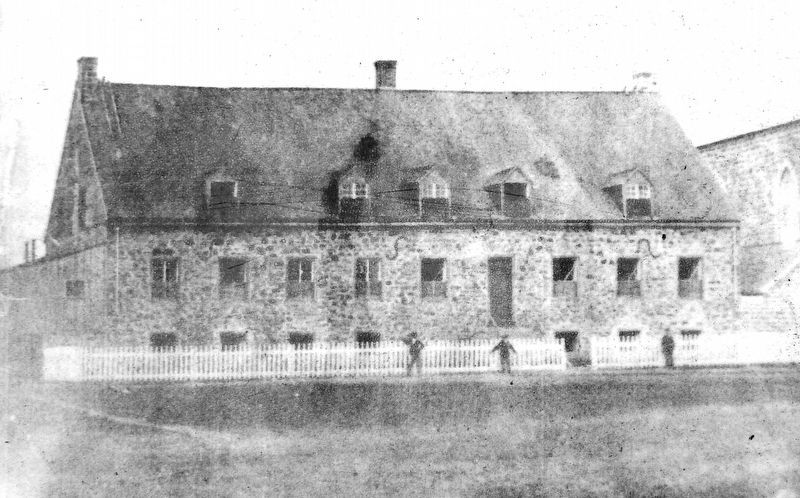
Cet édifice, devenu le couvent des sœurs de Sainte-Anne, sera rasé par les flammes lors de l'incendie
2. Marker detail: Fabrique de la paroisse Saint-Cyprien
A l'automne 1988, le Comité des fêtes du 150e anniversaire des Patriotes a profité d'une cérémonie à l'église de Napierville pour rembourser le montant d'argent qui avait été « emprunté » par le docteur Côté.
— From Dream to Exile — 1838 —
On this site stood the village chapel presbytery. This building, measuring 75 by 40 feet (22.5m by 12m), was built between 1823 and 1825. The attic floor with dormers served as a school and the priest's residence.
Noël-Laurent Amiot (1793-1845), the parish priest, followed the directives of the Bishop of Montreal, Mgr Jacques Lartigue (1777-1840), asking his flock to remain loyal to the British Crown and urging his parishioners not to disobey the authorities. Sometime before the “troubles,” he was already at odds with Doctor Côté (1809-1850), a Patriot deputy. In early November 1838, Doctor Côté, accompanied by a few supporters, came to ask him for the money stored in the safe of the Fabrique of Saint-Cyprien parish. Priest Amiot answered that he didn’t have the key to open the safe and that it was Joseph
Photographed by Cosmos Mariner, May 19, 2024
3. La Chapelle-Presbytère (1825-1886) Marker
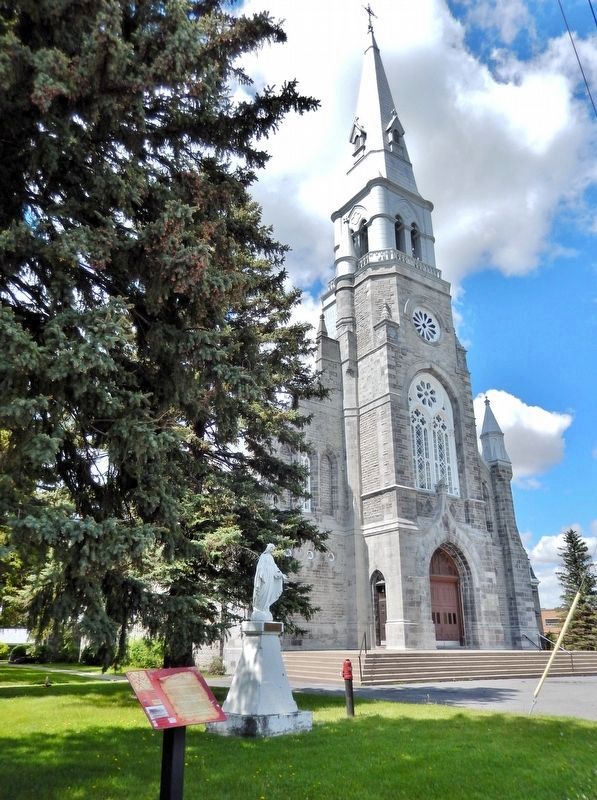
St. Cyprian Catholic Church is in the background.
François Trépanier (1796-1844) and several others then went to Joseph Grégoire's house, claiming to him that Father Amiot had sent them to fetch the said key. All armed with muskets and bayonets, and after Grégoire refused to give up the key, Trépanier threatened to take his life. Joseph Grégoire put the key in his pocket and headed to the rectory under their watch.
Upon entering the room where the priest was, he found Dr. Côté, armed with a sword and a pistol, sitting with Father Amiot. Joseph Grégoire asked the priest if he really intended to hand over the key. The priest replied that it was better to give it to him. Since many people from the parish were present, “it wasn't worth risking their lives.” Grégoire then gave the key to Dr. Côté, who immediately wanted to open the chest. Joseph Grégoire asked if he really intended to take “God's money” — the church's money — and placed his foot on the chest to prevent it from being opened. Côté replied, “we are not thieves,” and threatened him with a dagger he had in his hand. Grégoire removed his foot, and Côté took the 327 pounds that were
Photographed by Cosmos Mariner, May 19, 2024
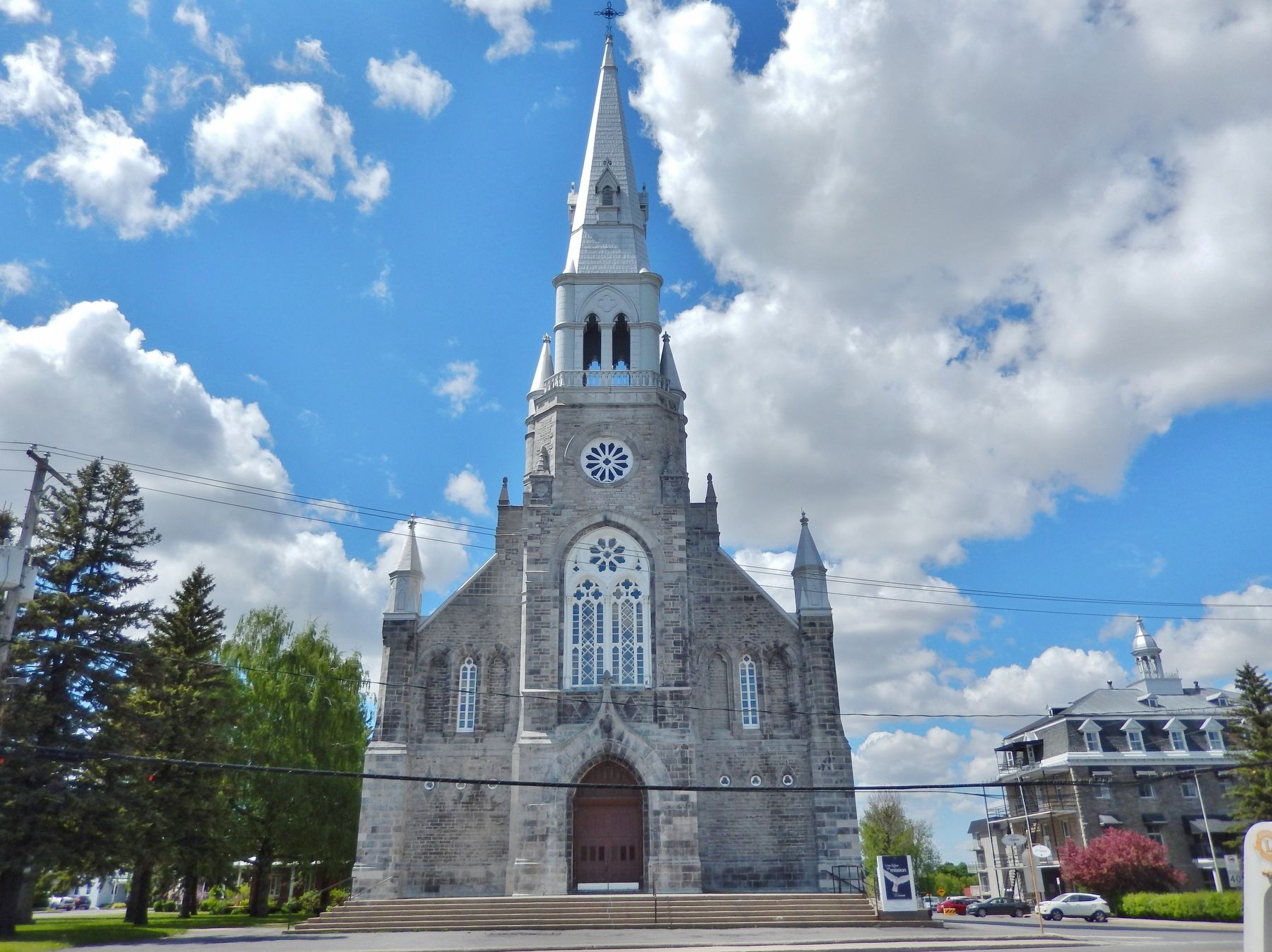
4. St. Cyprian Catholic Church
This building, which later became the convent of the Sisters of Sainte-Anne, was destroyed by fire during the new church fire on December 5, 1886.
In the fall of 1988, the 150th Anniversary Celebration Committee of the Patriots took advantage of a ceremony at the Napierville church to reimburse the amount of money that had been “borrowed” by Dr. Côté.
Erected by Municipalité de Napierville / Municipality of Napierville. (Marker Number 8.)
Topics. This historical marker is listed in these topic lists: Colonial Era • Patriots & Patriotism • Religion & Religious Structures • Wars, Non-US. A significant historical month for this entry is November 1838.
Location. 45° 11.337′ N, 73° 24.225′ W. Marker is in Napierville, Québec, in Les Jardins-de-Napierville. It is on Rue de l'Église (Québec Route 219) just north of Rue Saint-Alexandre, on the right when traveling south. The marker overlooks the wooded lot on the south side of St. Cyprian Catholic Church. Touch for map. Marker is at or near this postal address: 330 Rue Saint-Alexandre, Napierville QC J0J 1L0, Canada. Touch for directions.

Regionally, this marker is in Central Canada. Globally, it is in North America, the Western Hemisphere, and the Western World. Historically, it finds itself in what was once a British colony, the Viceroyalty of New France, the Haudenosaunee (Iroquois) Confederacy, and Rupert’s Land.
Other nearby markers. At least 8 other markers are within walking distance of this marker: Magasin d'Allen Clark (within shouting distance of this marker); Napierville Historique (within shouting distance of this marker); Docteur C.-H.-O. Côté, m.d. (about 180 meters away, measured in a direct line); Jean-Baptiste Lukin N.P. (about 210 meters away); La Prison (about 210 meters away); C'est ici que fut proclamée la République du Bas-Canada (about 210 meters away); Palais de Justice et prison du comté de L'Acadie / Acadie County Court House and Goal (about 240 meters away); Loop Odell (approx. 0.3 kilometers away). Touch for a list and map of all markers in Napierville.
Also see . . . Lower Canada Rebellion (Wikipedia).
Excerpt: The Lower Canada Rebellion, commonly referred to as the Patriots' Rebellion in French, is the name given to the armed conflict in 1837–38 between rebels and the British colonial government of Lower Canada (now southern Quebec). Together with the simultaneous rebellion in the neighbouring colony of Upper Canada (now southern Ontario), it formed the Rebellions of 1837–38. As a result of the rebellions, the Province of Canada was created from the former Lower Canada and Upper Canada. In Quebec, the rebellion, as well as the parliamentary and popular struggle, is now commemorated as the Journée nationale des Patriotes (National Patriots' Day) on the Canadian statutory holiday, Victoria Day.(Submitted on November 6, 2026, by Cosmos Mariner of Cape Canaveral, Florida.)
Credits. This page was last revised on November 7, 2026. It was originally submitted on November 6, 2026, by Cosmos Mariner of Cape Canaveral, Florida. This page has been viewed 12 times since then. Photos: 1, 2, 3, 4. submitted on November 6, 2026, by Cosmos Mariner of Cape Canaveral, Florida.
