Ankeny in Polk County, Iowa — The American Midwest (Upper Plains)
Why a Barn Style Museum?
Photographed by Jason Voigt, October 18, 2026
1. Why a Barn Style Museum? Marker
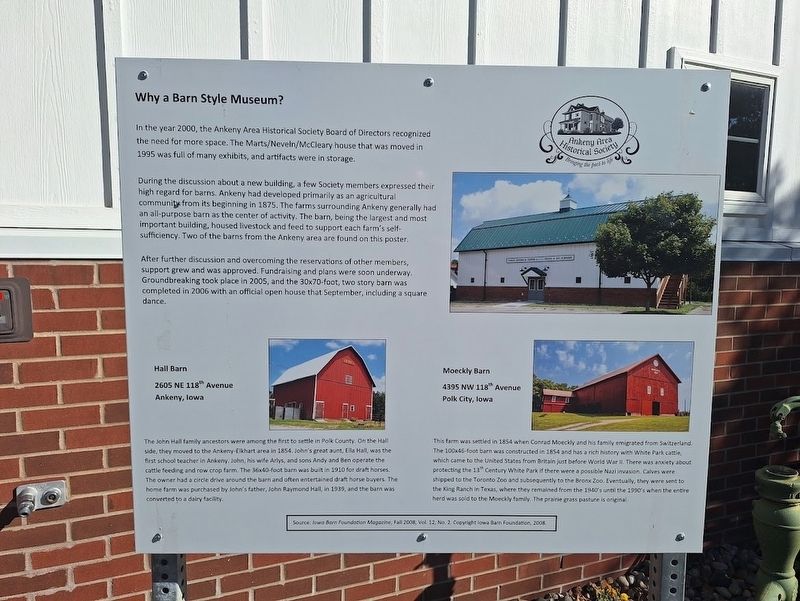
In the year 2000, the Ankeny Area Historical Society Board of Directors recognized the need for more space. The Marts/Neveln/McCleary house that was moved in 1995 was full of many exhibits, and artifacts were in storage.
During the discussion about a new building, a few Society members expressed their high regard for barns. Ankeny had developed primarily as an agricultural community from its beginning in 1875. The farms surrounding Ankeny generally had an all-purpose barn as the center of activity. The barn, being the largest and most important building, housed livestock and feed to support each farm's self-sufficiency. Two of the barns from the Ankeny area are found on this poster.
After further discussion and overcoming the reservations of other members, support grew and was approved. Fundraising and plans were soon underway. Groundbreaking took place in 2005, and the 30x70-foot, two story barn was completed in 2006 with an official open house that September, including a square dance.
Hall Barn
2605 NE 118th Avenue
Ankeny, Iowa
The John Hall family members were among the first to settle in Polk County.
this page online
Moeckly Barn
4395 NW 118th Avenue
Polk City, Iowa
This farm was settled in 1854 when Conrad Moeckly and his family emigrated from Switzerland. The 100x46-foot barn was constructed in 1854 and has a rich history with White Park cattle, which came to the United States from Britain just before World War II. There was anxiety about protecting the 13th Century White Park if there were a possible Nazi invasion. Calves were shipped to the Toronto Zoo and subsequently to the Bronx Zoo. Eventually, they were sent to the King Ranch in Texas, where they remained from the 1940's until the 1990's when the entire herd was sold to the Moeckly family. The prairie

Photographed by Jason Voigt, October 18, 2026
2. Why a Barn Style Museum? Marker
Erected by Ankeny Area Historical Society.
Topics. This historical marker is listed in these topic lists: Agriculture • Immigration • Settlements & Settlers • War, World II. A significant historical year for this entry is 2000.
Location. 41° 43.747′ N, 93° 36.216′ W. Marker is in Ankeny, Iowa, in Polk County. It can be reached from Southwest School Street south of Southwest 3rd Street. Touch for map. Marker is at or near this postal address: 304 SW School St, Ankeny IA 50023, United States of America. Touch for directions.

Regionally, this marker is in Greater Des Moines. It is also in the American Midwest and in the Corn Belt. Globally, it is in North America, the Western Hemisphere, the Western World, and the Anglosphere. Historically, it finds itself in what was once the territory of the Mississippian Culture and also the Louisiana Purchase.
Other nearby markers. At least 8 other markers are within 10 miles of this marker, measured as the crow flies: "The Bell" (a few steps from this marker); Marts/Neveln/McCleary House (within shouting distance of this marker); Town Square (approx. 6.4 miles away); Big Creek Schoolhouse (approx. 6.4 miles away); Polk County Freedom Rock (approx. 7.1 miles away); Ida B. Wise Smith (approx. 8.1 miles away); Paint It Black (approx. 9.2 miles away); Laos (approx. 9.3 miles away). Touch for a list and map of all markers in Ankeny.
Also see . . . Ankeny Area Historical Society. (Submitted on November 7, 2026, by Jason Voigt of Glen Carbon, Illinois.)
Credits. This page was last revised on November 7, 2026. It was originally submitted on November 7, 2026, by Jason Voigt of Glen Carbon, Illinois. This page has been viewed 12 times since then. Photos: 1, 2. submitted on November 7, 2026, by Jason Voigt of Glen Carbon, Illinois.
