Sioux City in Woodbury County, Iowa — The American Midwest (Upper Plains)
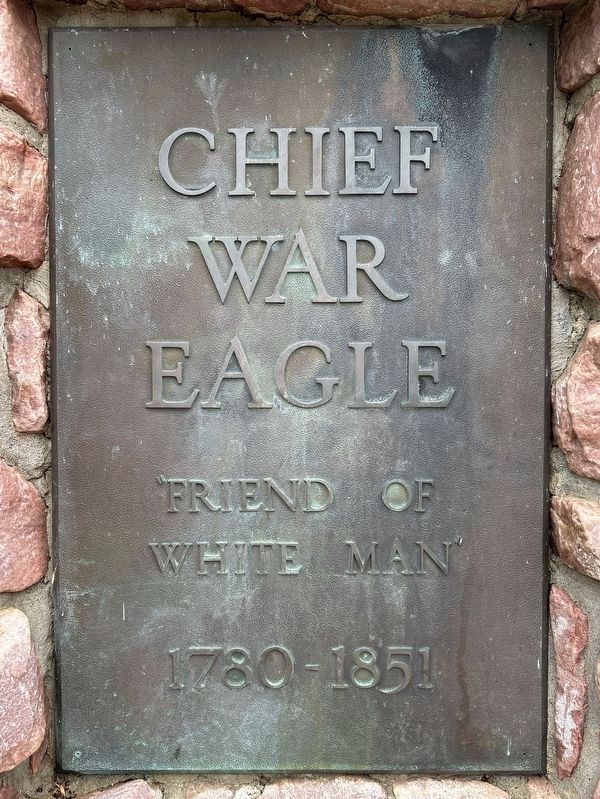
Chief War Eagle
"Friend of White Man"
| — | 1780-1851 | — |
September 26, 2026
1. Chief War Eagle, West Side Marker
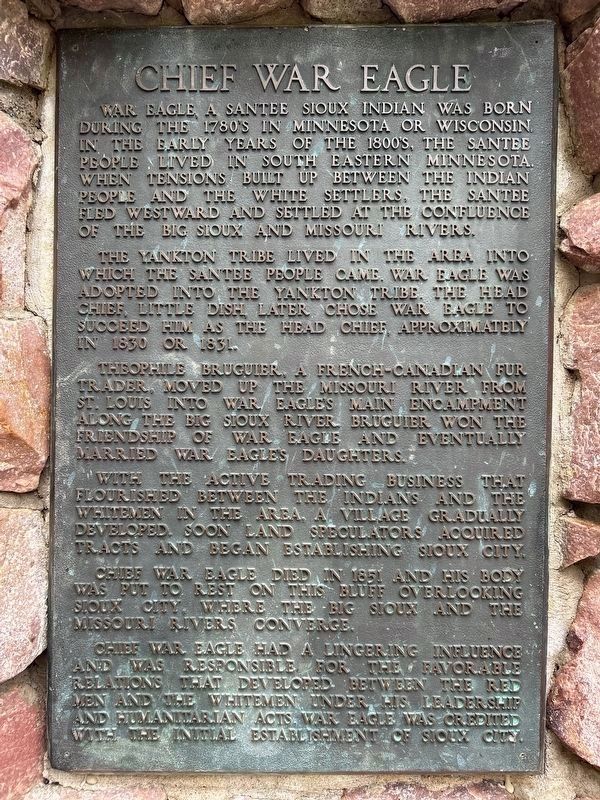
Chief War Eagle
War Eagle, a Santee Sioux Indian was born during the 1780's in Minnesota or Wisconsin. In the early years of the 1800's, the Santee people lived in south eastern Minnesota. When tensions built up between the Indian people and the white settlers, the Santee fled westward and settled at the confluence of the Big Sioux and Missouri Rivers.
The Yankton Tribe lived in the area into which the Santee people came. War Eagle was adopted into the Yankton Tribe. The head chief, Little Dish, later chose War Eagle to succeed him as the head chief, approximately in 1830 or 1831.
Theophile Bruguier, a French-Canadian fur trader, moved up the Missouri River from St. Louis into War Eagle's main encampment along the Big Sioux River. Bruguier won the friendship of War Eagle and eventually married War Eagle's daughters.
With the active trading business that flourished between the Indians and the whitemen in the area, a village gradually developed. Soon land speculators acquired tracts and began establishing Sioux City.
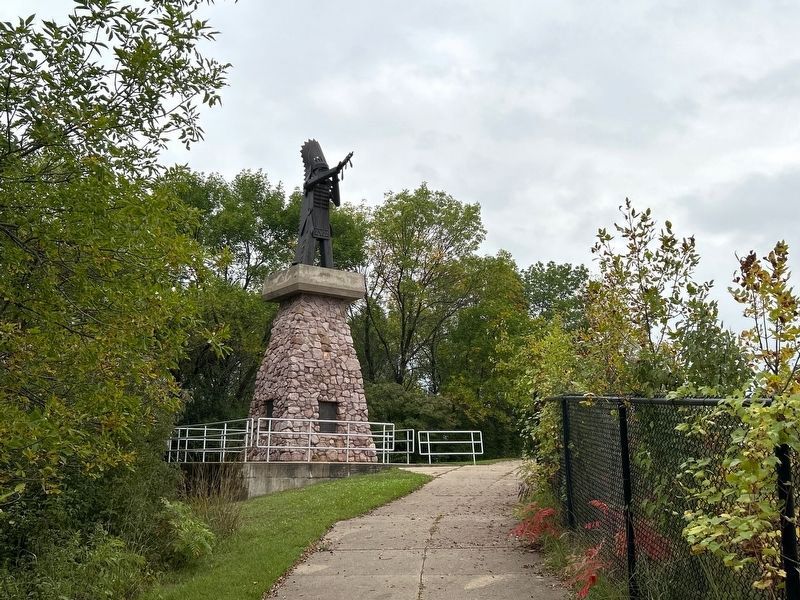
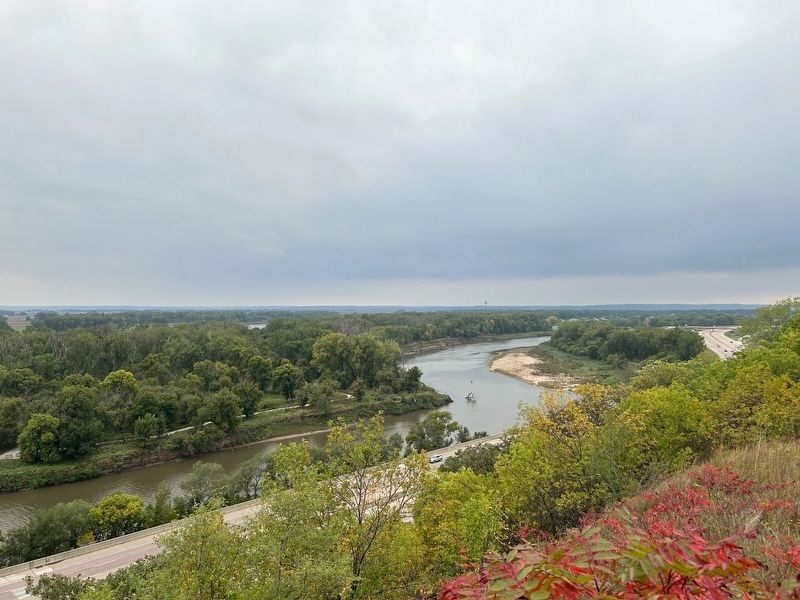
Chief War Eagle died in 1851 and his body was put to rest on this bluff overlooking Sioux City,
this page online
Chief War Eagle had a lingering influence and was responsible for the favorable relations that developed between the red men and the whitemen under his leadership and humanitarian acts. War Eagle was credited with the initial establishment of Sioux City.
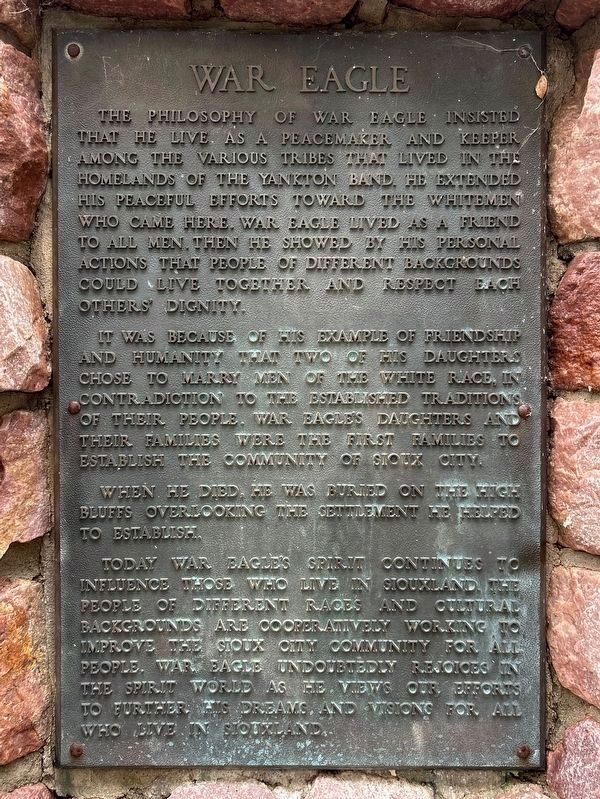
War Eagle
The philosophy of War Eagle insisted that he live as a peacemaker and keeper among the various tribes that lived in the homelands of the Yankton band. He extended his peaceful efforts toward the whitemen who came here. War Eagle lived as a friend to all men. Then he showed by his personal actions that people of different backgrounds could live together and respect each others' dignity.
It was because of his example of friendship and humanity that two of his daughters chose to marry men of the white race, in contradiction to the established traditions of their people. War Eagle's daughters and their families were the first families to establish the community of Sioux City.
When he died, he was buried on the high bluffs overlooking the settlement he helped to establish.
Today War Eagle's spirit continues
September 26, 2026
2. Chief War Eagle, North Side Marker
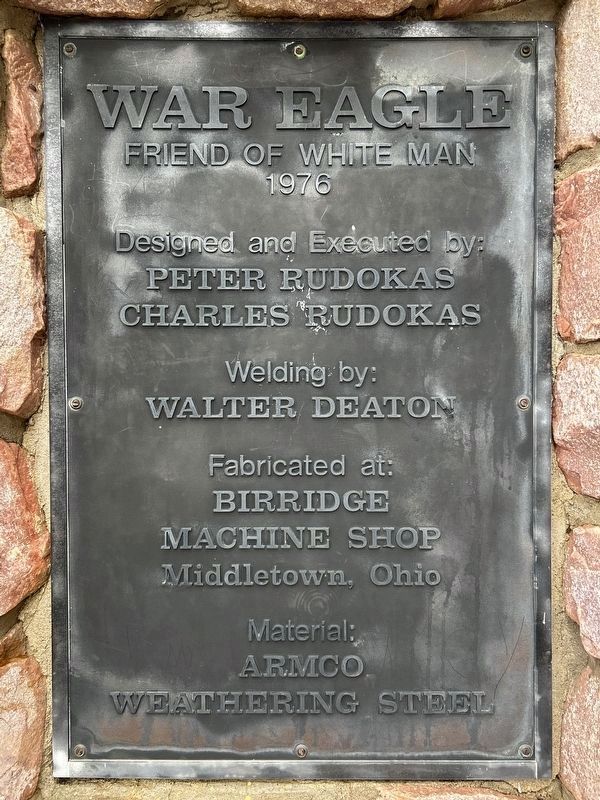
War Eagle
Friend of White Man
1976
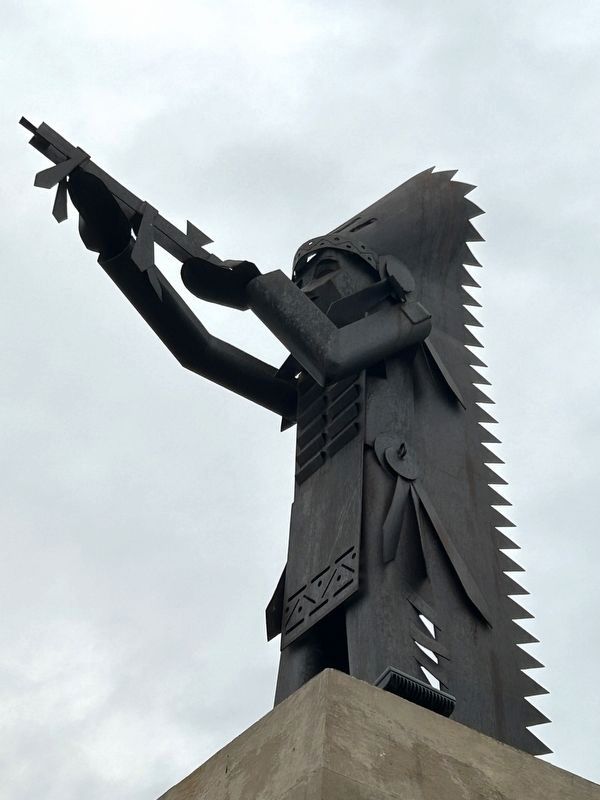
Designed and Executed by: Peter Rudokas · Charles Rudokas
Welding by: Walter Deaton
Fabricated at: Birridge Machine Shop Middletown, Ohio
Material: ARMCO Weathering Steel
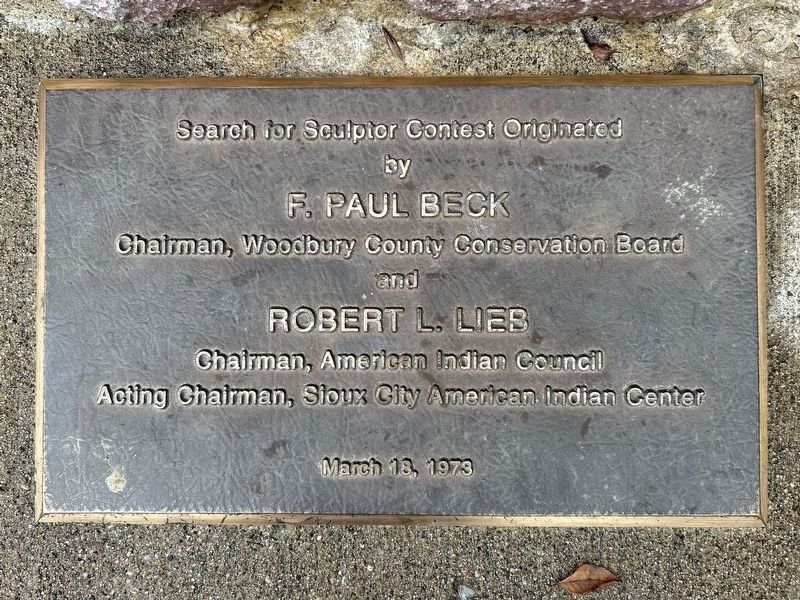
Search for Sculptor Contest Originated by
F. Paul Beck
Chairman, Woodbury County Conservation Board and
Robert L. Lieb
Chairman, American Indian Council
Acting Chairman, Sioux City American Indian Center
March 18, 1973
Erected 1976.
Topics. This historical marker is listed in these topic lists: Indigenous Peoples and Communities • Peace • Settlements & Settlers • Waterways & Vessels. A significant historical year for this entry is 1830.
Location. 42° 29.627′ N, 96° 27.154′ W. Marker is in Sioux City, Iowa, in Woodbury County. It can be reached from War Eagle Drive north of Grove
September 26, 2026
3. War Eagle, East Side Marker

Regionally, this marker is in Western Iowa and in Loess Hills. It is also in the American Midwest, in the Lewis & Clark Corridor, and in the Corn Belt. Globally, it is in North America, the Western Hemisphere, the Western World, and the Anglosphere. Historically, it finds itself in what was once the territory of the Mississippian Culture and also the Louisiana Purchase.
Other nearby markers. At least 8 other markers are within 2 miles of this marker, measured as the crow flies: Peace and Friendship (about 300 feet away, measured in a direct line); Theophile Bruguier (about 300 feet away); Old Missouri River Trail (about 600 feet away); a different marker also named The Old Missouri River Trail (about 600 feet away); M.V. Sergeant Floyd (approx. 1.8 miles away); The Lewis & Clark Expedition (approx. 1.8 miles away); Prospect Hill (approx. 1.9 miles away); Pacific Short Line Bridge (approx. 2.1 miles away). Touch for a list and map of all markers
September 26, 2026
4. War Eagle, South Side Marker
Also see . . . War Eagle — Sioux City Public Museum. (Submitted on November 7, 2026.)
Additional keywords. Waŋbdí Okíčhize, Wanbdi Okichize, Wambdi Okicize
September 26, 2026
5. Additional South Side Plaque
September 26, 2026
6. War Eagle Monument & Sculpture
September 26, 2026
7. Chief War Eagle Sculpture
September 26, 2026
8. War Eagle's View over the Big Sioux and Missouri Rivers
Credits. This page was last revised on November 8, 2026. It was originally submitted on November 7, 2026. This page has been viewed 9 times since then. Photos: 1, 2, 3, 4, 5, 6, 7, 8. submitted on November 7, 2026.
