Near Atkinson in Pender County, North Carolina — The American South (South Atlantic)
"My Native Land I Must Forego, And Roam a Lonely Stranger"
Moores Creek National Battlefield
| — | National Park Service, U.S. Department of the Interior | — |
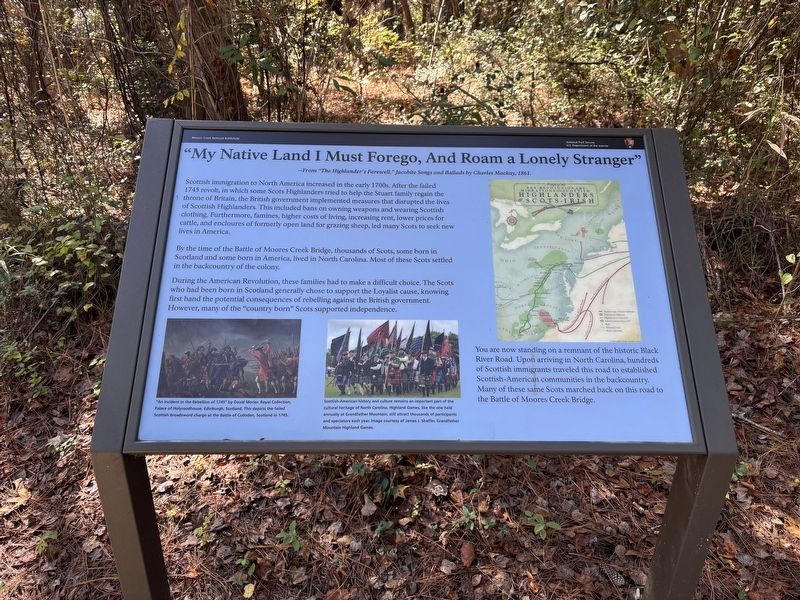
Photographed by Benjamin Rubin, November 8, 2026
1. "My Native Land I Must Forego, And Roam a Lonely Stranger" Marker
"My Native Land I Must Forego, And Roam a Lonely Stranger"
--From "The Highlander's Farewell" Jacobite Songs and Ballads by Charles Mackay, 1861.
Scottish immigration to North America increased in the early 1700s. After the failed 1745 revolt, in which some Scots Highlanders tried to help the Stuart family regain the throne of Britain, the British government implemented measures that disrupted the lives of Scottish Highlanders. This included bans on owning weapons and wearing Scottish clothing. Furthermore, famines, higher costs of living, increasing rent, lower prices for cattle, and encloures of formerly open land for grazing sheep, led many Scots to seek new lives in America.
By the time of the Battle of Moores Creek Bridge, thousands of Scots, some born in Scotland and some born in America, lived in North Carolina. Most of these Scots settled in the backcountry of the colony.
During the American Revolution, these families had to make a difficult choice. The Scots who had been born in Scotland generally chose to support the Loyalist cause, knowing first hand the potential consequences of rebelling against
this page online
You are now standing on a remnant of the historic Black River Road. Upon arriving in North Carolina, hundreds of Scottish immigrants traveled this road to established Scottish-American communities in the backcountry. Many of these same Scots marched back on this road to the Battle of Moores Creek Bridge.
(captions)
"An Incident in the Rebellion of 1745" by David Morier. Royal Collection, Palace of Holyroodhouse. Edinburgh. Scotland. This depicts the failed Scottish broadsword charge at the Battle of Culloden, Scotland in 1745.
Scottish-American history and culture remains an important part of the cultural heritage of North Carolina. Highland Games, like the one held annually at Grandfather Mountain, still attract thousands of participants and spectators each year. Image courtesy of James J. Shaffer, Grandfather Mountain Highland Games.
Erected by National Park Service, U.S. Department of the Interior.
Topics. This historical marker is listed in these topic lists: Colonial Era • Immigration • Settlements & Settlers • War, US Revolutionary. A significant historical year for this entry is 1745.
Location. 34° 27.562′ N, 78° 6.849′ W. Marker is near Atkinson, North Carolina, in Pender County. It can be reached from Patriots Hall Drive west of Moores Creek Drive, on the left when traveling west. Located on the west side of Moores Creek along the battlefield walking trail. Touch for map. Marker is at or near this postal address: 40 Patriots Hall Dr, Atkinson NC 28421, United States of America. Touch for directions.

Regionally, this marker is in the Coastal Plain. It is also in the American South, specifically in the Upper South, in the Tidewater, and on the Eastern Seaboard. Globally, it is in the North Atlantic Region, North America, the Western Hemisphere, the Western World, and the Anglosphere. Historically, it finds itself in what was once the territory of the Mississippian Culture, one of the original Thirteen Colonies, one of the Confederate States of America, and the Antebellum South.
Other nearby markers. At least 8 other markers are within walking distance of this marker: A Trap is Set (a few steps from this marker); Widow Moores' Bridge (within shouting distance of this marker); Stunning Defeat (about 500 feet away, measured in a direct line); Old Wilmington and Fayetteville Stage Road (about 600 feet away); Decisive Victory (about 600 feet away); Wisely Chosen Ground (about 600 feet away); Aftermath of Moores Creek (about 700 feet away); A Very Bad Swamp ... (about 700 feet away).
Also see . . . Moores Creek National Battlefield. National Park Service (Submitted on November 10, 2026.)
Credits. This page was last revised on November 10, 2026. It was originally submitted on November 10, 2026, by Benjamin Rubin of Columbia, South Carolina. This page has been viewed 10 times since then. Last updated on November 10, 2026, by Benjamin Rubin of Columbia, South Carolina. Photo 1. submitted on November 10, 2026, by Benjamin Rubin of Columbia, South Carolina. • Devry Becker Jones was the editor who published this page.
