Prittlewell in Southend-on-Sea, England, United Kingdom — Northwestern Europe (the British Isles)
A History of Prittlewell
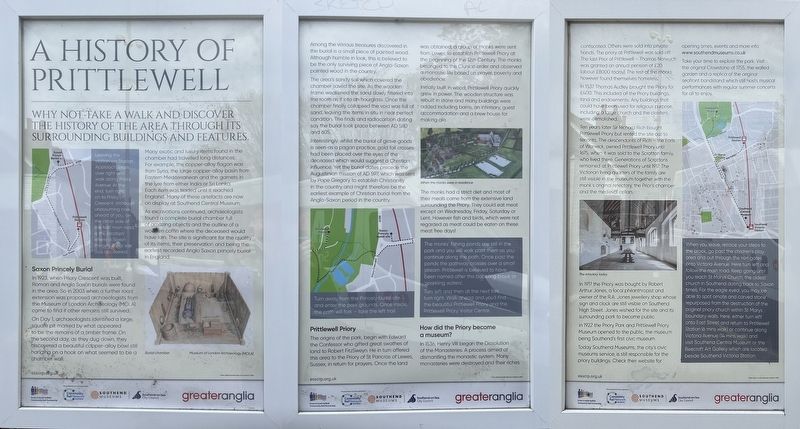
Photographed by Ray Gurganus
1. A History of Prittlewell Marker
Saxon Princely Burial
In 1923, when Priory Crescent was built, Roman and Anglo Saxon burials were found in the area. So in 2003 when a further road extension was proposed archaeologists from the Museum of London Archaeology (MOLA) came to find if other remains still survived.
On Day 1, archaeologists identified a large, square pit marked by what appeared to be the remains of a timber frame. On the second day, as they dug down, they discovered a beautiful copper-alloy bowl still hanging on a hook on what seemed to be a chamber wall.
Many exotic and luxury items found in the chamber had travelled long distances. For example, the copper-alloy flagon was from Syria, the large copper-alloy basin from Eastern Mediterranean and the garnets in the lyre from either India or Sri Lanka. Each item was traded until it reached England. Many of these artefacts are now on display at Southend Central Museum.
As excavations continued, archaeologists found a complete burial chamber full of amazing objects and the outline
this page online
Among the various treasures discovered in the burial is a small piece of painted wood. Although humble in look, this is believed to be the only surviving piece of Anglo-Saxon painted wood in the country.
The area's sandy soil which covered the chamber saved the site. As the wooden frame weakened the sand slowly filtered into the room as if into an hourglass. Once the chamber finally collapsed the void was full of sand, leaving the items in situ in near perfect condition. The finds and radiocarbon dating say the burial took place between AD 580 and 605.
Interestingly, whilst the burial of grave goods is seen as a pagan practice, gold foil crosses had been placed over the eyes of the deceased which would suggest a Christian influence. Yet the burial dates precede the Augustinian mission of AD 597, which was sent by Pope Gregory to establish Christianity in the country and might therefore be the earliest example of Christian burial from the Anglo-Saxon period in the country.
Prittlewell Priory
The origins of the park, begin with Edward the Confessor who gifted great swathes of land to Robert FitzSweyn. He in turn offered this area to the Priory of St Pancras of Lewes, Sussex, in return for prayers. Once the land was obtained, a group of monks were sent from Lewes to establish Prittlewell Priory at the beginning of the 12th Century. The monks belonged to the Cluniac order and observed a monastic life based on prayer, poverty and obedience.
Initially built in wood, Prittlewell Priory quickly grew in power. The wooden structure was rebuilt in stone and many buildings were added including barns, an infirmary, guest accommodation and a brew house for making ale.
The monks had a strict diet and most of their meals came from the extensive land surrounding the Priory. They could eat meat except on Wednesday, Friday, Saturday or Lent. However fish and birds, which were not regarded as meat could be eaten on these meat free days!
The monks' fishing ponds are still in the park and you will walk past them as you continue along the path. Once past the ponds the pathway crosses over a small stream. Prittlewell is believed to have been named after this babbling brook or 'sparkling waters'.
Turn left and then at the next fork, turn right. Walk ahead and you'll find the beautiful Prittlewell Priory and the Prittlewell Priory Visitor Centre.
How did the Priory become a museum?
In 1536, Henry VIII began the Dissolution of the Monasteries. A process aimed at dismantling the monastic system. Many monasteries were destroyed and their riches confiscated. Others were sold into private hands. The priory at Prittlewell was sold off. The last Prior of Prittlewell - Thomas Norwych was granted an annual pension of £20 (about £8000 today). The rest of the monks however found themselves homeless.
In 1537 Thomas Audley brought the Priory for £400. This included all the Priory buildings, land and endowments. Any buildings that could have been used for religious purpose, including a large church and the cloisters, were demolished.
Ten years later Sir Richard Rich bought Prittlewell Priory but rented the site out to tenants. The descendants of Rich - the Earls of Warwick, owned Prittlewell Priory until 1675, when it was sold to the Scratton family, who lived there. Generations of Scrattons remained at Prittlewell Priory until 1917. The Victorian living quarters of the family are still visible in the museum together with the monk's original refectory, the Prior's chamber and the medieval cellars.
In 1917 the Priory was bought by Robert Arthur Jones, a local philanthropist and owner of the R.A. Jones jewellery shop whose sign and clock are still visible on Southend High Street. Jones wished for the site and its surrounding park to become public.
In 1922 the Priory Park and Prittlewell Priory Museum opened to the public, the museum being Southend's first civic museum.
Today Southend Museums, the city's civic museums service, is still responsible for the priory buildings. Check their website for opening times, events and more info: www.southendmuseums.co.uk
Take your time to explore the park. Visit the original Crowstone of 1755, the walled garden and a replica of the original seafront bandstand which still hosts musical performances with regular summer concerts for all to enjoy.
When you leave, retrace your steps to the brook, go past the children's play area and out through the iron gates onto Victoria Avenue. Here turn left and follow the main road. Keep going until you reach St Marys Church, the oldest church in Southend dating back to Saxon times. For the eagle eyed, you may be able to spot ornate and carved stone repurposed from the destruction of the original priory church within St Marys boundary walls. Here, either turn left onto East Street and return to Prittlewell Station (6 mins walk) or continue along Victoria Avenue (14 mins walk) and visit Southend Central Museum or the Beecroft Art Gallery which are located beside Southend Victoria Station.
Erected by Greater Anglia.
Topics. This historical marker is listed in these topic lists: Anthropology & Archaeology • Cemeteries & Burial Sites • Religion & Religious Structures.
Location. 51° 33.025′ N, 0° 42.628′ E. Marker is in Southend-on-Sea, England. It is in Prittlewell. It is on Station Approach, on the right when traveling north. Touch for map. Marker is at or near this postal address: Station Approach, Southend-on-Sea, England SS2 6LD, United Kingdom. Touch for directions.

Regionally, it is on the Atlantic Ocean, in the North Atlantic Region, in Europe, in Atlantic Europe, on one of the British Isles, in the Western World, and in the Anglosphere. Historically, it finds itself in what was once the Roman Empire.
Other nearby markers. At least 8 other markers are within 10 kilometers of this marker, measured as the crow flies: St John the Baptist Church Gardens (approx. 1.8 kilometers away); Welcome to the Southend Cliff Gardens (approx. 1.9 kilometers away); Sub. Lt. Martin Solomon (approx. 4.3 kilometers away); Area of Correction (approx. 8.2 kilometers away); Tower Mill (approx. 8.4 kilometers away); Rayleigh Mount (approx. 8.4 kilometers away); a different marker also named Rayleigh Mount (approx. 8.5 kilometers away); a different marker also named Rayleigh Mount (approx. 8.6 kilometers away). Touch for a list and map of all markers in Southend-on-Sea.
Also see . . . Prittlewell royal Anglo-Saxon burial (Wikipedia). (Submitted on November 11, 2026.)
Credits. This page was last revised on November 11, 2026. It was originally submitted on November 10, 2026, by Ray Gurganus of Washington, District of Columbia. This page has been viewed 6 times since then. Photo 1. submitted on November 10, 2026, by Ray Gurganus of Washington, District of Columbia. • Andrew Ruppenstein was the editor who published this page.
Editor’s want-list for this marker. photo of the marker within its surroundings • Can you help?
