Sallisaw in Sequoyah County, Oklahoma — The American South (West South Central)
History of the Judge Franklin Faulkner Home
By Tom F. and Echo Rider
| — | November 15, 1986 | — |
Photographed by Cosmos Mariner, September 12, 2024
1. History of the Judge Franklin Faulkner Home Marker

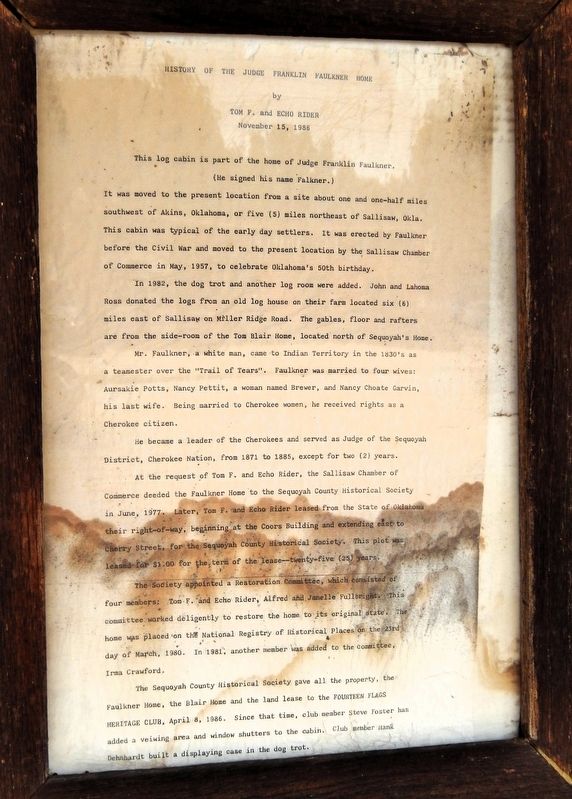
This log cabin is part of the home of Judge Franklin Faulkner. (He signed his name Falkner.)
It was moved to the present location from a site about one and one-half miles southwest of Akins, Oklahoma, or five miles northeast of Sallisaw, Okla. This cabin was typical of the early day settlers. It was erected by Faulkner before the Civil War and moved to the present location by the Sallisaw Chamber of Commerce in May 1957, to celebrate Oklahoma's 50th birthday.
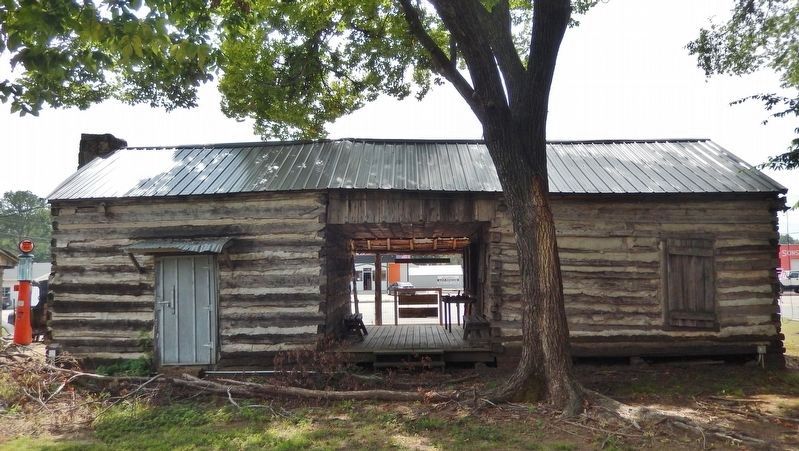
In 1982, the dog trot and another log room were added. John and Lahoma Ross donated the logs from an old log house on their farm located six miles east of Sallisaw on Miller Ridge Road. The gables, floor and rafters are from the side-room of the Tom Blair Home, located north of Sequoyah's Home.
Mr. Faulkner, a white man, came to Indian Territory in the 1830's as a teamster over the “Trail of Tears”. Faulkner was married to four wives: Aursakie Potts, Nancy Pettit, a woman named Brewer, and Nancy Choate Garvin, his last wife. Being married to Cherokee women, he received rights as a Cherokee citizen.
He became a leader of the Cherokees and served as Judge of the
this page online
At the request of Tom F. and Echo Rider, the Sallisaw Chamber of Commerce deeded the Faulkner Home to the Sequoyah County Historical Society in June 1977. Later, Tom F. and Echo Rider leased from the State of Oklahoma their right-of-way, beginning at the Coors Building and extending east to Cherry Street, for the Sequoyah County Historical Society. This plot was leased for $1.00 for the term of the lease — twenty-five years.
The Society appointed a Restoration Committee, which consisted of four members: Tom F. and Echo Rider, Alfred and Janelle Fullbright. This committee worked diligently to restore the home to its original state. The home was placed on the National Registry of Historical Places on the 23rd day of March 1980. In 1981, another member was added to the committee, Irma Crawford.
The Sequoyah County Historical Society gave all the property, the Faulkner Home, the Blair Home and the land lease to the Fourteen Flags Heritage Club, April 8, 1986. Since that time, club member Steve Foster has added a viewing area and window shutters to the cabin. Club
Photographed by Cosmos Mariner, September 12, 2024
2. History of the Judge Franklin Faulkner Home Marker
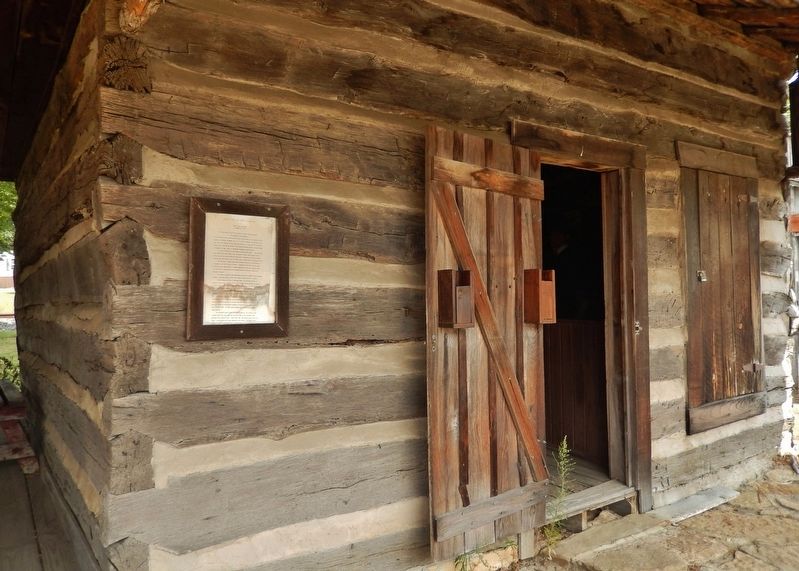
The marker is on the left side of the front entrance.
Topics and series. This historical marker is listed in these topic lists: Charity & Public Work • Indigenous Peoples and Communities • Law Enforcement • Settlements & Settlers. In addition, it is included in the National Register of Historic Places (NRHP) series list. A significant historical year for this entry is 1845.
Location. 35° 27.659′ N, 94° 47.148′ W. Marker is in Sallisaw, Oklahoma, in Sequoyah County. It is on East Cherokee Avenue (U.S. 64) just east of North Wheeler Avenue (U.S. 59), on the left when traveling east. The marker is mounted directly on the subject building, on the left side of the front entrance. Touch for map. Marker is at or near this postal address: 400 East Cherokee Avenue, Sallisaw OK 74955, United States of America. Touch for directions.

Regionally, this marker is in the Cherokee Nation and in Northeast Oklahoma—Green Country. It is also in the American South, specifically in the Ozarks, on the prairies, and on the Southern Plains. Globally, it is in North America, the Western Hemisphere, the Western World, and the
Photographed by Cosmos Mariner, September 12, 2024
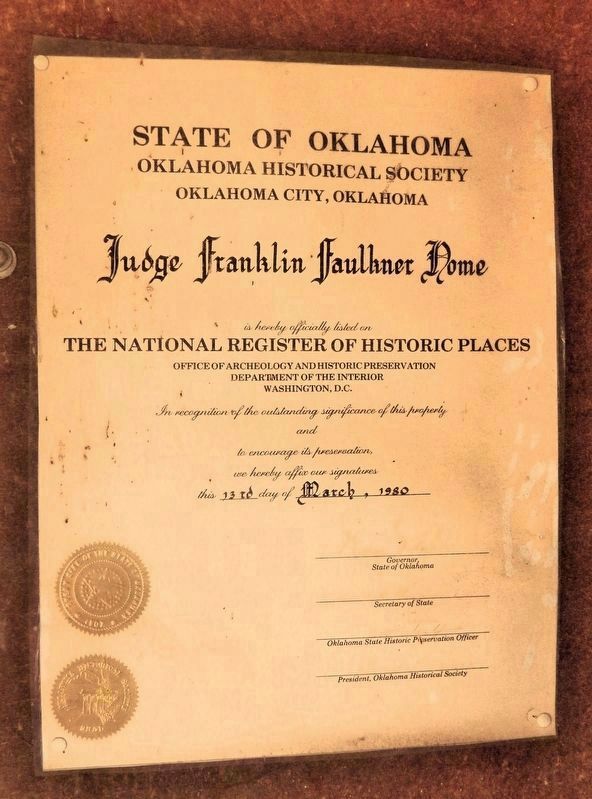
3. National Register of Historic Places Certificate
State of Oklahoma
Oklahoma Historical Society
Oklahoma City, Oklahoma
Judge Franklin Faulkner Home
is hereby officially listed in
The National Register of Historic Places
Office of Archaeology and Historic Preservation
Department of the Interior
Washington, D.C.
March 13, 1980
Other nearby markers. At least 8 other markers are within 9 miles of this marker, measured as the crow flies: Lattimore Log Cabin (a few steps from this marker); The Spirit of '76 (approx. ¼ mile away); Sallisaw High School (approx. 0.4 miles away); Hoppy Lockhart Welcome Center (approx. 4.4 miles away); Dwight Mission (approx. 5.3 miles away); Cephas Washburn (approx. 7.1 miles away); Dwight Presbyterian Mission (approx. 7.1 miles away); Sequoyah Waterfall Memorial (approx. 8.4 miles away). Touch for a list and map of all markers in Sallisaw.
Regarding History of the Judge Franklin Faulkner Home. National Register of Historic Places № 80003301.
From the National Register Nomination prepared by Kent Ruth, August 1979:
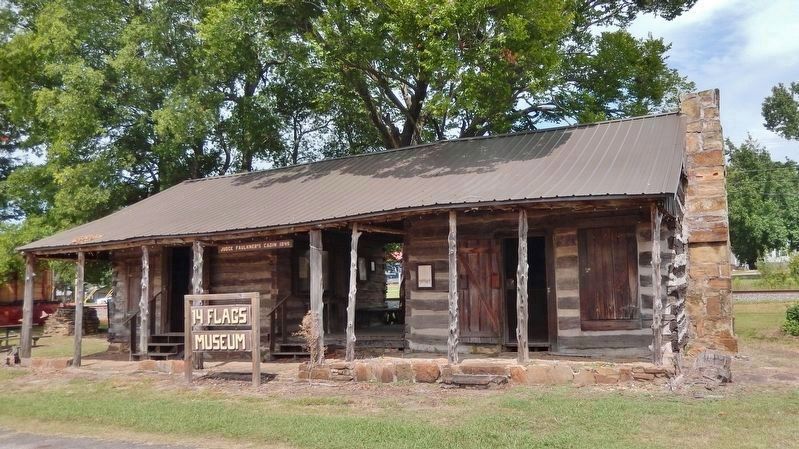
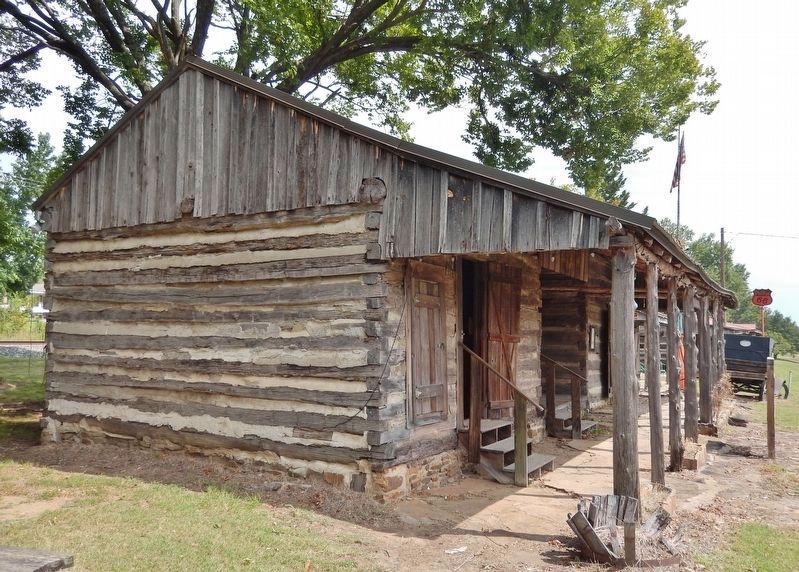
The Faulkner cabin was probably built in 1845 and is a typical — almost prototype — affair of early pioneer days, whatever the frontier. It was 18-x-18 feet in size with a front and back door and a single front window. The plain hip roof was extended in front to cover an8-x-18-foot porch, supported by cedar posts. Walls were of sawed logs, hand-notched at the corners, and mud-chinked. A massive stone chimney served a single fireplace.Photographed by Cosmos Mariner, September 12, 20244. Judge Franklin Faulkner Cabin (southeast elevation)Today it houses the 14 Flags Museum.
In 1956 the cabin, abandoned and threatened with destruction, was removed to a downtown location in nearby Sallisaw, some six miles to the southwest. There it was carefully restored. Only one log had to be replaced. The chimney was marked stone by stone, dismantled, and then re-laid at the new site. The interior mantel is at least partly original. The original floor remains, although a simple (rustic) new floor has been laid over it to protect it. The cabin now serves as a primarily summer-time-only information center for visitors. It contains some period furnishings, however, so it also serves as an informal pioneer or early Oklahoman museum.
Very few log structures of the age of the Faulkner Cabin still exist in Oklahoma today. Fewer still exist as complete and in near-original condition.
Franklin Faulkner might well represent the not insignificant number of non-Indians, mostly of West European stock, who cast their lot with the Cherokees when they were being pushedout of the Southeast, who accompanied them westward over the “Trail of Tears,” and who, through intermarriage, continued to play a role in the building of the Cherokee Nation for the rest of their lives. If not the most important of these self-adopted Cherokees, neither was he the least.Photographed by Cosmos Mariner, September 12, 20245. Judge Franklin Faulkner Cabin (southwest elevation)
Franklin Faulkner was one of eight sons born (about 1810) to white settlers living in the old Cherokee country of northern Georgia and eastern Tennessee. A young, largely self-taught lawyer when the U. S. government was forcing the Cherokees to move west of the Mississippi, he decided to go with them. He was a teamster and scout with a detachment under the command of a Captain Oldfield and the Rev. Stephen Foreman. The party left Tennessee Sept. 24, 1838, with 983 Cherokees. It arrived, with 921 members, Febr. 27, 1839.
Faulkner married a fullblood Cherokee woman soon after arriving in present Oklahoma. They had two children. When his wife died in 1845, he moved to the Sequoyah District of the Cherokee Nation — near the log home of famed alphabet-designer Sequoyah. There he built this simple log cabin. And there he married Nancy Pettit, another Cherokeewoman, and fathered six more children. After she died, he married again, twice, before his own death in 1387. And many of his numerous descendants, to the fifth and sixth generation, still live in Eastern Oklahoma. His buried, with two of his wives and several children and grandchildren in the Faulkner Cemetery, now destroyed, at the homesite.Photographed by Cosmos Mariner, September 12, 20246. Judge Franklin Faulkner Cabin (north/back elevation)
Also see . . . Judge Franklin Faulkner House (Wikipedia).
Excerpt: The Judge Franklin Faulkner House, now the 14 Flags Museum, was built around 1845. It was listed on the National Register of Historic Places in 1980. It was a 18 by 18 feet log cabin. It was moved in 1956 about six miles to downtown Sallisaw. It has also been known as Faulkner Cabin. Relatively recent photo shows a double pen log cabin. However, photos from 1979 and 1980 show a single pen cabin.(Submitted on November 13, 2026, by Cosmos Mariner of Cape Canaveral, Florida.)
Photographed by Cosmos Mariner, September 12, 2024
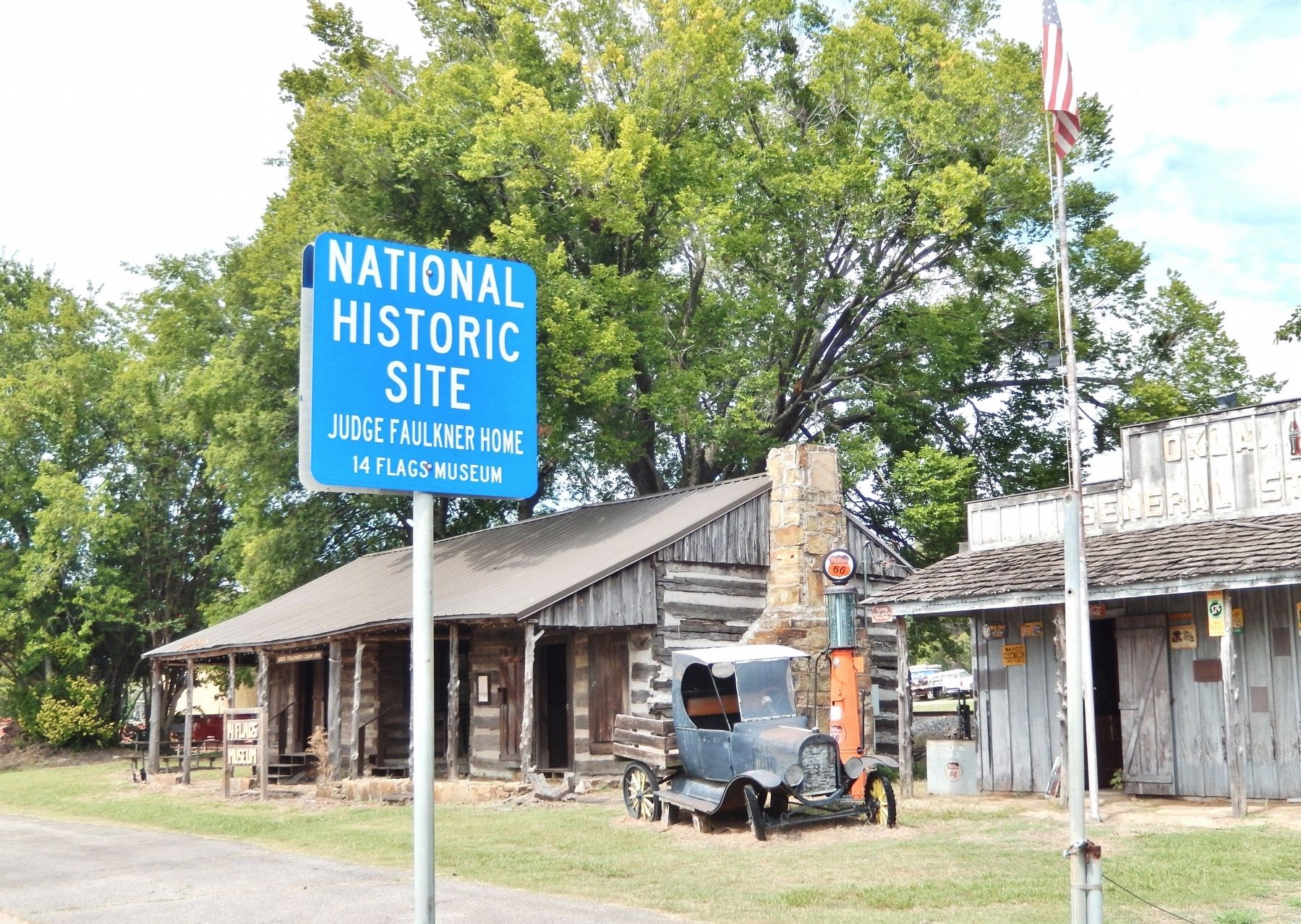
7. Judge Franklin Faulkner Cabin — National Historic Site
Credits. This page was last revised on November 13, 2026. It was originally submitted on November 11, 2026, by Cosmos Mariner of Cape Canaveral, Florida. This page has been viewed 12 times since then. Photos: 1, 2, 3, 4, 5, 6, 7. submitted on November 13, 2026, by Cosmos Mariner of Cape Canaveral, Florida.