Georgetown in Georgetown County, South Carolina — The American South (South Atlantic)
African Arrivals Beginning 1526
Georgetown, SC
| — | Middle Passage Port Marker | — |
Photographed by Kaycee Hailey, October 2026
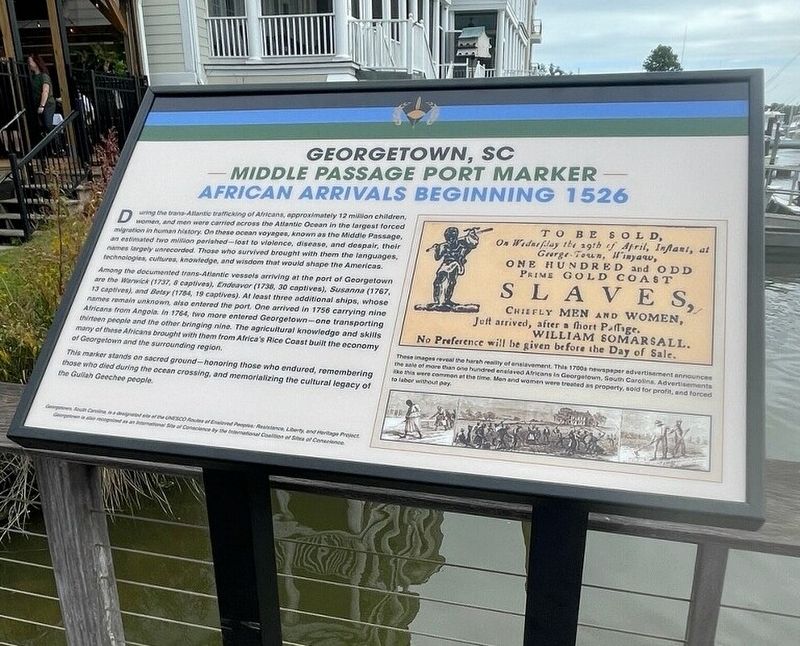
1. Georgetown, SC: Middle Passage Port Marker– African Arrivals Beginning 1526 Marker

During the trans-Atlantic trafficking of Africans, approximately 12 million children, women, and men were carried across the Atlantic Ocean in the largest forced migration in human history. On these ocean voyages, known as the Middle Passage, an estimated two million perished - lost to violence, disease, and despair, their names largely unrecorded. Those who survived brought with them the languages, technologies, cultures, knowledge, and wisdom that would shape the Americas.
Among the documented trans-Atlantic vessels arriving at the port of Georgetown are the Warwick (1737, 8 captives), Endeavor (1738, 30 captives), Susanna (1767, 13 captives), and Betsy (1784, 19 captives). At least three additional ships, whose names remain unknown, also entered the port. One arrived in 1756 carrying nine Africans from Angola. In 1764, two more entered Georgetown - one transporting thirteen people and the other bringing nine. The agricultural knowledge and skills many of these Africans brought with them from Africa's Rice Coast built the economy of Georgetown and the surrounding region.
This marker stands on sacred ground-honoring
this page online
Erected 2026 by Middle Passage Ceremonies and Port Markers Project.
Topics. This historical marker is listed in these topic lists: African Americans • Colonial Era • Industry & Commerce • Waterways & Vessels.
Location. 33° 21.964′ N, 79° 17.023′ W. Marker is in Georgetown, South Carolina, in Georgetown County. It can be reached from Front Street, on the right when traveling south. Located by the South Carolina Maritime Museum. Touch for map. Marker is at or near this postal address: 727 Front Street, Georgetown SC 29440, United States of America. Touch for directions.

Regionally, this marker is in the Pee Dee and on Waccamaw Neck. It is also in the American South, specifically in the Deep South, and on the Eastern Seaboard. Globally, it is in the North Atlantic Region, North America, the Western Hemisphere, the Western World, and the Anglosphere. Historically, it finds itself in what was once the territory of the Mississippian Culture, one of the original Thirteen Colonies, one of the Confederate States of America, and the Antebellum South.
Other nearby markers. At least 8 other markers are within walking distance of this marker: Life on the Rivers of Georgetown (a few steps from this marker); Georgetown (a few steps from this marker); Georgetown County Veteran’s Memorial (within shouting distance of this marker); a different marker also named Ship's Propeller (within shouting distance of this marker); Francis Marion (within shouting distance of this marker); Dedicated to the Memory of Major C. Spencer Guerry (within shouting distance of this marker); 801 & 803 Front Street (within shouting distance of this marker); 732 - 734 Front Street (within shouting distance of this marker). Touch for a list and map of all markers in Georgetown.
Another marker is no longer nearby. Ship’s Propeller (was within shouting distance of this marker but has been replaced with another marker now near it).
Also see . . .
1. Georgetown dedicates markers recognizing its Middle Passage history (GAB News, Oct. 26, 2026). Overview:
A well-attended ceremony took place Saturday at Maritime Park on Front Street in Georgetown to dedicate markers on the Harborwalk boardwalk and at East Bay Park, recognizing Georgetown’s history as a Middle Passage port.(Submitted on November 23, 2026.)
The markers join 22 other UNESCO Routes of Enslaved Peoples markers worldwide.
2. Annotated Bibliography (Middle Passage Project). Primary and secondary references for the Trans-Atlantic Human Trade in Georgetown, South Carolina (Submitted on November 23, 2026.)
Credits. This page was last revised on November 23, 2026. It was originally submitted on November 13, 2026, by Kaycee Hailey of Charlotte, North Carolina. This page has been viewed 12 times since then. Photo 1. submitted on November 13, 2026, by Kaycee Hailey of Charlotte, North Carolina. • Andrew Ruppenstein was the editor who published this page.
Editor’s want-list for this marker. photo of the marker within its surroundings • Can you help?