
Saint Marks in Wakulla County, Florida — The American South (South Atlantic)
Salt Works
Photographed by Cosmos Mariner, September 22, 2024
1. Salt Works Marker
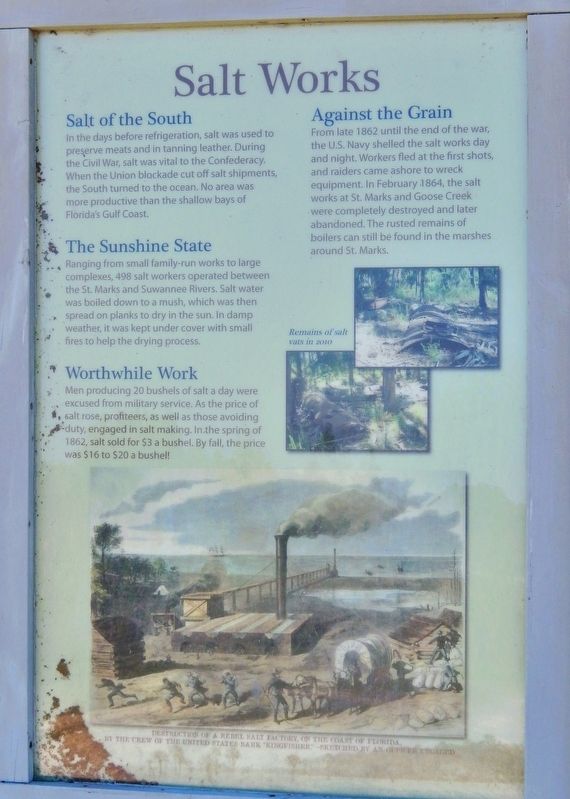
Salt of the South
In the days before refrigeration, salt was used to preserve meats and in tanning leather. During the Civil War, salt was vital to the Confederacy. When the Union blockade cut off salt shipments, the South turned to the ocean. No area was more productive than the shallow bays of Florida's Gulf Coast.
The Sunshine State
Ranging from small family-run works to large complexes, 498 salt workers operated between the St. Marks and Suwannee Rivers. Salt water was boiled down to a mush, which was then spread on planks to dry in the sun. In damp weather, it was kept under cover with small fires to help the drying process.
Worthwhile Work
Men producing 20 bushels of salt a day were excused from military service. As the price of salt rose, profiteers, as well as those avoiding duty, engaged in salt making. In the spring of 1862, salt sold for $3 a bushel. By fall, the price was $16 to $20 a bushel!
Against the Grain
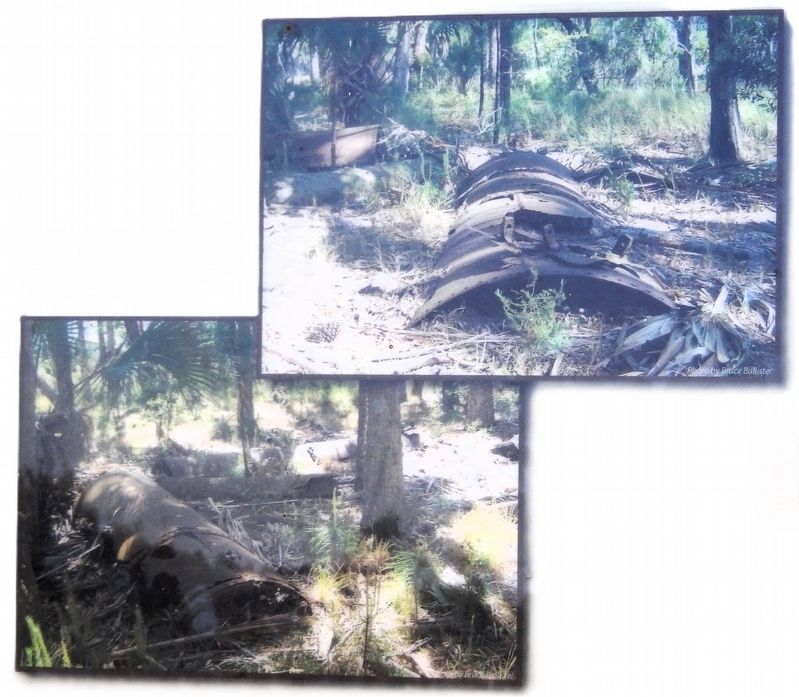
From late 1862 until the end of the war, the U.S. Navy shelled the salt works day and night. Workers fled at the first shots, and raiders came ashore to wreck equipment. In February 1864, the salt works at
this page online
Topics. This historical marker is listed in these topic lists: Industry & Commerce • Parks & Recreational Areas • War, US Civil. A significant historical month for this entry is February 1864.
Location. 30° 7.796′ N, 84° 8.708′ W. Marker is in Saint Marks, Florida, in Wakulla County. It is on Lighthouse Road (County Road 59) 5½ miles south of U.S. 98, on the right when traveling south. The marker is in the Saint Marks National Wildlife Refuge, in a pullout just north of the Light House Road Boat Ramp. Touch for map. Marker is in this post office area: Saint Marks FL 32355, United States of America. Touch for directions.

Regionally, this marker is in Florida’s Big Bend and in Greater Tallahassee. It is also in the American South, specifically in the Deep South, and on the Gulf Coast. Globally, it is in the North Atlantic Region, North America, a Gulf of Mexico state, the Western Hemisphere, the Western World, and the Anglosphere. Historically, it finds itself in what was
2. Marker detail: Remains of salt vats in 2010
Other nearby markers. At least 8 other markers are within 4 miles of this marker, measured as the crow flies: St. Marks & the Civilian Conservation Corps (here, next to this marker); Port Leon (approx. 1½ miles away); Fatal B-17 Crash On St. Marks National Wildlife Refuge (approx. 3.2 miles away); Bo Lynn's Grocery (approx. 3.9 miles away); a different marker also named Port Leon (approx. 3.9 miles away); Telltale Bones (approx. 3.9 miles away); St. Marks Bike Trail Park (approx. 4 miles away); The City of St. Marks (approx. 4 miles away).
Another marker is no longer nearby. Port Leon (was approx. 3.9 miles away but has been confirmed missing).
Also see . . . Civil War Salt Works (St. Marks Wildlife Refuge).
Excerpt: Early in the war, the salt industry drew little attention from the Union. From late 1862 until the end of the war, the US Navy shelled the salt works repeatedly. Workers fled as raiders came ashore to destroy equipment. In February 1864, two separate attacks destroyed(Submitted on November 14, 2026, by Cosmos Mariner of Cape Canaveral, Florida.)the salt works at St. Marks and Goose Creek. The latter produced 800 bushels of salt each day. Buildings and equipment destroyed by an 1863 raid on a large St. Andrew Bay plant were valued at $6 million at that time.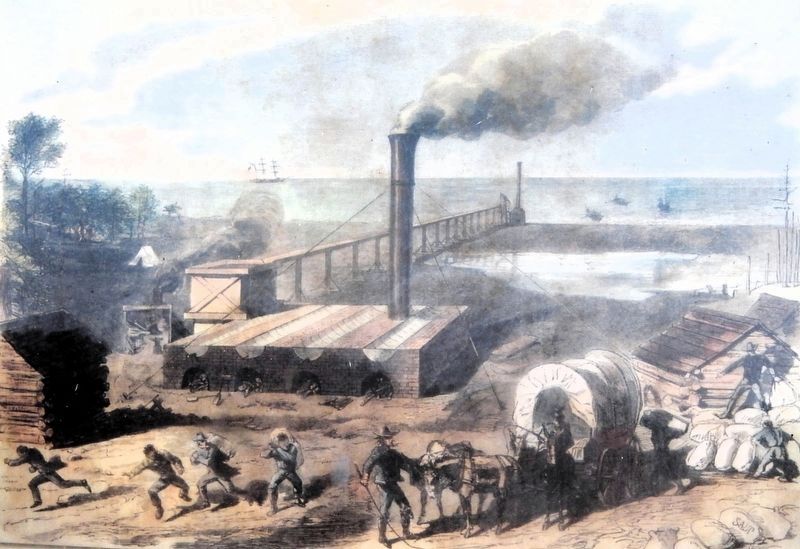 3. Marker detail: Destruction of a Rebel Salt FactoryDestruction of a rebel salt factory, on the coast of Florida, by the crew of the United States Bark “Kingfisher,” — sketched by an officer engaged.
Men who could produce 20 bushels of salt a day were excused from serving, but he labor could be just as dangerous a the front line once the Union began targeting larger operations. Heavy storms also took a toll on the workers and the equipment. As the salt was shipped farther from the coast and passed through the hands of of dealers, the price increased.
Salt was still a necessary commodity after the war. When regular trade resumed the number of people engaged in its production declined in the Gulf coast area. Bricks, wood, kettles, and boilers that could be put to other uses were scavenged from the sites. Broke parts or materials that were too large to easily move were left behind and continue to deteriorate.
Photographed by Cosmos Mariner, September 22, 2024
4. Salt Works Marker
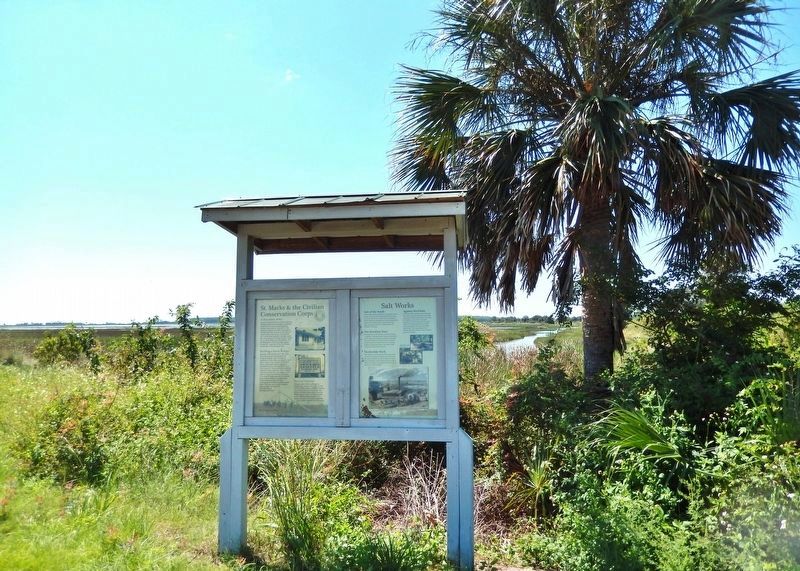
This marker is the rightmost of two panels in the interpretive kiosk at this location.
Credits. This page was last revised on November 14, 2026. It was originally submitted on November 13, 2026, by Cosmos Mariner of Cape Canaveral, Florida. This page has been viewed 9 times since then. Photos: 1, 2, 3, 4. submitted on November 14, 2026, by Cosmos Mariner of Cape Canaveral, Florida.
