
Gay Village in Manchester in Greater Manchester, England, United Kingdom — Northwestern Europe (the British Isles)
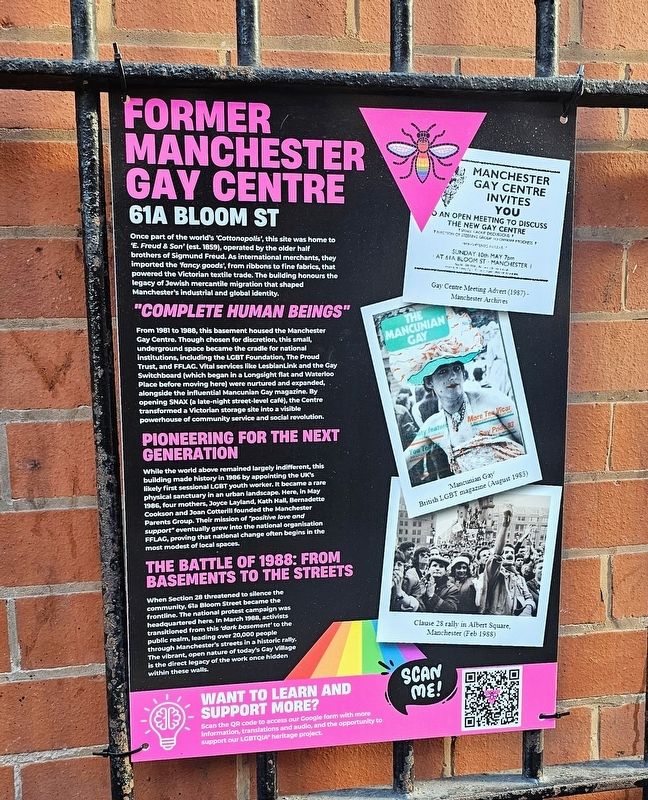
Former Manchester Gay Centre
61a Bloom St
Photographed by Ian Lefkowitz, September 14, 2026
1. Former Manchester Gay Centre Marker
“Complete Human Beings”
From 1981 to 1988, this basement housed the Manchester Gay Centre. Though chosen for discretion, this small, underground space became the cradle for national institutions, including the LGBT Foundation, The Proud Trust, and FFLAG. Vital services like LesbianLink and the Gay Switchboard (which began in a Longsight flat and Waterloo Place before moving here) were nurtured and expanded, alongside the influential Mancunian Gay magazine. By opening SNAX (a late-night street-level café), the Centre transformed a Victorian storage site into a visible powerhouse of community service and social revolution.
Pioneering for the Next Generation
While the world above remained largely indifferent, this building made history
this page online
The Battle of 1988: From Basements to the Streets
When Section 28 threatened to silence the community, 61a Bloom Street became the frontline. The national protest campaign was headquartered here. In March 1988, activists transitioned from this ‘dark basement’ to the public realm, leading over 20,000 people through Manchester’s streets in a historic rally. The vibrant, open nature of today’s Gay Village is the direct legacy of the work once hidden within these walls.
(Captions)
Gay Centre Meeting Advert (1987) — Manchester Archives
‘Mancunian Gay’ British LGBT magazine (August 1983)
Clause 28 rally in Albert Square, Manchester (Feb 1988)
Erected 2026 by LGBT Foundation.
Topics. This historical
Photographed by Ian Lefkowitz, September 14, 2026
2. Former Manchester Gay Centre Marker
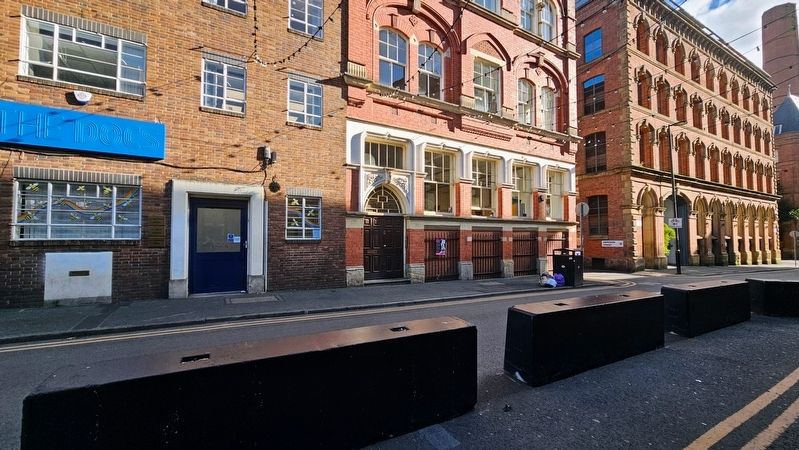
The marker is found near the building's entrance.
Location. 53° 28.608′ N, 2° 14.304′ W. Marker is in Manchester, England, in Greater Manchester. It is in Gay Village. It is at the intersection of Bloom Street and Abingdon Street, on the left when traveling south on Bloom Street. Touch for map. Marker is at or near this postal address: 61a Bloom Street, Manchester, England M1 3LY, United Kingdom. Touch for directions.

Regionally, this marker is in North West England. Globally, it is on the Atlantic Ocean, in the North Atlantic Region, in Europe, in Atlantic Europe, on one of the British Isles, in the Western World, and in the Anglosphere. Historically, it finds itself in what was once the Roman Empire.
Other nearby markers. At least 8 other markers are within walking distance of this marker: New York New York (a few steps from this marker); Co-operative Insurance Company (within shouting distance of this marker); Trades Union Congress (within shouting distance of this marker); The Beacon of Hope (about 120 meters away, measured in a direct line); a different marker also named The Beacon of Hope (about 120 meters away); Alan Mathison Turing (about 150 meters away); a different marker also named Alan Mathison Turing (about 150 meters away); Les Dawson (approx. 0.3 kilometers away). Touch for a list and map of all markers in Manchester.
Also see . . . David Cross: LGBT+ History Month – Manchester’s Section 28 Protest (The University of Manchester).
Section 28 was part of the Local Government Act (1988) which became law during Margaret Thatcher’s tenure as Prime Minister. It instructed that local authorities should not ‘promote’ homosexuality or publish any material with the intention of doing so...The response from LGBT+ people and their allies was immediate and strong. On that day, thirty-eight years ago, more than 20,000 people marched through the streets of Manchester to express their anger at the legislation.(Submitted on November 15, 2026, by Ian Lefkowitz of New York, New York.)
Additional keywords. LGBT; LGBTQ; 🏳️🌈
Credits. This page was last revised on November 18, 2026. It was originally submitted on November 14, 2026, by Ian Lefkowitz of New York, New York. This page has been viewed 7 times since then. Photos: 1. submitted on November 14, 2026, by Ian Lefkowitz of New York, New York. 2. submitted on November 15, 2026, by Ian Lefkowitz of New York, New York. • Andrew Ruppenstein was the editor who published this page.
