
Athens in Athens County, Ohio — The American Midwest (Great Lakes)
The Hocking River
| — | Outdoor Museum | — |
Photographed by Craig Doda, September 27, 2026
1. The Hocking River Marker

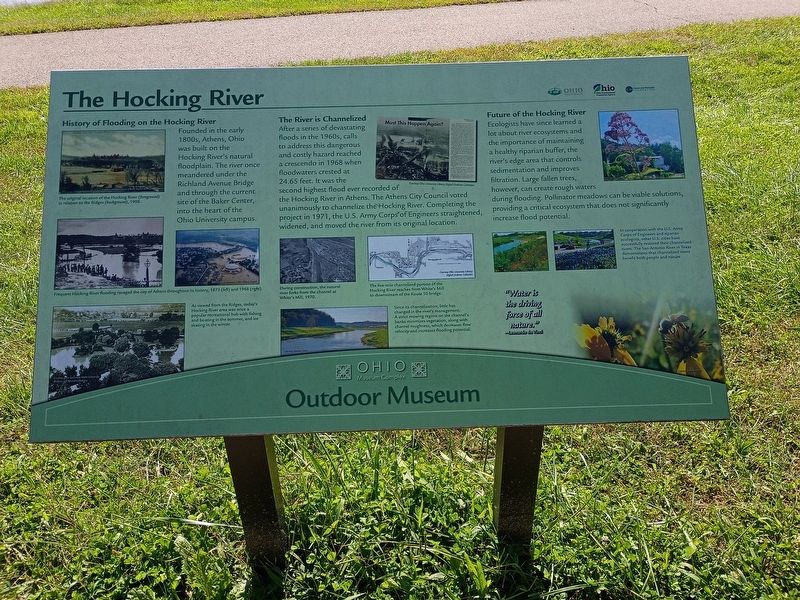
History of Flooding on the Hocking River
Founded in the early 1800s, Athens, Ohio was built on the Hocking River's natural floodplain. The river once meandered under the Richland Avenue Bridge and through the current site of the Baker Center, into the heart of the Ohio University campus.
The River is Channelized
After a series of devastating floods in the 1960s, calls to address this dangerous and costly hazard reached a crescendo in 1968 when floodwaters crested at 24.65 feet. It was the second highest flood ever recorded of the Hocking River in Athens. The Athens City Council voted unanimously to channelize the Hocking River. Completing the project in 1971, the U.S. Army Corps of Engineers straightened, widened, and moved the river from its original location. Must this happen again?
Future of the Hocking River
Ecologists have since learned a lot about river ecosystems and the importance of maintaining a healthy riparian buffer, the river's edge area that controls sedimentation and improves filtration. Large fallen trees, however, can create rough waters during flooding. Pollinator meadows can be viable
this page online
"Water is the driving force of all nature."[Captions:]
-Leonardo da Vinci
The original location of the Hocking River (foreground) in relation to the Ridges (background), 1908.
Frequent Hocking River flooding ravaged the city of Athens throughout its history, 1873 (left) and 1968 (right).
As viewed from the Ridges, today's Hocking River area was once a popular recreational hub with fishing and boating in the summer, and ice skating in the winter.
During construction, the natural river forks from the channel at White's Mill, 1970.
The five-mile channelized portion of the Hocking River reaches from White's Mill to downstream of the Route 50 bridge.
Since its channelization, little has changed in the river's management. A strict mowing regime on the channel's banks minimizes vegetation, along with channel roughness, which decreases flow velocity and increases flooding potential.
In cooperation with the U.S. Army Corps of Engineers and riparian ecologists, other U.S. cities have successfully restored their channelized rivers. The San Antonio River in Texas demonstrates that channelized rivers benefit both people and nature.
Erected by Ohio
Photographed by Craig Doda, September 27, 2026
2. The Hocking River Marker
Topics. This historical marker is listed in these topic lists: Environment • Industry & Commerce • Waterways & Vessels. A significant historical year for this entry is 1968.
Location. 39° 19.236′ N, 82° 6.277′ W. Marker is in Athens, Ohio, in Athens County. It is at the intersection of Richland Avenue and South Green Avenue, on the right when traveling north on Richland Avenue. Touch for map. Marker is at or near this postal address: 100 Richland Ave, Athens OH 45701, United States of America. Touch for directions.

Regionally, this marker is in the Hocking Hills. It is also in the American Midwest, in the Ohio River Valley, in Appalachia, and specifically in Northern Appalachia. Globally, it is in North America, the Western Hemisphere, the Western World, and the Anglosphere. Historically, it finds itself in what was once the Haudenosaunee (Iroquois) Confederacy, the territory of the Mississippian Culture, and the Northwest Territory.
Other nearby markers. At least 8 other markers are within walking distance of this marker: Donald R. Johnson Memorial Channel (about 300 feet away, measured in a direct
Photographed by Craig Doda, September 27, 2026
3. The Hocking River Marker
Credits. This page was last revised on November 16, 2026. It was originally submitted on November 15, 2026, by Craig Doda of Napoleon, Ohio. This page has been viewed 13 times since then. Photos: 1, 2, 3. submitted on November 15, 2026, by Craig Doda of Napoleon, Ohio. • Devry Becker Jones was the editor who published this page.
