North End in Boston in Suffolk County, Massachusetts — The American Northeast (New England)
Father Taylor’s Bethel
Photographed by Sean P. Flynn, November 8, 2026
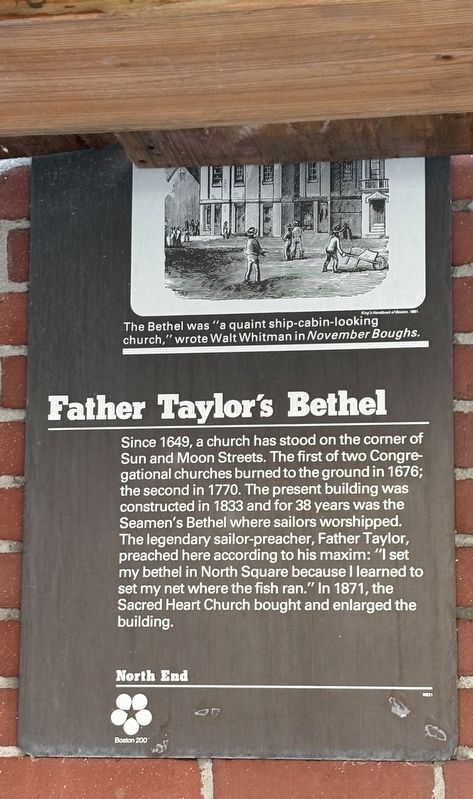
1. Father Taylor’s Bethel Marker
 Since 1649, a church has stood on the corner of Sun and Moon Streets. The first of two Congregational churches burned to the ground in 1676; the second in 1770. The present building was constructed in 1833 and for 38 years was the Seamen's Bethel where sailors worshipped. The legendary sailor-preacher, Father Taylor, preached here according to his maxim: "I set my bethel in North Square because I learned to set my net where the fish ran." In 1871, the Sacred Heart Church bought and enlarged the building.
[Caption below photo:]
The Bethel was "a quaint ship-cabin-looking church," wrote Walt Whitman in November Boughs.
Erected by Boston 200. (Marker Number NE21.)
Topics. This historical marker is listed in these topic lists: Colonial Era • Religion & Religious Structures • Waterways & Vessels. A significant historical year for this entry is 1649.
Location. 42° 21.831′ N, 71° 3.197′ W. Marker is in Boston, Massachusetts, in Suffolk County. It is in North End. It is at the intersection of North Square and Sun Court Street on North Square. The marker is affixed to Sacred Heart Catholic Church. Touch for map. Marker is at or near this postal address: 12 North Square, Boston MA 02109, United States of America. Touch for directions.

Regionally, this marker is in Historic Boston. It is also in the American Northeast, in New England, and on the Eastern Seaboard. Globally, it is in the North Atlantic Region, North America, the Western Hemisphere, the
this page online
Other nearby markers. At least 8 other markers are within walking distance of this marker: The Missionaries of St. Charles (here, next to this marker); Bishop John Baptist Scalabrini (here, next to this marker); November 28, 1887 | Piacenza, Italy (a few steps from this marker); USS Constitution (a few steps from this marker); Historic Sacred Heart Italian Church (a few steps from this marker); Second Church Site (a few steps from this marker); Boston Gift Shop (within shouting distance of this marker); The Paul Revere House (within shouting distance of this marker). Touch for a list and map of all markers in Boston.
More about this marker. When visited in the fall
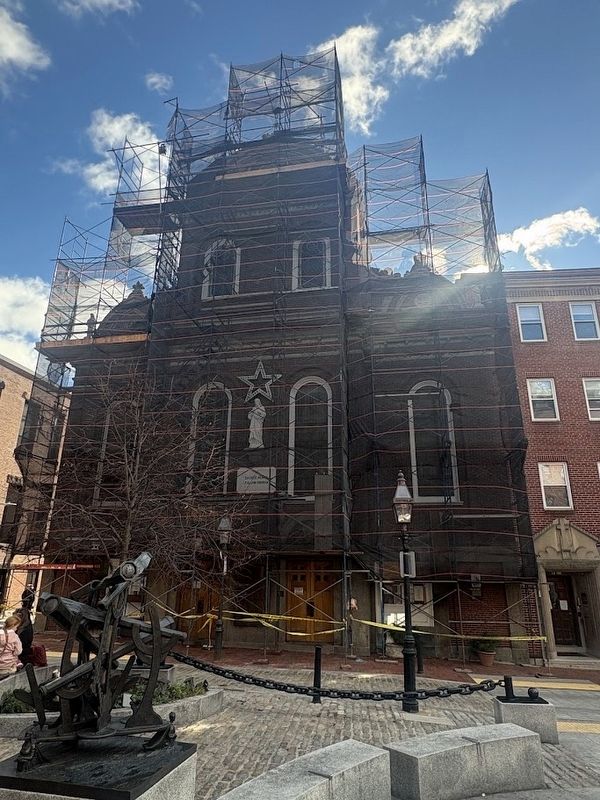
Photographed by Sean P. Flynn, November 8, 2026
2. Sacred Heart Catholic Church
Regarding Father Taylor’s Bethel. Father Taylor died in 1871, and the church was acquired by a group of Italian immigrants that year. In 1888 it became Sacred Heart Catholic Church.
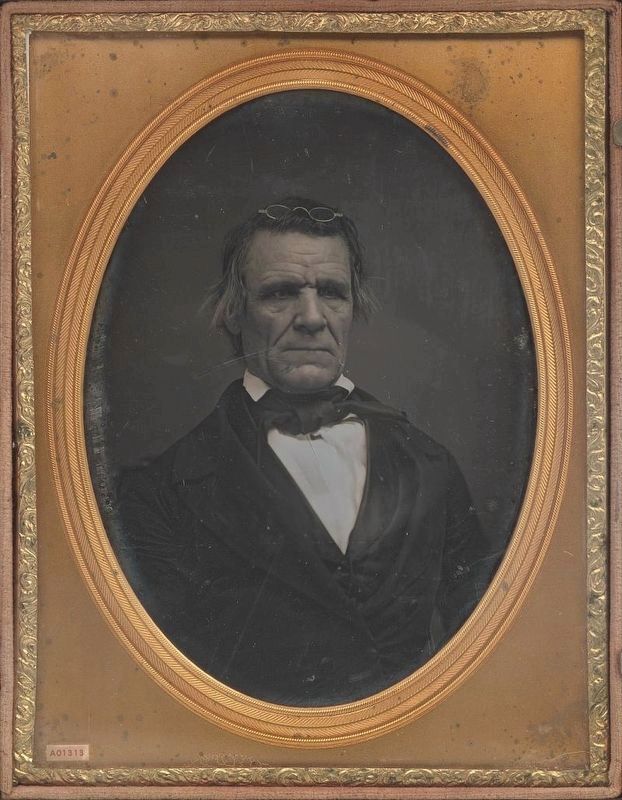
Also see . . . Father Taylor bio. The Walt Whitman Archive looks at the life of Edward Thompson "Father" Taylor, the famed Methodist preacher to Seamen in Boston's North End. Whitman himself met Father Taylor in 1860.
Excerpt: "There, in a chapel noted for its resemblance to a timbered ship, he paced his quarterdeck pulpit, exhorting in a sincere, joyous, spontaneous, colorful, idiomatic manner that enthralled all who heard him. For literati no trip to Boston was complete without taking in the hallelujah(Submitted on November 16, 2026, by Sean P. Flynn of Oak Park, Illinois.)drama of Father Taylor and his congregation of rough-and-ready sea dogs grappling to rescue impenitent sinners from storm-tossed brine and rock-bound coasts. Ralph Waldo Emerson exalted Taylor as the near perfect master of oratory. William Ellery Channing, Charles Dickens, Jenny Lind, Harriet Martineau, and countless others chorused similar paeans, while Herman Melville immortalized Father Taylor by transforming him into Father Mapple of Moby-Dick."Courtesy of the National Portrait Gallery, Smithsonian Institution, circa 18533. Edward Thompson "Father" TaylorFather Taylor was famed for his oratorical abilities, and was the inspiration for Father Mapple in Herman Melville's Moby-Dick.
Credits. This page was last revised on November 16, 2026. It was originally submitted on November 15, 2026, by Sean P. Flynn of Oak Park, Illinois. This page has been viewed 7 times since then. Photos: 1. submitted on November 15, 2026, by Sean P. Flynn of Oak Park, Illinois. 2, 3. submitted on November 16, 2026, by Sean P. Flynn of Oak Park, Illinois.