
Elephant and Castle in Southwark in Greater London, England, United Kingdom — Northwestern Europe (the British Isles)
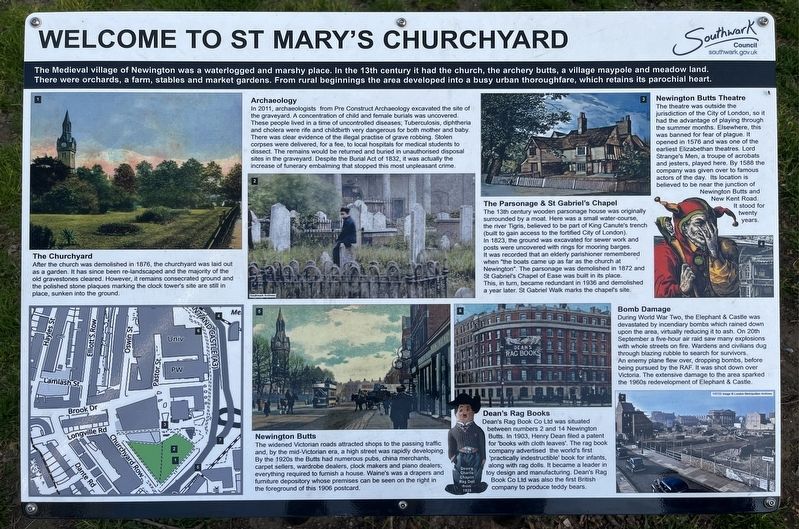
Welcome to St Mary's Churchyard
Photographed by Ray Gurganus, April 8, 2026
1. Welcome to St Mary's Churchyard Marker
The Churchyard
After the church was demolished in 1876, the churchyard was laid out as a garden. It has since been re-landscaped and the majority of the old gravestones cleared. However, it remains consecrated ground and the polished stone plaques marking the clock tower's site are still in place, sunken into the ground.
Archaeology
In 2011, archaeologists from Pre Construct Archaeology excavated the site of the graveyard. A concentration of child and female burials was uncovered. These people lived in a time of uncontrolled diseases. Tuberculosis, diphtheria and cholera were rife and childbirth very dangerous for both mother and baby. There was clear evidence of the legal practise of grave robbing. Stolen corpses were delivered, for a fee, to local hospitals for medical students to dissect.
this page online
The Parsonage & St Gabriel's Chapel
The 13th century wooden parsonage house was originally surrounded by a moat. Here was a small water-course the river Tigris, believed to be part of King Canute's trench (built to gain access to the fortified City of London). In 1823, the ground was excavated for sewer work and posts were uncovered with rings for mooring barges. It was recorded that an elderly parishioner remembered when "the boats came up as far as the church at Newington". The parsonage was demolished in 1872 and St Gabriel's Chapel of Ease was built in its place. This, in turn, became redundant in 1936 and demolished a year later. St Gabriel Walk marks the chapels site.
Newington Butts Theatre
The theatre was outside the jurisdiction of the City of London, so it had the advantage of playing through the summer months. Elsewhere, this was banned for fear of plague. It opened in 1576 and was one of the earliest Elizabethan theatres. Lord Strange's Men, a troupe of acrobats and jesters, played here. By 1588 the company was given over to famous actors of the day. Its location is believed to be near the junction of Newington Butts and New Kent Road It stood for twenty years.
Bomb Damage
During World War Two, the Elephant & Castle was devastated by incendiary bombs which rained down upon the area, virtually reducing it to ash. On 20th September a five-hour air raid saw many explosions with whole streets on fire. Wardens and civilians dug through blazing rubble to search for survivors An enemy plane flew over, dropping bombs, before being pursued by the RAF. It was shot down over Victoria. The extensive damage to the area sparked the 1960s redevelopment of Elephant & Castle.
Newington Butts
The widened Victorian roads attracted shops to the passing traffic and, by the mid-Victorian era, a high street was rapidly developing By the 1920s the Butts had numerous pubs, china merchants, carpet sellers, wardrobe dealers, clock makers and piano dealers; everything required to furnish a house. Waine's was a drapers and furniture depository whose premises can be seen on the right in the foreground of this 1906 postcard.
Dean's Rag Books
Dean's Rag Book Co Ltd was situated between numbers 2 and 14 Newington Butts. In 1903, Henry Dean filed a patent for books with cloth leaves. The rag book company advertised the world's first practically indestructible book for infants along with rag dolls. It became a leader in toy design and manufacturing. Dean's Rag Book Co Ltd was also the first British company to produce teddy bears.
Topics. This historical marker is listed in these topic lists: Anthropology & Archaeology • Cemeteries & Burial Sites • Industry & Commerce • Religion & Religious Structures. A significant historical year for this entry is 1876.
Location. 51° 29.588′ N, 0° 6.105′ W. Marker is in Southwark, England, in Greater London. It is in Elephant and Castle. It is on Saint Gabriel Walk. Touch for map. Marker is at or near this postal address: 2 St Gabriel Walk, Southwark, England SE1 6SF, United Kingdom. Touch for directions.

Regionally, this marker is in London and in the Greater South East. Globally, it is on the Atlantic Ocean, in the North Atlantic Region, in Europe, in Atlantic Europe, on one of the British Isles, in the Western World, and in the Anglosphere. Historically, it finds itself in what was once the Roman Empire.
Other nearby markers. At least 8 other markers are within walking distance of this marker: St Mary's Churchyard (within shouting distance of this marker); The Faraday Memorial (approx. 0.3 kilometers away); Craigie Aitchison (approx. half a kilometer away); The Ice Age Tree Trail (approx. 0.6 kilometers away); Section of the Berlin Wall (approx. 0.6 kilometers away); British 15-inch naval guns (approx. 0.6 kilometers away); St George's Fields (approx. 0.6 kilometers away); Soviet World War II Memorial (approx. 0.6 kilometers away). Touch for a list and map of all markers in Southwark.
Credits. This page was last revised on November 18, 2026. It was originally submitted on November 16, 2026, by Ray Gurganus of Washington, District of Columbia. This page has been viewed 4 times since then. Photo 1. submitted on November 16, 2026, by Ray Gurganus of Washington, District of Columbia. • Andrew Ruppenstein was the editor who published this page.
Editor’s want-list for this marker. photo of the marker within its surroundings • Can you help?
