
Crystal River in Citrus County, Florida — The American South (South Atlantic)
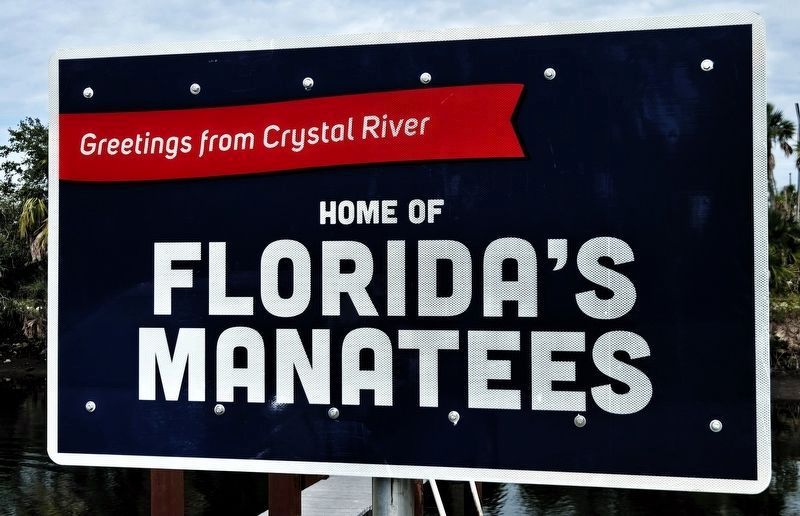
Home of Florida's Manatees
Greetings From Crystal River
| — | America250FL Road Trip | — |
Photographed by Cosmos Mariner, November 16, 2026
1. Home of Florida's Manatees Marker (south side)
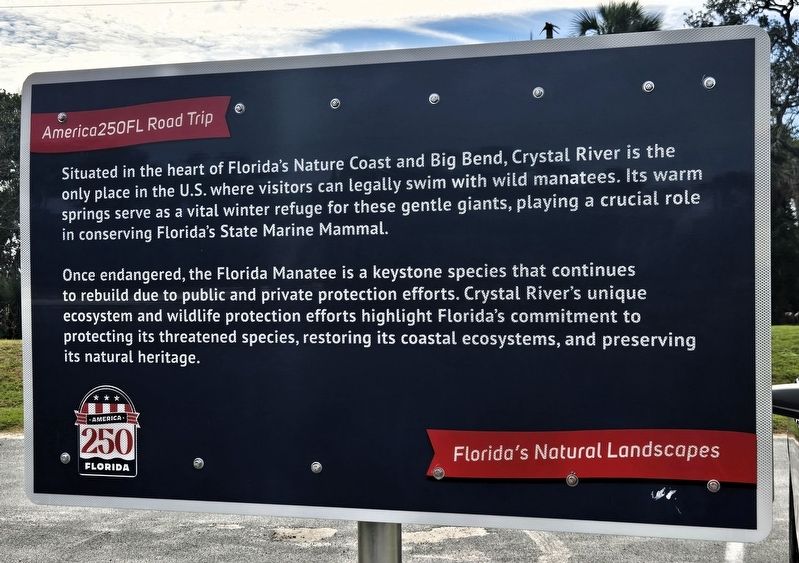
Situated in the heart of Florida's Nature Coast and Big Bend, Crystal River is the only place in the U.S. where visitors can legally swim with wild manatees. Its warm springs serve as a vital, winter refuge for these gentle giants, playing a crucial role in conserving Florida’s State Marine Mammal.
Once endangered, the Florida Manatee is a keystone species that continues to rebuild due to public and private protection efforts. Crystal River’s unique ecosystem and wildlife protection efforts highlight Florida's commitment to protecting its threatened species, restoring its coastal ecosystems, and preserving its natural heritage.
Florida's Natural Landscapes
Erected 2026 by America250FL Road Trip.
Topics and series. This historical marker is listed in these topic lists: Animals • Environment • Waterways & Vessels. In addition, it is included in the America 250 series list.
Location. 28° 54.524′ N, 82° 38.203′ W. Marker is in Crystal River, Florida, in Citrus County. It is on West Trawler Lane just west of North Sailboat Avenue, on the right when traveling
this page online

Regionally, this marker is on the Gulf Coast. It is also in the American South and on the Gulf Coast. Globally, it is in the North Atlantic Region, North America, a Gulf of Mexico state, the Western Hemisphere, the Western World, and the Anglosphere. Historically, it finds itself in what was once New Spain, the territory of the Mississippian Culture, one of the Confederate States of America, and the Antebellum South.
Other nearby markers. At least 8 other markers are within walking distance of this marker: A Place to Call Home (approx. half a mile away); Crystal River: An Enduring Legacy (approx. half a mile away); A View from the Top (approx. half a mile away); A Separate Resting Place (approx. half a mile away); Watery World (approx. half a mile away); Remembering the Dead (approx. 0.6 miles away); Temple or Stage? (approx. 0.6 miles away); Mystery in Stone
Photographed by Cosmos Mariner, November 16, 2026
2. Home of Florida's Manatees Marker (north side)
Also see . . .
1. The Florida manatee (Trichechus manatus latirostris) (US Forest & Wildlife Service).
Excerpt: The West Indian manatee is a large herbivorous marine mammal. There are two subspecies of West Indian manatees: the Florida manatee (Trichechus manatus latirostris) and the Antillean manatee (Trichechus manatus manatus). As its name suggests, the Florida manatee is native to Florida and is found primarily in coastal areas throughout the state. Manatees are cold-intolerant so their distribution in the US varies significantly between the warmer and colder months of the year. During the warmer months, the Florida manatee’s range may extend west to Texas and north to Delaware Bay and potentially beyond. As water temperatures decrease in the fall, manatees return to peninsular Florida and their warm water sites.(Submitted on November 17, 2026, by Cosmos Mariner of Cape Canaveral, Florida.)
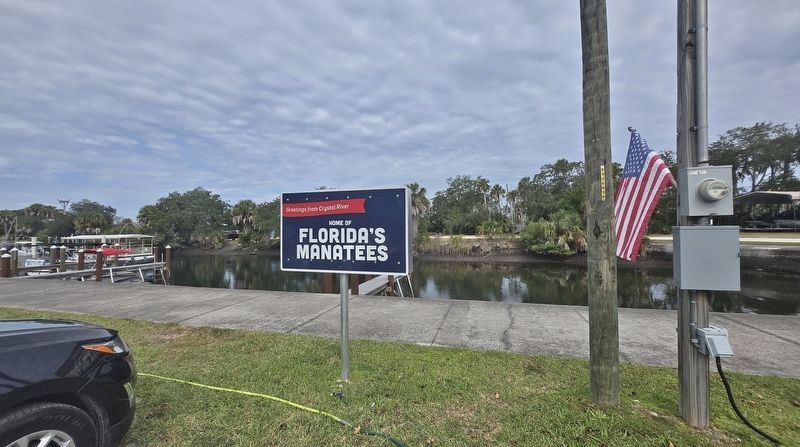
Today, the range-wide population estimate for the West Indian manatee is at least 13,000 manatees. When aerial surveys began in 1991, the minimum population estimate in Florida was 1,267 manatees. Today and with the use ofmore robust survey methodology, at least 8,350 are estimated to inhabit Florida, representing a significant increase over the past 33 years.Photographed by Cosmos Mariner, November 16, 20263. Home of Florida's Manatees MarkerLooking north; tour and fishing boat docks with access to the Crystal River are in the background.
The health and survival of the West Indian manatee is threatened by human-related impacts such as collisions with watercraft, habitat loss (both the loss of forage and warm water), entanglements in fishing gear and other marine debris, entrapments due to high water events, crushing in navigation locks or other water control structures, as well as natural events such as cold snaps and red tide.
Manatees are federally protected under the Endangered Species Act and under the Marine Mammal Protection Act.
2. Florida Manatee Facts and Information (Florida Fish and Wildlife Conservation Commission).
Excerpt: In the United States, the Florida manatee, a sub-species of the West Indian manatee, inhabits the state’s coastal waters, rivers and springs. Some Florida manatee are known to travel up the eastern coastline into Georgia, the Carolinas, and a few travel as far north as Massachusetts during warm months.(Submitted on November 17, 2026, by Cosmos Mariner of Cape Canaveral, Florida.)
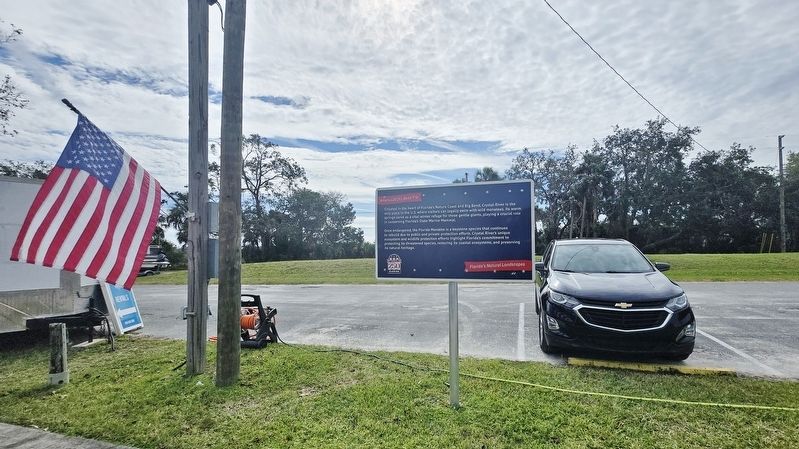
Inthe Gulf, Florida manatees can be found west through coastal Louisiana and are occasionally sighted as far west as Texas. Prior to winter’s coldest months, manatees migrate to warm water habitats in Florida. These warm-water sites include artesian springs and power plant discharge canals. Florida is at the northern end of the manatee’s winter range and these warm-water habitats play an important role in their survival during the winter months.Photographed by Cosmos Mariner, November 16, 20264. Home of Florida's Manatees MarkerLooking south; the Crystal River Preserve State Park headquarters parking lot is in the background.
3. America 250 FL Road Trip. (Submitted on November 17, 2026, by Cosmos Mariner of Cape Canaveral, Florida.)
Photographed by Cosmos Mariner, November 16, 2026
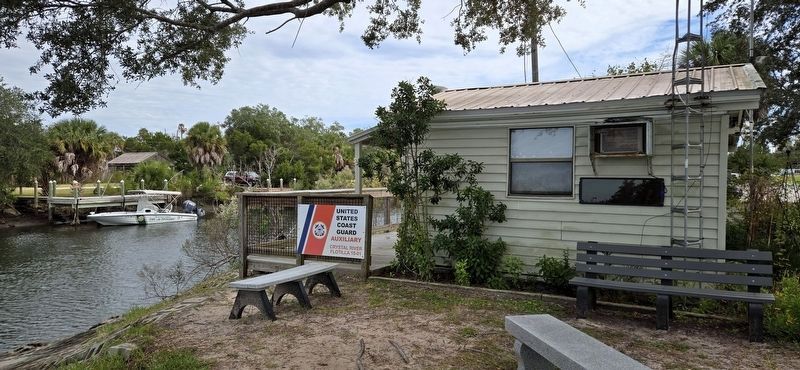
5. US Coast Guard Auxiliary
There is also United States Coast Guard Auxiliary office at this location.
Credits. This page was last revised on November 18, 2026. It was originally submitted on November 17, 2026, by Cosmos Mariner of Cape Canaveral, Florida. This page has been viewed 10 times since then. Photos: 1, 2, 3, 4. submitted on November 17, 2026, by Cosmos Mariner of Cape Canaveral, Florida. 5. submitted on November 18, 2026, by Cosmos Mariner of Cape Canaveral, Florida.
