
Port Richey in Pasco County, Florida — The American South (South Atlantic)
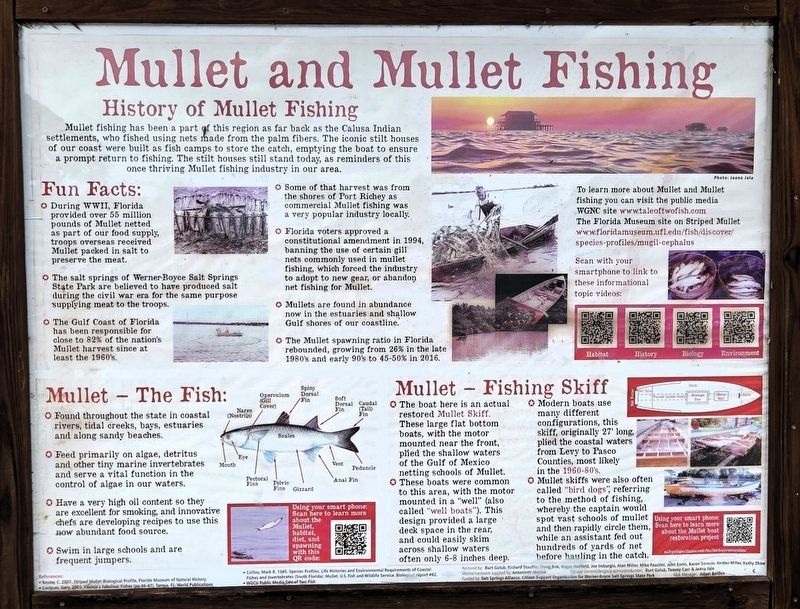
Mullet and Mullet Fishing
Photographed by Cosmos Mariner, November 16, 2026
1. Mullet and Mullet Fishing Marker
History of Mullet Fishing
Mullet fishing has been a part of this region as far back as the Calusa Indian settlements, who fished using nets made from the palm fibers. The iconic stilt houses of our coast were built as fish camps to store the catch, emptying the boat to ensure a prompt return to fishing. The stilt houses still stand today, as reminders of this once thriving Mullet fishing industry in our area.
Fun Facts:
• During WWII, Florida provided over 55 million pounds of Mullet netted as part of our food supply, troops overseas received Mullet packed in salt to preserve the meat.
• The salt springs of Werner-Boyce Salt Springs State Park are believed to have produced salt during the civil war era for the same purpose supplying meat to the troops.
• The Gulf Coast of Florida has been responsible for close to 82% of the nation's Mullet harvest since at least the 1960's.
• Some of that harvest was from the shores of Port Richey as commercial Mullet fishing was a very popular industry locally.
• Florida voters approved a constitutional amendment in 1994, banning the use of certain gill nets commonly used in mullet fishing,
this page online
• Mullets are found in abundance now in the estuaries and shallow Gulf shores of our coastline.
• The Mullet spawning ratio in Florida rebounded, growing from 26% in the late 1980's and early 90's to 45-50% in 2016.
Mullet — The Fish:
• Found throughout the state in coastal rivers, tidal creeks, bays, estuaries and along sandy beaches.
• Feed primarily on algae, detritus and other tiny marine invertebrates and serve a vital function in the control of algae in our waters.
• Have a very high oil content so they are excellent for smoking, and innovative chefs are developing recipes to use this now abundant food source.
• Swim in large schools and are frequent jumpers.
Mullet — Fishing Skiff
• The boat here is an actual restored Mullet Skiff. These large flat bottom boats, with the motor mounted near the front, plied the shallow waters of the Gulf of Mexico netting schools of Mullet.
• These boats were common to this area, with the motor mounted in a “well” (also called “well boats”). This design provided a large deck space in the rear, and could easily skim
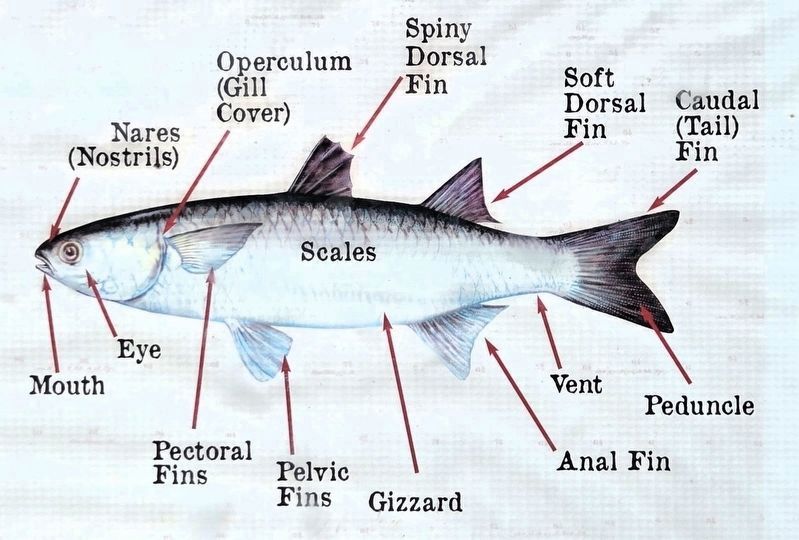
2. Marker detail: Mullet Anatomy Illustration
• Modern boats use many different configurations, this skiff, originally 27' long, plied the coastal waters from Levy to Pasco Counties, most likely in the 1960-80’s.
• Mullet skiffs were also often called “bird dogs”; referring to the method of fishing, whereby the captain would spot vast schools of mullet and then rapidly circle them, while an assistant fed out hundreds of yards of net before hauling in the catch.
References:
• Bester, C., 2007. Striped Mullet Biological Profile. Florida Museum of Natural History.
• Cochran, Gary. 2003. Florida's Fabulous Fishes (pp. 46-47), Tampa, FL: World Publications
• Collins, Mark R. 1985. Species Profiles: Life Histories and Environmental Requirements of Coastal Fishes and Invertebrates (South Florida): Mullet. U.S. Fish and Wildlife Service. Biological Report #82.
• WGCU Public Media, Tale of Two Fish
Erected by Salt Springs Alliance, Citizen Support Organization for Werner-Boyce Salt Springs State Park.
Topics. This historical marker is listed in these topic lists: Animals • Indigenous Peoples and Communities • Industry & Commerce
Photographed by Cosmos Mariner, November 16, 2026
3. Mullet and Mullet Fishing Marker
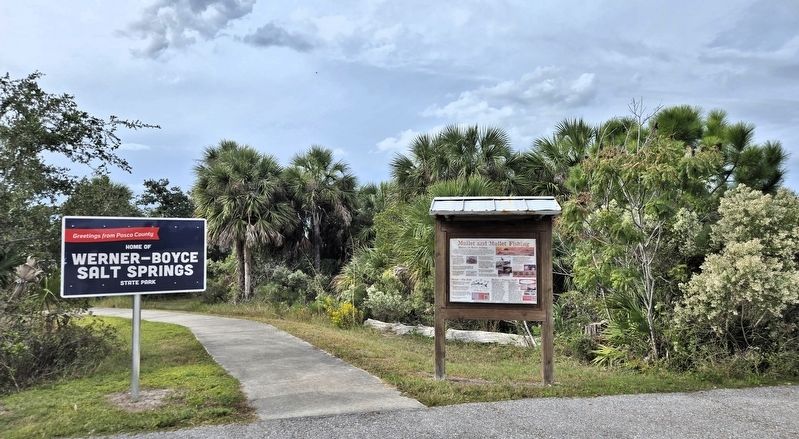
The marker is on a kiosk (right) at the west end of the Werner-Boyce Salt Springs State Park trailhead parking lot.
Location. 28° 17.338′ N, 82° 43.213′ W. Marker is in Port Richey, Florida, in Pasco County. It can be reached from U.S. 19 just north of Ridge Crest Drive, on the right when traveling south. The marker is at the trailhead ½ mile west of US Highway 19 on the Werner-Boyce Salt Springs State Park road. Touch for map. Marker is at or near this postal address: 8737 US Highway 19, Port Richey FL 34668, United States of America. Touch for directions.

Regionally, this marker is on the Gulf Coast and on Tampa Bay. It is also in the American South and on the Gulf Coast. Globally, it is in the North Atlantic Region, North America, a Gulf of Mexico state, the Western Hemisphere, the Western World, and the Anglosphere. Historically, it finds itself in what was once New Spain, the territory of the Mississippian Culture, one of the Confederate States of America, and the Antebellum South.
Other nearby markers. At least 8 other markers are within 3 miles of this marker, measured as the crow flies: Home of Werner-Boyce Salt Springs State Park (here, next to this
Photographed by Cosmos Mariner, November 16, 2026
4. Werner-Boyce Salt Springs State Park Entrance
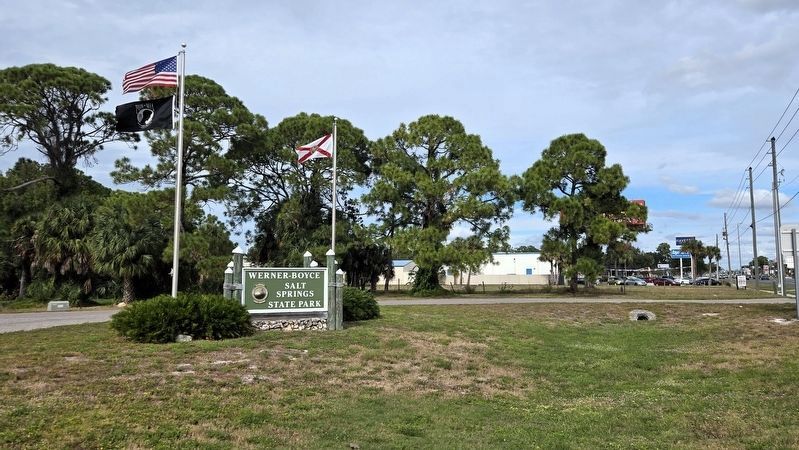
Turn here from US Highway 19 to enter the park. The trailhead and marker are ½ mile west on the park road.
Related markers. Click here for a list of markers that are related to this marker. Werner-Boyce Salt Springs State Park
Also see . . .
1. Mullet: A Tale of Two Fish – WGCU Local Productions (PBS.org).
Excerpt: The long and storied history of Florida's most under-appreciated fish is explored, including its importance as a food source for Native Americans, Spanish explorers and early Florida pioneers, as well as the rise and fall of Florida's commercial mullet fishing industry in the 20th century.(Submitted on November 18, 2026, by Cosmos Mariner of Cape Canaveral, Florida.)
2. Striped Mullet (Mugil cephalus) (Florida Museum - Discover Fish).
Excerpt: Along the Florida gulf coast, the striped mullet is regarded as an excellent food fish. They are also used as bait for a variety of fishes, including billfish, commonly bringing a higher price as bait than as food fish. In fresh and brackish waters, they are caught with a hook and line. Popular bait includes earthworms, oatmeal, and chicken feed. Mullet caught in freshwater often have a muddy or sulfide-like taste. In saltwater areas, mullet are snagged with hooks or captured with cast nets, seines, gill nets, or trammel nets. A net ban has been in effect in the state of Florida since 1995. Prior to the net ban amendment, mullet were severely overfished throughout the state. Currently, mullet are on the road to full recovery. Large numbers of mullet are taken during the migration to spawning grounds offshore. These fish are prized for their roe. The striped mullet is marketed fresh, dried, salted, and frozen with the roe sold fresh or smoked. This fish is also used in Chinese medicinal practices. It is a very important commercial fish in many other parts of the world.(Submitted on November 18, 2026, by Cosmos Mariner of Cape Canaveral, Florida.)
Credits. This page was last revised on November 18, 2026. It was originally submitted on November 17, 2026, by Cosmos Mariner of Cape Canaveral, Florida. This page has been viewed 8 times since then. Photos: 1, 2, 3. submitted on November 17, 2026, by Cosmos Mariner of Cape Canaveral, Florida. 4. submitted on November 18, 2026, by Cosmos Mariner of Cape Canaveral, Florida.
