Albany in Carroll County, New Hampshire — The American Northeast (New England)
Passaconaway Cemetery
Photographed by Maxine Booth, November 19, 2026
1. Passaconaway Cemetery Marker

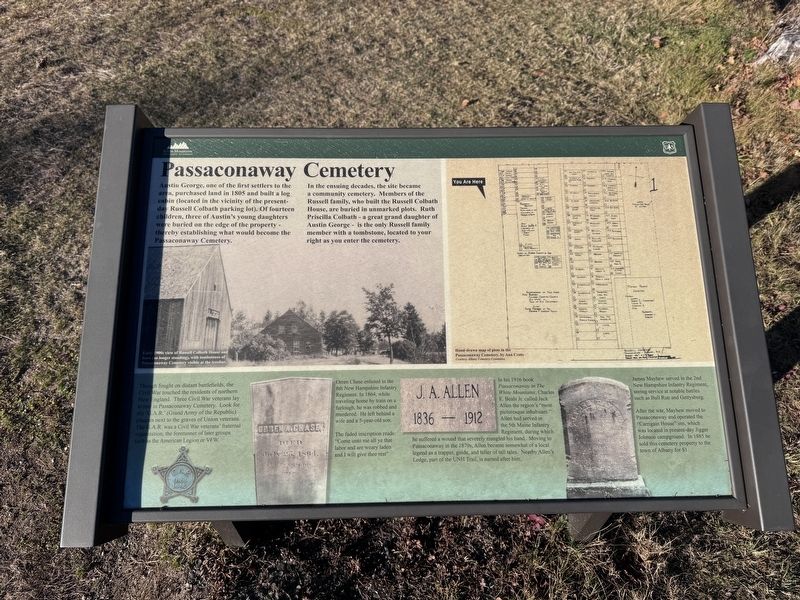
Austin George, one of the first settlers to the area, purchased land in 1805 and built a log cabin (located in the vicinity of the present-day Russell Colbath parking lot). Of fourteen children, three of Austin’s young daughters were buried on the edge of the property - thereby establishing what would become the Passaconaway Cemetery.
In the ensuing decades, the site became a community cemetery. Members of the Russell family, who built the Russell Colbath House, are buried in unmarked plots. Ruth Priscilla Colbath - a great grand daughter of Austin George - is the only Russell family member with a tombstone, located to your right as you enter the cemetery.
Though fought on distant battlefields, the Civil War touched the residents of northern New England. Three Civil War veterans lay at rest in Passaconaway Cemetery. Look for the ‘G.A.R.’ (Grand Army of the Republic) plaques next to the graves of Union veterans. The G.A.R. was a Civil War veterans’ fraternal organization, the forerunner of later groups such as the American Legion or VFW.
Orren Chase enlisted in the 8th New Hampshire Infantry
this page online
The faded inscription reads: “Come unto me all ye that labor and are weary laden and I will give thee rest”
In his 1916 book Passaconaway in The White Mountains, Charles E. Beals Jr. called Jack Allen the region’s “most picturesque inhabitant.” Allen had served in the 5th Maine Infantry Regiment, during which he suffered a wound that severely mangled his hand. Moving to Passaconaway in the 1870s, Allen became somewhat of a local legend as a trapper, guide, and teller of tall tales. Nearby Allen’s Ledge, part of the UNH Trail, is named after him.
James Mayhew served in the 2nd New Hampshire Infantry Regiment, seeing service at notable battles such as Bull Run and Gettysburg.
After the war, Mayhew moved to Passaconaway and operated the “Carrigain House” inn, which was located in present-day Jigger Johnson campground. In 1885 he sold this cemetery property to the town of Albany for $1.
Erected by White Mountain National Forest - White Mountains Interpretive Association.
Photographed by Maxine Booth, November 19, 2026
2. Passaconaway Cemetery Marker
Topics. This historical marker is listed in these topic lists: Cemeteries & Burial Sites • Settlements & Settlers • War, US Civil.
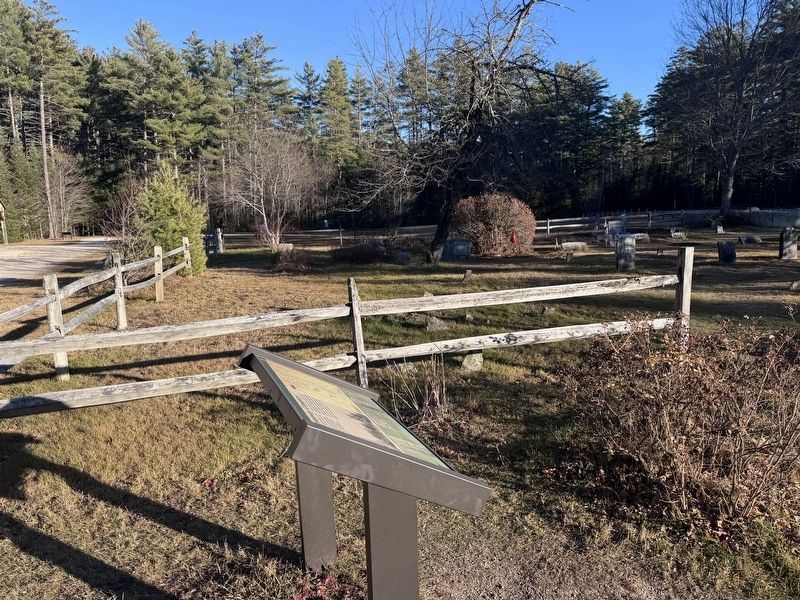
Location. 43° 59.744′ N, 71° 20.362′ W. Marker is in Albany, New Hampshire, in Carroll County. It can be reached from Kancamagus Highway, on the right when traveling west. Marker is located at the entrance to the Passaconaway Cemetery, at the Russell Colbath Historic Site, part of the Forest Service's White Mountain National Forest. Touch for map. Marker is at or near this postal address: 3683 Kancamagus Highway, Conway NH 03818, United States of America. Touch for directions.

Regionally, this marker is in the White Mountains. It is also in the American Northeast and in New England. Globally, it is in North America, the Western Hemisphere, the Western World, and the Anglosphere. Historically, it finds itself in what was once one of the original Thirteen Colonies.
Other nearby markers. At least 8 other markers are within 5 miles of this marker, measured as the crow flies: The Father of White Mountain Art (approx. 2 miles away); How Sabbaday Falls Got Its Name (approx. 2.7 miles away); By Foot and Horseback, Stagecoach and Car (approx. 2.7 miles away); Rocky Gorge: a favorite stop since the Civil War (approx. 3.1 miles away); Lower Falls (approx. 4.9 miles away); Cart Roads and Wagon Paths Connect a Community (approx. 4.9 miles away); How the Covered Bridge was Built (approx. 4.9 miles away); Albany Covered Bridge: A Vital Link to Town (approx. 5 miles away). Touch for a list and map of all markers in Albany.
Another marker is no longer nearby. How the Covered Bridge was built (was approx. 4.9 miles away but has been replaced with another marker now near it).
Credits. This page was last revised on November 21, 2026. It was originally submitted on November 19, 2026, by Maxine Booth of Albany, New Hampshire. This page has been viewed 17 times since then. Photos: 1, 2. submitted on November 19, 2026, by Maxine Booth of Albany, New Hampshire. • Andrew Ruppenstein was the editor who published this page.