Harrisonville in Cass County, Missouri — The American Midwest (Upper Plains)
Marler-Wirt-Allen Memorial Park
Photographed by Jason Voigt, October 20, 2026
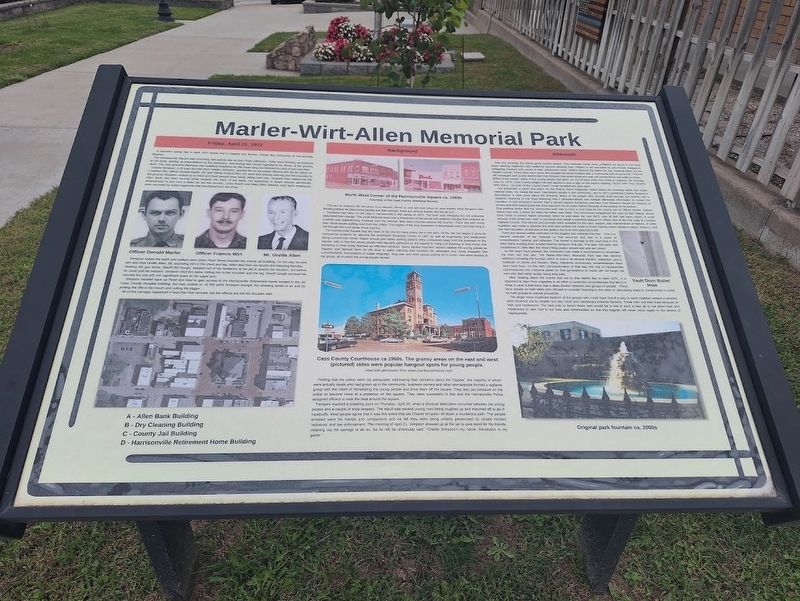
1. Marler-Wirt-Allen Memorial Park Marker

Friday, April 21, 1972
A beautiful spring day in April 1972 would end in tragedy and forever change the community of Harrisonville, Missouri.
The Harrisonville Square was humming with activity late on that Friday afternoon. Folks were finishing up business at the bank, picking up prescriptions at the pharmacy, and buying last minute ingredients for dinner at the grocery store. The very peaceful afternoon was suddenly shattered as rifle shots rang out followed by cries of pain and fear.
Charlie Simpson, a 25 year old man from Holden, Missouri, opened fire on two police officers with his 30-caliber M-1 carbine rifle. Officer Donald Marler, 26, and Officer Francis Wirt, 24, were shot without warning and fell wounded to the ground. Simpson walked up to them and fired several more shots, killing both men. Simpson then walked into the Allen bank and fired several shots toward the back of the bank, not appearing to target anyone specifically. Miraculously no one took a direct hit, but two women, Linda Roach and Mary Ellen Stewart, both bank employees, were wounded by bullet fragments that ricocheted from the shots.
this page online
Simpson exited the bank and walked west down Pearl Street towards the county jail building. On the way he took aim and shot Orville Allen, 58, wounding him in the chest and leg. Allen died from his injuries the following Monday. Hearing the gun shots, Sheriff Bill Gough, stepped out of his residence at the jail to assess the situation, but before he could pull his weapon, Simpson shot him twice, hitting him in the shoulder and the leg. Sheriff Gough survived his wounds but was left with significant scars on his upper arm.
Simpson headed back up Pearl and tried to gain access to the Harrisonville Retirement Home located in the old Cass County Hospital building, but was unable to. At this point Simpson brought the shooting spree to an end by putting the rifle in his mouth and pulling the trigger.
All of this carnage happened in less than five minutes, but the effects are still felt decades later.
Background
This act of violence did not occur in a vacuum. While no one will ever know for sure exactly what Simpson was thinking before he killed three people and then himself, there are several events that led up to it.
Tensions
Photographed by Jason Voigt, October 20, 2026
2. Marler-Wirt-Allen Memorial Park Marker
The Harrisonville Square was the heart of the city for many years, but in the early 1970s, the city began to grow its commercial footprint by opening the Southland Shopping Center in 1967 as well as businesses and restaurants along Commercial Street. Easier access and better parking options drew consumers away from the business on the square. Add to that the young people that regularly gathered on the square to "hang out" listening to loud music and behaving in what many deemed as offensive behavior. Many square business owners labeled the young people as 'hippies' and blamed them for the drop in sales claiming they blocked the sidewalks and made shoppers
Photographed by Jason Voigt, October 20, 2026
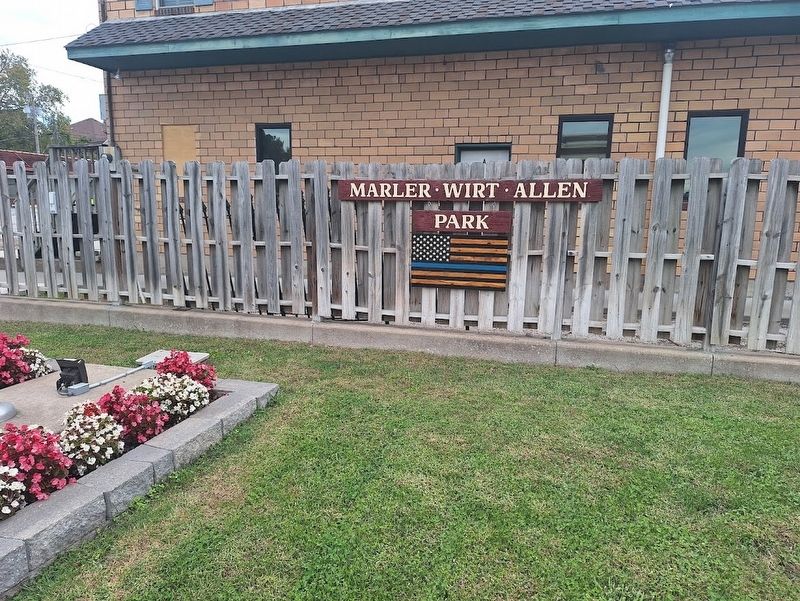
3. Marler-Wirt-Allen Memorial Park
Feeling that the police were not adequately addressing their concerns about the 'hippies', the majority of whom were actually locals who had grown up in the community, business owners and other townspeople formed a vigilante group with the intent of intimidating the young people and drive them off the square. They also put pressure on the police to become more of a presence on the square. They were successful in this and the Harrisonville Police assigned officers to walk the beat around the square.
Tempers reached a breaking point on Thursday, April 20, when a physical altercation occurred between the young people and a couple of shop keepers. The result was several young men being roughed up and marched off to jail in handcuffs. Most people agree that it was this event that set Charlie Simpson off down a murderous path. The people arrested were his friends and companions and he felt they were being unfairly persecuted by closed minded 'rednecks' and law enforcement. The morning of April 21, Simpson showed up at the jail to post bond for his friends, cleaning out his savings to do so. As he left he ominously said, "Charlie Simpson's my name. Revolution is my game."
Aftermath
After the shooting, the blame game quickly started. One business owner even published an article in the local paper blaming inattentive and neglectful parents allowing their children to be corrupted by out-of-town instigators. Instigating mayhem and unrest in their wholesome town. Others blamed the police for not cracking down on the 'hippies' sooner. There were even some who thought the whole incident was a Communist plot of some sort. The FBI did investigate and quickly determined that Simpson had acted alone and was not connected to any political group. Within a few weeks, many of the young people had been run out of town under the threat of violence. On Monday, June 21, 1972, Cass County judges met and agreed to post a sign on the square reading: "Keep off the grass and wall - by order of the County Court." It was installed two days later.
Joe Eszterhas, a writer and editor for the Rolling Stone magazine, heard about the shooting which had made national news. He visited the town, interviewed people in the community, and in 1973, published Charlie Simpson's Apocalypse, a case study about the shooting. Many of the people who actually lived through the events had a negative response to the book believing that it sensationalized and outright fabricated information to create the narrative. In fact Simpson's brother filed a lawsuit against Eszterhas and New York Random House for invasion of privacy and libel claiming that the book exposed him to public hatred because of the actions of his brother.
One positive action that the community took was to form a trust fund for the young son of Officer Marler. Nathan Marler was only 3 years old when his father was killed. The community established the trust so that Nathan would have funds to pursue higher education when he was older. By July 1972, over $7,500 had been raised. A small amount of the funds was used to purchase and install a memorial plaque for Officer Wirt at the Our Lady of Lourdes Catholic Church. The interest and principle were available for the care, support, and maintenance of Nathan. In 1984 a petition was made to dissolve the trust and transfer the funds to North Dakota where Marler's widow, Darlene, and son had relocated. At the time of the petition the fund held about $14,500.
There are several visible remainders of the tragedy that unfolded that day. One is a visceral reminder of the violence of that occurred and one is a place of remembrance, healing, and reflection. The former is damage to the vault door in the Allen Bank building from a bullet fired by Simpson that day. The later, this park, was established in 1984 after the Hoke's filing station closed and was torn down.
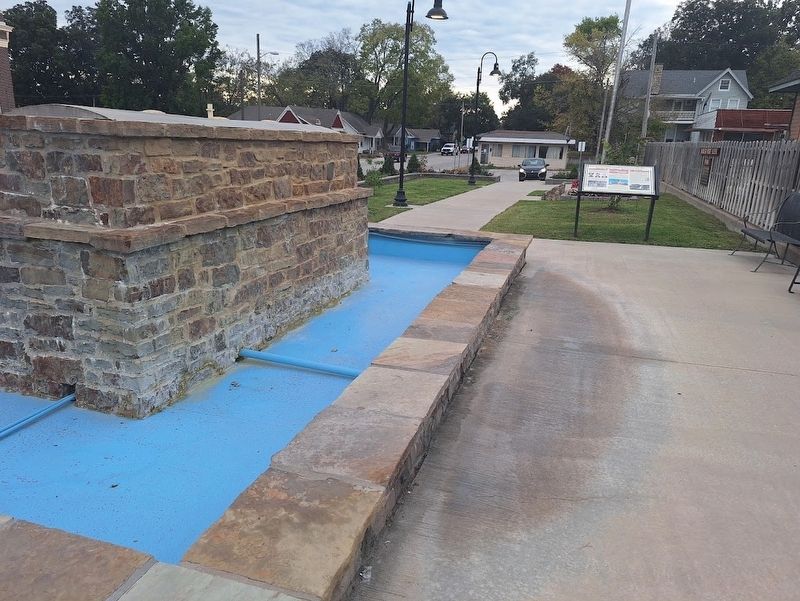
As the years have passed, the community has made a commitment to remember the lives lost that day. The Marler-Wirt-Allen Memorial Park has had several additions including the fountain which is now in its second revision, walkways, and a multitude of plants and flowers. Many milestone anniversary remembrances have been held here. On the 50th commemoration of that day, the City of Harrisonville commissioned this historical panel so that generations to come will not forget the men who died while simply doing their jobs.
After reading about the events that led to that fateful day in April 1972, it is important to learn from tragedies in an effort to avoid the circumstances that led to it. What is clear is that there was a deep division between two groups of people. There were people on both sides who refused to consider listening to the other or discussing ways to compromise in order for both groups to coexist peacefully.
The larger more moderate factions of the groups who could have found a way to work together toward a solution were drowned out by smaller but very vocal and reactionary extreme factions. Three men lost their lives because of hate and intolerance. The best way to honor these men would be to live in such a way as to not allow hate and intolerance to take root in our lives and communities so that this tragedy will never occur again in the streets of Harrisonville.
Topics. This historical marker is listed in these topic lists: Law Enforcement • Parks & Recreational Areas. A significant historical date for this entry is April 21, 1972.
Location. 38° 39.199′ N, 94° 20.945′ W. Marker is in Harrisonville, Missouri, in Cass County. It can be reached from the intersection of Main Street and West Mechanic Street (Missouri Route 7). Touch for map. Marker is at or near this postal address: 309 South Main St, Harrisonville MO 64701, United States of America. Touch for directions.

Regionally, this marker is in Greater Kansas City. It is also in the American Midwest, in the Lewis & Clark Corridor, in the Corn Belt, and on the Santa Fe Trail Corridor. Globally, it is in North America, the Western Hemisphere, the Western World, and the Anglosphere. Historically, it finds itself in what was once the territory of the Mississippian Culture, the Louisiana Purchase, and the Antebellum South.
Other nearby markers. At least 8 other markers are within walking distance of this marker: Operation Enduring Freedom (a few steps from this marker); Jennison’s Jayhawks raid Harrisonville Square (about 300 feet away, measured in a direct line); United We Stand Divided We Fall (about 400 feet away); Harrisonville WWI Memorial (about 400 feet away); Cass County (about 500 feet away); Harrisonville Courthouse Square Historic District (about 600 feet away); General Order No. 11 (about 700 feet away); Jefferson Highway (approx. 0.6 miles away). Touch for a list and map of all markers in Harrisonville.
Additional keywords. hate crime, murder suicide
Credits. This page was last revised on November 26, 2026. It was originally submitted on November 25, 2026, by Jason Voigt of Glen Carbon, Illinois. This page has been viewed 5 times since then. Photos: 1, 2. submitted on November 25, 2026, by Jason Voigt of Glen Carbon, Illinois. 3. submitted on November 26, 2026, by Jason Voigt of Glen Carbon, Illinois.