Near Winchester in Frederick County, Virginia — The American South (Mid-Atlantic)
Battle of Kernstown
March 23, 1862
Photographed by Devry Becker Jones (CC0), October 31, 2020
1. Battle of Kernstown Marker
Inscription.
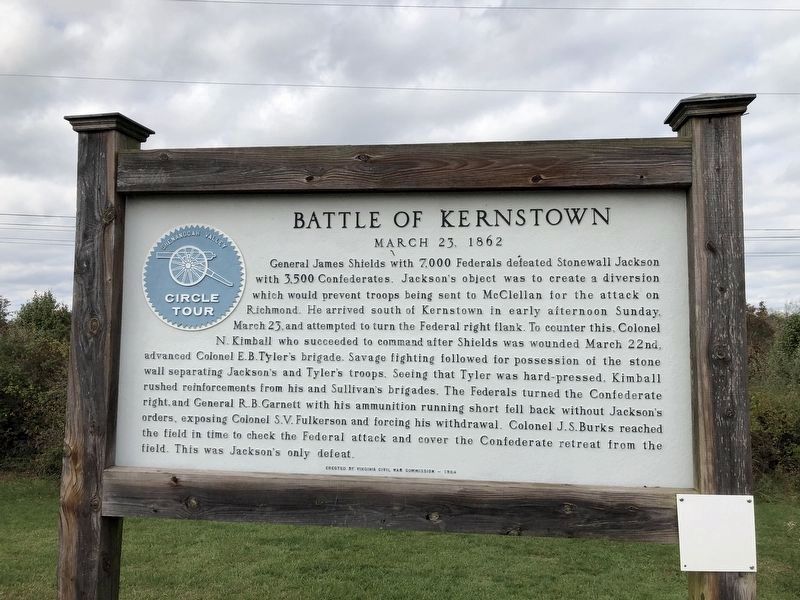
Battle of Kernstown. March 23, 1862. General James Shields with 7,000 Federals defeated Stonewall Jackson with 3,500 Confederates. Jackson's object was to create a diversion which would prevent troops being sent to McClellan for the attack on Richmond. He arrived south of Kernstown in early afternoon Sunday, March 23, and attempted to turn the Federal right flank. To counter this, Colonel N. Kimball who succeeded to command after Shields was wounded March 22nd, advanced Colonel E.B. Tyler's brigade. Savage fighting followed for possession of the stone wall separating Jackson's and Tyler's troops. Seeing that Tyler was hard-pressed, Kimball rushed reinforcements from his and Sullivan's brigades. The Federals turned the Confederate right, and General R.B. Garnett with his ammunition running short fell back without Jackson's orders, exposing Colonel S.V. Fulkerson and forcing his withdrawal. Colonel J.S. Burks reached the field in time to check the Federal attack and cover the Confederate retreat from the field. This was Jackson's only defeat.
General James Shields with 7,000 Federals defeated Stonewall Jackson with 3,500 Confederates. Jackson's object was to create a diversion which would prevent troops being sent to McClellan for the attack on Richmond. He arrived south of Kernstown in early afternoon Sunday, March 23, and attempted to turn the Federal right flank. To counter this, Colonel N. Kimball who succeeded to command after Shields was wounded March 22nd, advanced Colonel E.B. Tyler's brigade. Savage fighting followed for possession of the stone wall separating Jackson's and Tyler's troops. Seeing that Tyler was hard-pressed, Kimball rushed reinforcements from his and Sullivan's brigades. The Federals turned the Confederate right, and General R.B. Garnett with his ammunition running short fell back without Jackson's orders, exposing Colonel S.V. Fulkerson and forcing his withdrawal. Colonel J.S. Burks reached the field in time to check the Federal attack and cover the Confederate retreat from the field. This was Jackson's only defeat.
Erected 1964 by Virginia Civil War Commission.
Topics. This historical marker is listed in this topic list:
Click or scan to see this page online
War, US Civil. A significant historical date for this entry is March 23, 1851.
Location. 39° 8.403′ N, 78° 11.679′ W. Marker is near Winchester, Virginia, in Frederick County. It is on Opequon Church Lane, on the right when traveling west. Located in front of the Church in the north side parking lot. Touch for map. Marker is at or near this postal address: 217 Opequon Church Lane, Winchester VA 22602, United States of America. Touch for directions.

Regionally, this marker is in Virginia’s Shenandoah Valley. It is also in the American South, specifically in the Upper South, and in the Mid-Atlantic. Globally, it is in North America, the Western Hemisphere, the Western World, and the Anglosphere. Historically, it finds itself in what was once the territory of the Mississippian Culture, one of the original Thirteen Colonies, one of the Confederate States of America, and the Antebellum South.
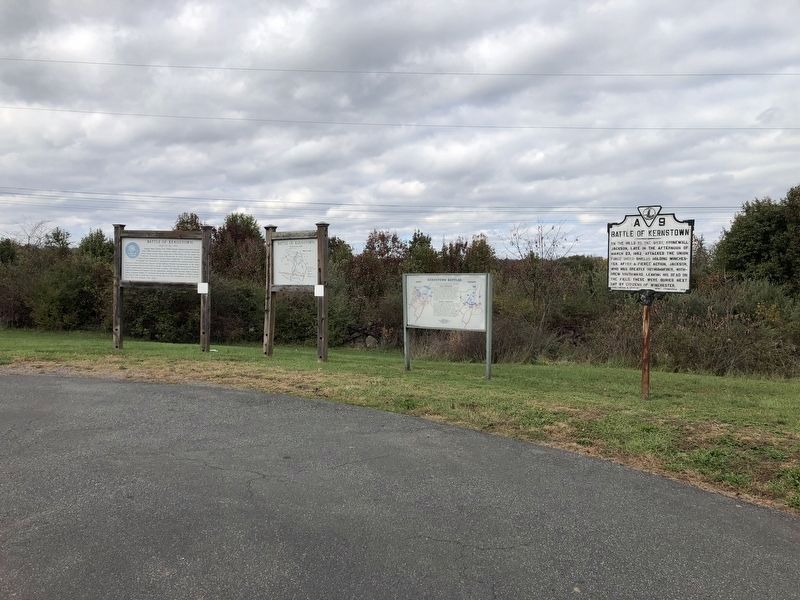
Other nearby markers. At least 8 other markers are within walking distance of this marker: Kernstown Battles (here, next to this marker); a different marker also named Battle of Kernstown (here, next to this marker); a different marker also named
Photographed by Devry Becker Jones (CC0), October 31, 2020
Another marker is no longer nearby. Opequon Presbyterian Church (was about 300 feet away, measured in a direct line but has been replaced with another marker now near it).
More about this marker. This marker is part of the Shenandoah Valley Circle Tour.
Credits. This page was last revised on July 7, 2021. It was originally submitted on July 13, 2010, by Craig Swain of Leesburg, Virginia. This page has been viewed 1,766 times since then and 32 times this year. Photos:1, 2. submitted on November 2, 2020, by Devry Becker Jones of Washington, District of Columbia.
