
Cherry Valley in Otsego County, New York — The American Northeast (Mid-Atlantic)
Cherry Valley Museum
| — | Cherry Valley Massacre | — |
Photographed by Howard C. Ohlhous, July 19, 2008
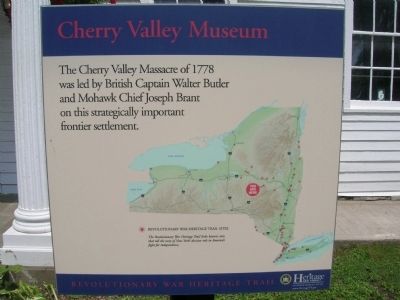
1. Cherry Valley Museum Marker
The Cherry Valley Massacre of 1778
was led by British Captain Walter Butler
and Mohawk Chief Joseph Brant
on this strategically important
frontier settlement.
Erected by Heritage New York.
Topics. This historical marker is listed in these topic lists: Notable Buildings • Notable Events • Patriots & Patriotism • War, US Revolutionary. A significant historical year for this entry is 1778.
Location. 42° 47.85′ N, 74° 45.07′ W. Marker is in Cherry Valley, New York, in Otsego County. It is at the intersection of Main Street (New York State Route 166) and Wall Street, on the right when traveling west on Main Street. Touch for map. Marker is at or near this postal address: 49 Main Street, Cherry Valley NY 13320, United States of America. Touch for directions.

Regionally, this marker is in Upstate New York and in the Mohawk Valley. It is also in the American Northeast, in the Mid-Atlantic, in Appalachia, and specifically in Northern Appalachia. Globally, it is in North America, the Western Hemisphere, the Western World, and the Anglosphere. Historically, it finds itself in what was once the
this page online
Other nearby markers. At least 8 other markers are within walking distance of this marker: A different marker also named Cherry Valley Museum (here, next to this marker); a different marker also named Cherry Valley Museum (here, next to this marker); Limestone Mansion (about 300 feet away, measured in a direct line); Civil War Monument (approx. 0.2 miles away); First Presbyterian Church (approx. ¼ mile away); Cherry Valley Massacre (approx. 0.4 miles away); Site of Rev. Samuel Dunlop's House (approx. half a mile away); Colonel Alden Felled (approx. 0.6 miles away). Touch for a list and map of all markers in Cherry Valley.
Regarding Cherry Valley Museum. Once a stop on the major route west for 18th and 19th century Americans as well as native Americans before them, Cherry Valley is now a quiet and charming village cut off from the hustle and bustle of city life. Cherry Valley's sometimes dark history can be examined at the Cherry Valley Historical Society, where the entire building is filled with exhibits, artifacts, and genealogy,
Photographed by Howard C. Ohlhous, October 18, 2008
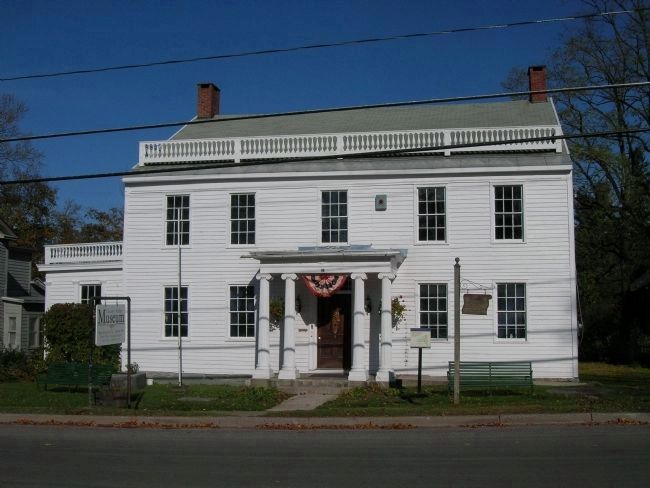
2. Cherry Valley Museum & Marker
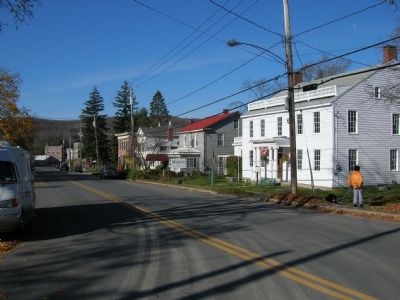
Throughout much of the 19th Century, the White-Phelon-Stuliff House, named for the three families who lived there since it was built in 1832, was a popular place for travelers to spend the night on their way west or on their return from the east. The building is now home to the Cherry Valley Historical Society.
Also see . . .
1. Cherry Valley Massacre. Wikipedia entry (Submitted on May 30, 2024, by Larry Gertner of New York, New York.)
2. Cherry Valley Museum. This is Cooperstown website entry (Submitted on January 11, 2020, by Michael Herrick of Southbury, Connecticut.)
Additional keywords. Burning of The Valleys
Photographed by Scott J. Payne, September 19, 2015
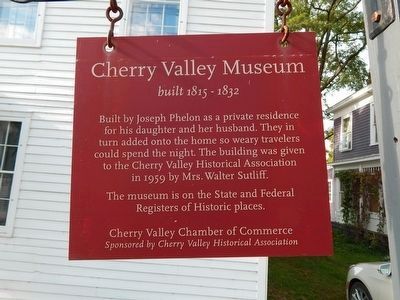
3. Cherry Valley Museum Marker
Photographed by Howard C. Ohlhous, October 18, 2008
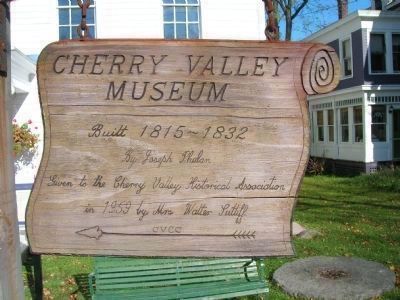
4. Another Cherry Valley Museum Marker
Cherry Valley Museum
Built 1815 - 1832
by Joseph Phelan
Given to the Cherry Valley Histoirical Associaton
in 1959 by Mrs. Walter Luttiff
C.V.C.C.
<----««
Photographed by Howard C. Ohlhous, October 18, 2008
5. The White-Phelon-Stuliff House on Main Street in Cherry Valley, New York
Photographed by Howard C. Ohlhous, October 18, 2008
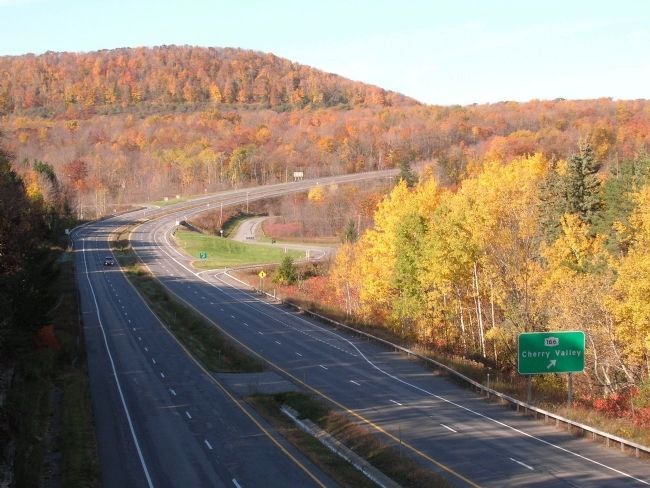
6. Cherry Valley
Credits. This page was last revised on May 30, 2024. It was originally submitted on July 27, 2010, by Howard C. Ohlhous of Duanesburg, New York. This page has been viewed 2,295 times since then and 81 times this year. Photos: 1, 2. submitted on July 27, 2010, by Howard C. Ohlhous of Duanesburg, New York. 3. submitted on March 8, 2016, by Scott J. Payne of Deposit, New York. 4, 5, 6. submitted on July 27, 2010, by Howard C. Ohlhous of Duanesburg, New York. • Craig Swain was the editor who published this page.
